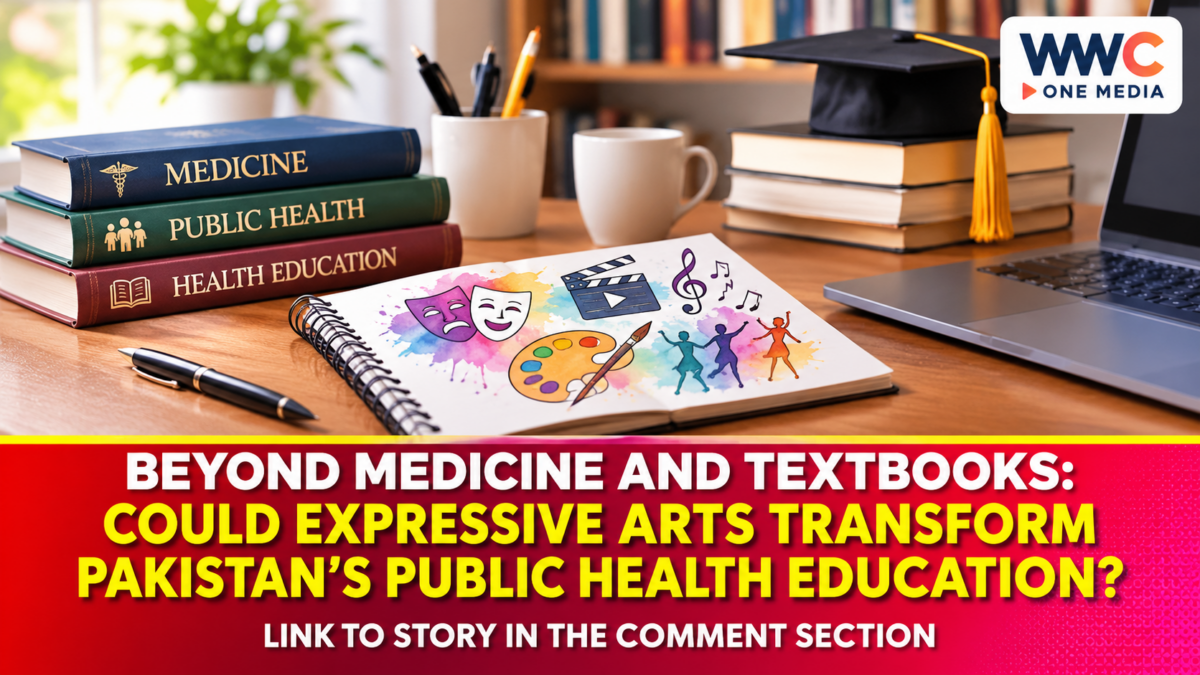
ISLAMABAD, PAKISTAN — The intersection of arts and public health is opening new possibilities for healthcare education, bringing creative expression, visual communication and storytelling into discussions about community well-being.
For institutions such as Pakistan’s Health Services Academy (HSA) and the Pakistan National Council of the Arts (PNCA), combining expertise in healthcare education and artistic expression presents an opportunity to explore alternative approaches to health communication.
The concept extends beyond conventional classroom instruction, examining how future public health professionals could communicate complex medical information in ways that communities can better understand.
Arts in Public Health: Moving Beyond Traditional Instruction
Public health education involves more than understanding diseases and developing prevention strategies. It also requires professionals to communicate information accurately and effectively.
Expressive arts offer another approach to presenting health-related concepts through creative activities, including visual storytelling, theatre and artistic performances.
Illustrations could explain the relationship between environmental conditions and disease prevention, while storytelling could present healthcare challenges through relatable situations.
These are potential educational applications rather than confirmed activities under a particular Pakistani academic programme.
The importance of improving health awareness and education also extends across the Asia-Pacific, as explored in WWC ONE MEDIA’s coverage of Taiwan’s updated school health and student well-being policies.
Pakistan’s Public Health and Cultural Institutions
The Health Services Academy is a recognised public-sector educational institution in Islamabad, operating under a charter granted by the Government of Pakistan.
Pakistan’s Higher Education Commission lists May 24, 2018, as its establishment date as a recognised higher education institution.
Meanwhile, the Pakistan National Council of the Arts was established in 1973 and operates under the government’s National Heritage and Culture Division.
Its responsibilities include supporting artistic development, cultural preservation and educational activities.
PNCA’s work covers visual and performing arts, theatre, music, puppetry and cultural exchanges.
The two institutions represent complementary areas of expertise. Public health education provides the scientific foundation for healthcare communication, while artistic disciplines provide potential methods for presenting information to wider audiences.
Combining those disciplines could create opportunities for students to examine health challenges from both scientific and social perspectives.
International Research Examines the Relationship Between Arts and Health
The exploration of creative approaches to healthcare is supported by a growing body of international research.
A major evidence review published on Nov. 5, 2019, examined findings from more than 3,000 studies investigating the relationship between artistic activities, health and well-being.
The review considered research covering disease prevention, health promotion and the management of illness across different stages of life.
Its evidence included randomised controlled trials, observational research and smaller exploratory studies.
However, the diversity of the research means that not every artistic intervention can be expected to produce identical results.
The effectiveness of a particular activity depends on its purpose, implementation, participants and the quality of its evaluation.
Expressive arts should therefore be considered potential complementary tools rather than replacements for professional medical treatment or established healthcare practices.
How Creative Storytelling Could Strengthen Health Communication
One potential application of expressive arts is making healthcare information more accessible.
Visual presentations can simplify complicated explanations, while narratives can connect health information with situations that audiences recognise from everyday life.
A public health student could, for example, develop an illustrated explanation of a preventive health measure or create a theatrical presentation demonstrating barriers to healthcare access.
These examples illustrate possible teaching methods and are not descriptions of confirmed HSA classroom activities.
The objective would be to communicate evidence-based information without compromising medical accuracy.
Clear communication is particularly important when addressing misinformation, public confidence and preventive healthcare.
Similar issues feature in WWC ONE MEDIA’s reporting on Singapore’s disease agency and its expanded international public health role.
Creative communication could provide additional ways of encouraging public participation, provided that the underlying health messages remain accurate and appropriate for their intended audiences.
From Creative Classrooms to Community Engagement
The potential value of combining artistic expression with public health education also lies in creating opportunities for dialogue.
A participatory workshop could allow community members to describe their healthcare concerns, while visual narratives could help educators explore how audiences interpret health messages.
Such approaches could assist students in identifying communication barriers and considering alternative ways of presenting information.
However, participation alone would not demonstrate that a programme has improved health outcomes.
Evaluating its effectiveness would require appropriate assessment methods, such as surveys, interviews and measures of audience understanding.
Professional education and interdisciplinary collaboration are also important themes in regional healthcare development, as highlighted in WWC ONE MEDIA’s coverage of Asian Pacific Digestive Week 2026 and its specialist medical education programme.
Although specialist clinical education and expressive arts serve different purposes, both illustrate the opportunities for cooperation across professional disciplines.
Why Health Communication Matters Across the Asia-Pacific
Communication for Health has become an established area of international public health work.
In the Western Pacific region, strategic communication initiatives include developing research tools for healthcare communicators and encouraging more effective approaches to public engagement.
Resources published in March 2026 cover practical methods such as surveys, qualitative interviews and focus group discussions.
These methods can help healthcare communicators examine how audiences receive and interpret information.
For health education institutions across Asia-Pacific economies, the broader opportunity is to connect scientific expertise with communication methods that accommodate different languages, cultural backgrounds and community circumstances.
Creative activities could become part of that process, but their effectiveness would need to be evaluated independently.
What Happens Next?
The next step for any arts-based public health education programme would be to establish clear learning objectives, develop appropriate educational materials and assess whether participants improve their communication skills.
Important considerations would include the accuracy of health information, the suitability of artistic content for different audiences and the measurable results of community engagement activities.
The broader question is whether future public health professionals can become more effective communicators by combining scientific knowledge with creative expression.
Art cannot replace medicine. However, carefully designed creative activities could provide another way of helping communities understand healthcare information.
Frequently Asked Questions
What are expressive arts in public health education?
Expressive arts involve creative activities such as visual storytelling, performance and artistic expression that may complement healthcare education and community communication.
What is the Health Services Academy in Pakistan?
HSA is a recognised public-sector higher education institution based in Islamabad, Pakistan.
What is the Pakistan National Council of the Arts?
PNCA is a national cultural institution established in 1973 that promotes artistic development, cultural heritage and creative education.
Can expressive arts improve health communication?
Creative approaches may support understanding and engagement. Their effectiveness depends on the specific intervention, audience and quality of implementation.
Can expressive arts replace medical treatment?
No. Artistic activities may complement healthcare education and selected therapeutic or preventive activities, but they are not substitutes for evidence-based medical care.