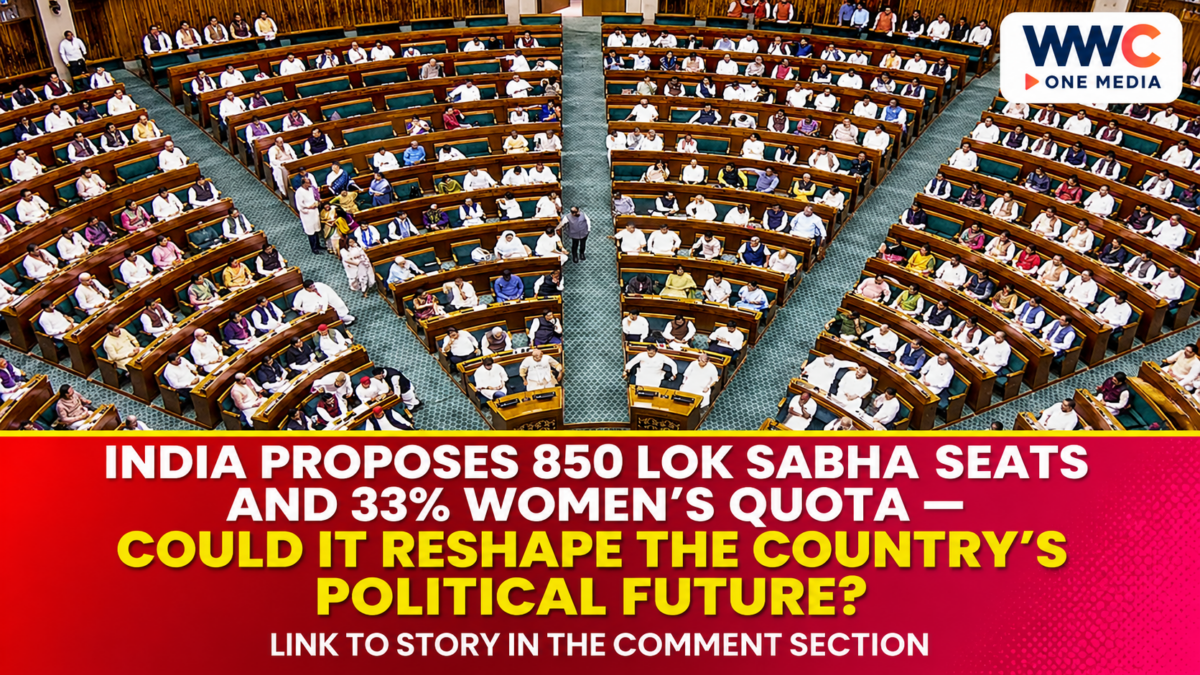
NEW DELHI, INDIA — India is preparing for a major overhaul of its electoral representation under a revised constitutional amendment that proposes increasing legislative seats by 50%, raising the maximum strength of the Lok Sabha to 850 members and accelerating the implementation of women’s political reservations.
The Constitution (One Hundred and Thirty-second Amendment) Bill, 2026, dated Nov. 27, represents a renewed government effort to restructure parliamentary representation after an earlier constitutional amendment failed to secure the required majority in April.
The India Delimitation Bill 2026 could fundamentally change the composition of the country’s national and state legislatures while maintaining the relative distribution of parliamentary representation among states.
However, the proposed measures must overcome significant legislative requirements before becoming law.
India Delimitation Bill 2026 proposes a major parliamentary expansion
The revised constitutional amendment proposes increasing the maximum membership of the Lok Sabha, India’s lower house of Parliament, to 850.
Under the proposed structure, up to 815 members would represent states, while up to 35 would represent Union territories.
The maximum permitted membership of an individual state legislative assembly would also increase to 650.
The accompanying delimitation framework provides for a 50% increase in the existing allocation of seats across states and Union territories, including their applicable legislative assemblies.
The proposal follows several months of uncertainty surrounding the government’s electoral reform agenda, previously examined in WWC ONE MEDIA’s coverage of India’s renewed parliamentary delimitation debate.
Importantly, the proposed 850-member figure represents a constitutional ceiling rather than a confirmed final allocation of parliamentary seats.
The precise composition would depend on the implementation of the new legal framework.
What is delimitation, and why does it matter?
Delimitation is the process of determining electoral constituency boundaries and, where legally authorised, adjusting the distribution of legislative seats.
Its purpose is to establish the geographic and demographic framework through which citizens elect their representatives.
India’s constitutional arrangements have historically linked parliamentary representation to population figures.
However, the Constitution (Eighty-fourth Amendment) Act, 2001, maintained the allocation of parliamentary and state legislative seats using the 1971 Census framework until the relevant figures from the first census conducted after 2026 became available.
The Constitution (Eighty-seventh Amendment) Act, 2003, subsequently permitted constituency boundaries to be revised using 2001 Census figures without changing the overall allocation of seats to states.
The result is a distinction between the number of representatives assigned to each state and the boundaries of individual electoral constituencies.
Delimitation should also not be confused with voter registration. Separate questions concerning electoral eligibility have been examined in WWC ONE MEDIA’s coverage of India’s voter-roll revision and the protection of voting rights.
While both processes affect elections, they serve different legal and administrative purposes.
Why India wants to maintain the distribution of seats until 2051
One of the most consequential provisions of the revised legislation concerns the distribution of parliamentary representation among states.
Differences in population growth have complicated the prospect of reallocating seats exclusively through updated population figures.
The government’s revised approach seeks to address these concerns through a uniform expansion of legislative seats rather than immediately changing the relative representation of states.
A hypothetical state with 20 parliamentary constituencies, for example, would receive 30 under a straightforward 50% increase.
Another state with 40 constituencies would receive 60.
Both would gain additional representatives while maintaining the same relative proportion between them.
These examples illustrate the proposed formula rather than actual allocations for individual states.
The revised constitutional arrangement would continue until 2051.
The approach seeks to balance two competing objectives: expanding legislative representation while avoiding substantial immediate changes in the distribution of political influence among states.
Nevertheless, maintaining existing proportions could leave differences in population per constituency unresolved.
The legislative debate will therefore involve questions about both regional representation and equality of representation among individual voters.
Women’s reservation could move closer to implementation
India established the constitutional foundation for women’s legislative reservations through the Constitution (One Hundred and Sixth Amendment) Act, 2023, popularly known as the Nari Shakti Vandan Adhiniyam.
The amendment received presidential assent on Sept. 28, 2023.
It provides for approximately one-third of directly elected seats in the Lok Sabha, state legislative assemblies and the Delhi Legislative Assembly to be reserved for women.
The reservation includes women belonging to Scheduled Castes and Scheduled Tribes within the applicable reserved-seat framework.
However, Article 334A linked implementation to a delimitation exercise following the publication of relevant figures from the first census conducted after the amendment’s commencement.
The revised 2026 constitutional bill seeks to accelerate that process by linking implementation to the first delimitation undertaken after the commencement of the proposed amendment.
It also addresses women’s reservations in the legislative assemblies of Puducherry and Jammu and Kashmir.
Under the proposed framework, reserved constituencies would be subject to rotation arrangements established through the applicable legislation.
The new proposal does not establish an unconditional guarantee that women’s reservations will be operational by a specific election date.
Its implementation remains dependent on legislative approval and the completion of the required electoral preparations.
Why the earlier constitutional amendment failed
The government previously introduced the Constitution (One Hundred and Thirty-first Amendment) Bill, 2026, alongside the Delimitation Bill and the Union Territories Laws (Amendment) Bill on April 16.
The constitutional amendment failed to obtain the special parliamentary majority required under Article 368 on April 17.
Consequently, the accompanying legislative measures were not advanced after their introduction.
The government subsequently prepared a revised constitutional amendment and proposed replacing the earlier delimitation legislation with the Delimitation (Second) Bill, 2026.
The new framework explicitly provides for the uniform 50% seat increase.
The accompanying proposal also calls for establishing a Delimitation Commission after the commencement of the new legislation.
The commission would be responsible for implementing the revised allocation framework, determining territorial constituencies using the latest available published census figures and administering the rotation of constituencies reserved for women.
The renewed legislative effort follows developments covered in WWC ONE MEDIA’s earlier report on India’s Parliament reconvening and the outstanding electoral reform agenda.
Electoral representation and constitutional safeguards remain central
The proposed reforms raise important questions about how India balances population changes, geographic representation, gender inclusion and constitutional safeguards.
Increasing the number of constituencies could potentially reduce the number of residents represented by individual legislators. However, the practical effects would depend on the final boundaries and distribution of seats.
Women’s reservations would establish a mechanism for expanding female representation, while preserving applicable provisions for historically disadvantaged communities.
The implementation process would also require attention to transparency, legal consistency and electoral administration.
These considerations form part of a wider discussion about India’s electoral institutions, including the legal distinction between electoral registration and citizenship explored in WWC ONE MEDIA’s coverage of India’s Supreme Court framework for voter-roll deletions.
What happens next for India’s delimitation reforms?
The revised constitutional amendment must secure the parliamentary support required for constitutional changes before its provisions can be implemented.
Supporting legislation and the establishment of the proposed Delimitation Commission would be important subsequent steps.
Existing legislative representation would remain unaffected until the dissolution of the relevant Parliament or legislative assembly under the proposed transitional provisions.
As of Nov. 28, 2026, the proposed 850-member Lok Sabha ceiling, uniform legislative expansion and accelerated women’s reservations remain legislative proposals.
India’s renewed delimitation initiative could reshape political representation for decades. But its ultimate impact will depend on whether Parliament approves the reforms and how effectively the resulting electoral framework is implemented.
Frequently asked questions
What is the India Delimitation Bill 2026?
It is part of a proposed electoral reform package that would expand legislative representation, redraw constituency boundaries and facilitate women’s legislative reservations.
Will India’s Lok Sabha have 850 members?
The revised constitutional amendment proposes a maximum strength of 850 members. The final number remains subject to legislative approval and implementation.
How much would parliamentary seats increase?
The proposed framework provides for a 50% increase in the existing allocation of seats across states and Union territories.
What percentage of legislative seats would be reserved for women?
Approximately one-third, or 33%, of applicable directly elected legislative seats would be reserved for women.
Has the Delimitation Bill 2026 become law?
No. As of Nov. 28, 2026, the revised measures remain proposed legislation requiring parliamentary approval.