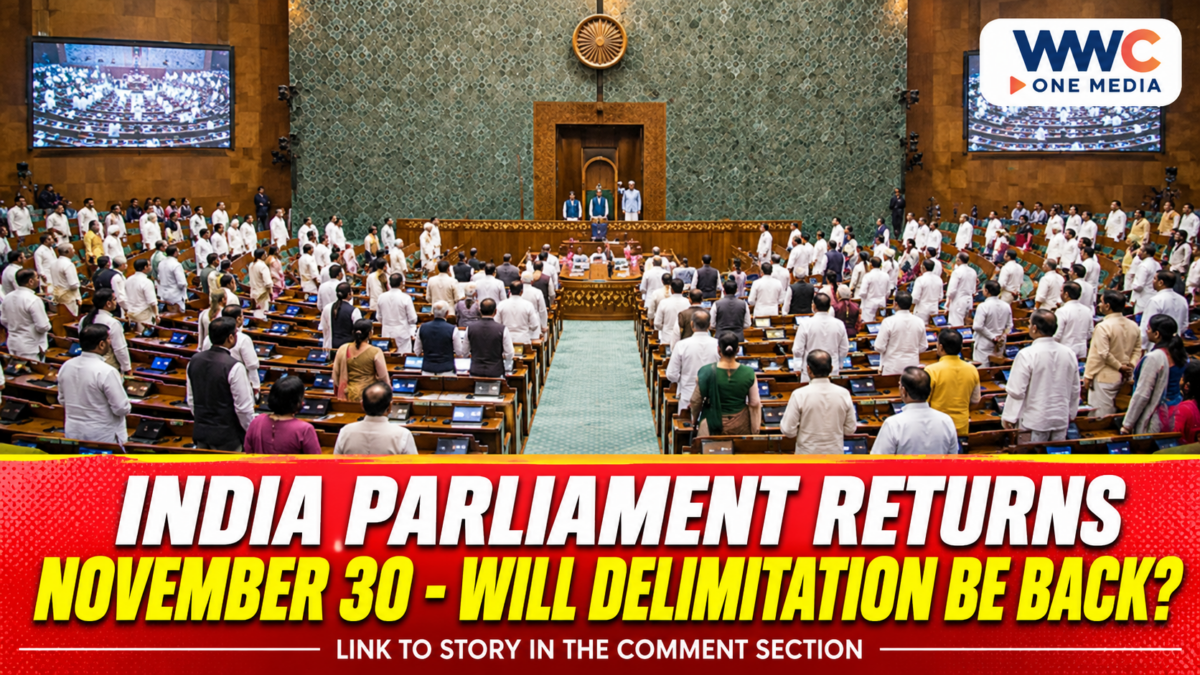
India’s Parliament is set to reconvene in New Delhi from November 30, bringing the government’s unresolved legislative agenda back into focus after more than three months without a sitting of the Houses.
The Lok Sabha will meet on Monday, November 30, while the Rajya Sabha will resume on Wednesday, December 2. The sittings may conclude on December 3, depending on government business.
The parliamentary timetable is now officially confirmed. But the more consequential question remains unanswered: will Prime Minister Narendra Modi’s government use the reconvened sittings to revive its proposed changes to electoral constituency boundaries and the implementation of women’s reservation?
The government has described the purpose as transacting essential government business. The published announcement does not identify a specific legislative agenda.
That distinction matters because the earlier constitutional amendment package failed in the Lok Sabha in April. The proposed changes did not become law, and a new parliamentary sitting does not automatically revive the defeated legislation.
Parliament Returns After More Than Three Months
The Lok Sabha and Rajya Sabha were adjourned sine die on August 13, 2026, following the Monsoon Session. Neither House had been formally prorogued before the government moved to reconvene them.
Adjournment sine die means that a House ends its sittings without announcing a date for its next meeting. Prorogation is a separate constitutional procedure that formally ends a parliamentary session.
The distinction is important in this case. The November sittings are being treated as the second part of the Eighth Session of the Eighteenth Lok Sabha, rather than simply being described as an entirely new parliamentary session.
The Lok Sabha is scheduled to meet at 11 a.m. on November 30. The Rajya Sabha is scheduled to meet at 11 a.m. on December 2.
The official parliamentary information also states that there will be no Question Hour, Zero Hour or Private Members’ Business during the sittings. This indicates a restricted programme focused on essential government business rather than a normal full parliamentary schedule.
The short timetable leaves lawmakers with limited time to consider whatever measures the government places before them.
The Delimitation Proposal Remains the Biggest Political Question
The prospect of renewed delimitation legislation has attracted attention because of the government’s earlier attempt to change the constitutional framework governing parliamentary representation.
Three related Bills were introduced in the Lok Sabha on April 16, 2026:
- The Constitution (One Hundred and Thirty-First Amendment) Bill, 2026.
- The Union Territories Laws (Amendment) Bill, 2026.
- The Delimitation Bill, 2026.
The proposals were designed to work together. The constitutional amendment sought to revise provisions governing population, parliamentary representation and the implementation of women’s reservation. The related legislation addressed delimitation and changes affecting Union Territories.
The constitutional amendment did not secure the required majority during consideration in the Lok Sabha. The Ministry of Parliamentary Affairs subsequently recorded that the two dependent Bills were not proceeded with.
This means the April proposals did not establish a new delimitation framework. Their provisions cannot be treated as current law.
The government would need to introduce and advance any renewed proposal through the appropriate parliamentary process. If it seeks another constitutional amendment, it must meet the requirements of Article 368 of the Constitution.
WWC previously examined why India’s delimitation proposals remained stalled, including the difference between a Bill introduced in Parliament and legislation that has actually been enacted.
Women’s Reservation Is Connected to the Debate
The political importance of the proposed constitutional changes extends beyond the number of parliamentary seats.
India’s Constitution already contains provisions for reserving approximately one-third of seats for women in the Lok Sabha and state legislative assemblies under the Constitution (One Hundred and Sixth Amendment) Act, 2023.
The amendment was brought into force on April 16, 2026. However, Article 334A links the implementation of women’s reservation to a delimitation exercise undertaken after publication of the relevant figures from the first census taken after the amendment’s commencement.
The failed 131st Amendment Bill proposed changing this framework.
The distinction is essential: the 2023 constitutional amendment remains part of the existing legal framework, while the proposed 2026 changes did not pass.
The debate therefore concerns how and when the reservation provisions will be implemented, as well as how electoral constituencies and parliamentary representation may be adjusted.
For the government, advancing the women’s reservation agenda requires addressing the legal process. For lawmakers, the challenge is assessing whether the proposed route also provides adequate safeguards for the representation of India’s states.
Why State Representation Could Become a Major Obstacle
Delimitation is the process of redrawing electoral constituency boundaries and, where authorised, adjusting the allocation of legislative seats.
In a country as large and diverse as India, changes to constituency boundaries can affect how different regions are represented in the national legislature.
Population growth has not been uniform across Indian states. This has made proposals involving population-based seat redistribution politically sensitive, particularly among states concerned about losing their relative share of parliamentary representation.
Tamil Nadu and other southern states have raised concerns about the consequences of a future delimitation exercise. Their central question is whether changes to the allocation of seats could reduce their influence in the Lok Sabha.
The government would therefore need to address more than the overall size of Parliament. It would have to explain the proposed allocation formula, the census figures to be used and the safeguards available to states.
These questions cannot be resolved by political assurances alone. The actual wording of any new Bill would be central to determining what changes are being proposed.
The broader electoral environment is also under scrutiny. WWC’s report on India’s voter-roll revision and opposition demands for electoral transparency examines a separate dispute over voter registration and election administration. Although voter-roll revision and delimitation are different processes, both demonstrate why the rules governing representation and participation matter.
The Government Still Needs Parliamentary Support
A constitutional amendment faces a higher approval threshold than an ordinary Bill.
Article 368 requires a majority of the total membership of each House of Parliament and a majority of not less than two-thirds of members present and voting.
This requirement makes support beyond the governing parties important if the government wants to pass a constitutional amendment.
The April defeat demonstrated that a proposal with significant political backing can still fail when it does not secure the required constitutional majority.
Any revised legislation would need to address the concerns that prevented the earlier package from advancing. That could include the relationship between population figures and seat allocation, protections for state representation and the legal timetable for implementing women’s reservation.
The government has not publicly specified the full legislative agenda for the November 30–December 3 sittings. It would therefore be premature to report that the delimitation Bills will definitely return or that a new constitutional amendment is ready for a vote.
The political calculations surrounding the ruling Bharatiya Janata Party also extend beyond Parliament. WWC’s report on the BJP’s unresolved Uttar Pradesh leadership question ahead of the 2027 Assembly election examines another part of the party’s political positioning.
What Happens Next
The immediate milestone is the reopening of the Lok Sabha on November 30, followed by the Rajya Sabha on December 2.
The parliamentary business announced for those days will determine whether the government intends to revisit delimitation, women’s reservation or another set of essential legislative matters.
If a new constitutional amendment is introduced, its text will be the most important document to examine. Lawmakers and the public will need to assess whether it changes the census reference, the allocation of seats, the maximum size of the Lok Sabha or the conditions for implementing women’s reservation.
The April proposals remain a failed legislative package, not an automatically revived set of Bills.
India’s next parliamentary sittings may therefore become an important test of the government’s ability to build consensus on electoral reform. The dates are settled. Whether the government can secure the votes for a new constitutional framework is a different question.
Frequently Asked Questions
1. When will India’s Parliament reconvene?
The Lok Sabha will reconvene on November 30, 2026, and the Rajya Sabha on December 2. The sittings may conclude on December 3, subject to government business.
2. Why is Parliament reconvening?
The government has stated that the Houses will meet to transact essential government business. The published announcement does not specify the complete legislative agenda.
3. Will the delimitation Bill return?
The government has not confirmed that the April 2026 Delimitation Bill will be reintroduced. Any new proposal would require its own formal legislative process.
4. What happened to the Constitution (131st Amendment) Bill?
It failed to secure the required majority in the Lok Sabha in April 2026. The two related Bills were not proceeded with.
5. Does India already have a women’s reservation law?
Yes. The Constitution (One Hundred and Sixth Amendment) Act, 2023, provides for approximately one-third reservation for women in the Lok Sabha and state legislative assemblies. Article 334A sets the conditions for its implementation.
6. Why is delimitation controversial?
Changes to constituency boundaries and seat allocation can affect the relative representation of India’s states. States with different population-growth patterns have raised concerns about how a future redistribution could affect their influence in Parliament.