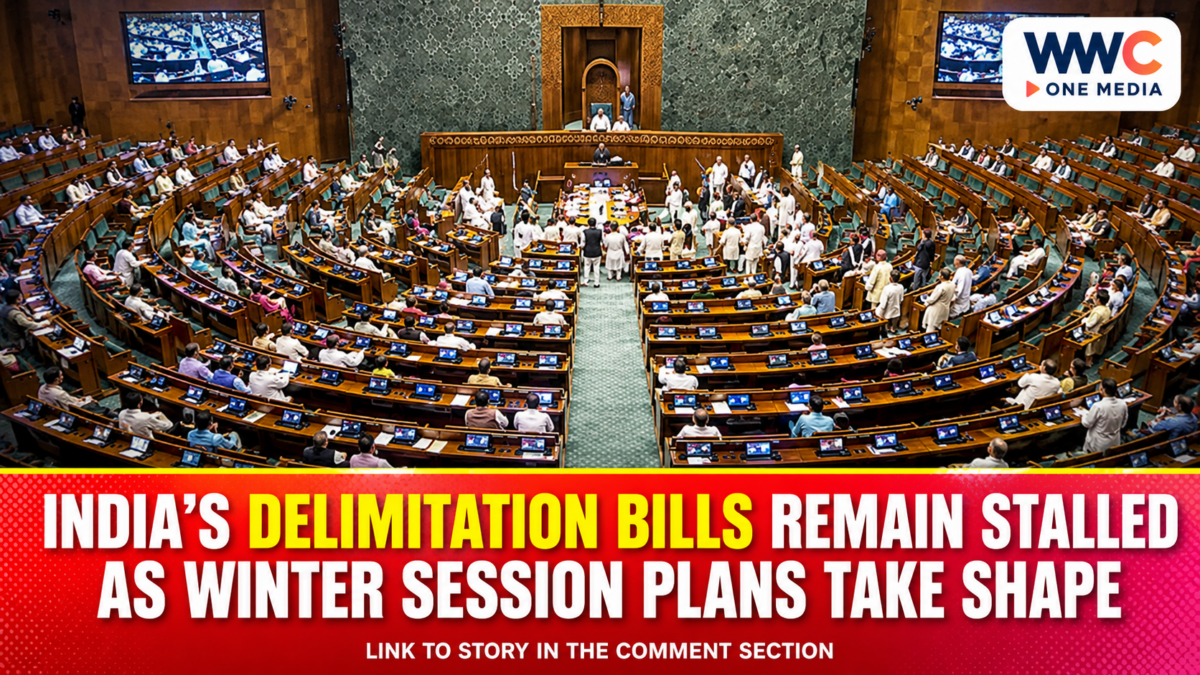
The legislative record shows that the delimitation proposal reached Parliament in April 2026 but did not complete the required lawmaking process.
Three related bills were introduced in the Lok Sabha on April 16: the Constitution (One Hundred and Thirty-First Amendment) Bill, 2026; the Union Territories Laws (Amendment) Bill, 2026; and the Delimitation Bill, 2026.
The proposals were connected. The constitutional amendment sought to revise the framework for determining population and allocating seats, while the Delimitation Bill proposed a commission to redraw parliamentary and state assembly constituencies. The Union Territories legislation was designed to align related laws with the proposed constitutional changes.
The subsequent parliamentary record is decisive. The Ministry of Parliamentary Affairs reported that the Constitution amendment was not passed and that the two dependent bills were not proceeded with. The proposed framework therefore did not become law through that session.
This distinction matters because a bill introduced in Parliament is not the same as an enacted statute. Its provisions cannot be treated as operative legal rules simply because the text was formally presented to lawmakers.
The Women’s Reservation Provision Already Has a Constitutional Basis
The debate also needs to be separated from the earlier constitutional decision to provide seats for women.
The Constitution (One Hundred and Sixth Amendment) Act, 2023, inserted provisions for women’s reservation in the Lok Sabha and state legislative assemblies. The Central Government brought the amendment into force on April 16, 2026.
Article 334A links the implementation of those reservations to a delimitation exercise after publication of the relevant figures from the first census taken after the amendment’s commencement.
The failed 131st Amendment proposal sought to change that framework. Since it did not pass, its proposed replacement wording must not be presented as the current constitutional rule.
What Happens Next
The next significant developments would be an official parliamentary schedule, a formal announcement of legislative business and, if the government decides to revisit the issue, publication of any revised bill.
A December 15 start date should not be treated as confirmed until the competent parliamentary authorities formally announce the session dates. Likewise, a possible return of delimitation legislation does not mean the earlier bills have automatically been revived.
The central issue remains whether a future proposal can secure the required parliamentary support while addressing the constitutional and political questions surrounding constituency boundaries, state representation and women’s reservation.