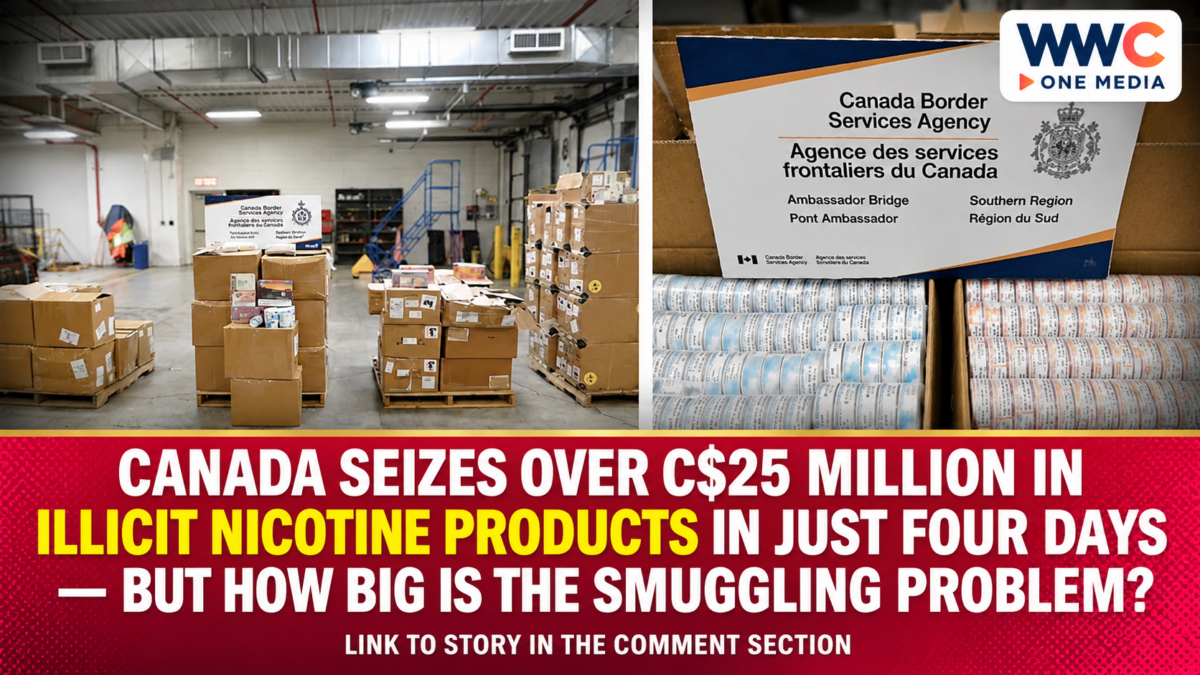
NIAGARA FALLS, CANADA — Canadian border authorities have intercepted more than C$25 million worth of illicit nicotine products across Southern Ontario, following a series of seizures involving commercial shipments arriving from the United States.
The Canada nicotine seizure, announced on Nov. 26, 2026, involved four significant interceptions across three international border crossings between Nov. 7 and 10.
The multimillion-dollar haul has placed renewed attention on illegal nicotine distribution, cross-border commercial cargo and the financial consequences of contraband trading.
Canada nicotine seizure: Ambassador Bridge records C$18.54 million haul
The largest of the four disclosed interceptions occurred on Nov. 9 at the Ambassador Bridge.
Border services officers confiscated 9,270 kilograms of nicotine pouches valued at C$18.54 million.
That single interception accounted for the majority of the combined value of the four announced seizures.
Two further shipments of nicotine pouches were intercepted at Queenston Bridge on Nov. 10, while another shipment containing nicotine vaping products and pouches was seized at Blue Water Bridge on Nov. 7.
The latest enforcement results highlight the importance of monitoring commercial shipments alongside ordinary passenger traffic.
Four seizures across three border crossings
The four significant interceptions disclosed by Canadian authorities were:
| Date | Border crossing | Estimated value |
|---|---|---|
| Nov. 7 | Blue Water Bridge | C$355,250 |
| Nov. 9 | Ambassador Bridge | C$18,540,000 |
| Nov. 10 | Queenston Bridge | C$5,317,500 |
| Nov. 10 | Queenston Bridge | C$2,887,230 |
| Combined value | C$27,099,980 |
The enforcement operation reflects Canada’s continuing efforts to prevent illicit nicotine products from entering its domestic market through international commercial transportation.
Canada had already intercepted millions in tobacco and nicotine products
The November seizures follow earlier multimillion-dollar enforcement operations in Southern Ontario.
During August 2026, Canadian border authorities intercepted more than C$13.8 million worth of illicit tobacco and nicotine products.
Those interceptions included loose-leaf tobacco, cigarettes, nicotine pouches and waterpipe tobacco.
By the Sept. 4 announcement of the August enforcement results, Southern Ontario’s cumulative seizures for 2026 had already exceeded C$52.2 million.
However, seizure figures should not be interpreted as a complete measurement of Canada’s illegal nicotine market. They represent detected and intercepted merchandise rather than the total volume of illicit products potentially circulating within the country.
Why nicotine pouches face strict regulation in Canada
Nicotine pouches are not universally prohibited in Canada.
Certain products have received regulatory authorisation as smoking cessation treatments for adults aged 18 and older.
Canadian regulations distinguish between authorised nicotine replacement therapies and products that have not received the necessary approval.
Non-prescription nicotine replacement products in emerging forms, including nicotine pouches, are subject to pharmacy-based sales restrictions intended to reduce youth access and recreational nicotine consumption.
Unauthorised products raise additional concerns because consumers cannot necessarily establish whether they comply with Canadian requirements governing safety, quality, packaging and labelling.
The November seizure announcement did not identify the individual brands involved or disclose their nicotine concentrations.
Border security and illicit trade remain concerns across APEC economies
Canada’s latest interceptions also illustrate an enforcement challenge relevant to economies throughout the Asia-Pacific region.
Commercial border inspections must balance legitimate international trade with efforts to prevent unauthorised and improperly declared merchandise from reaching domestic markets.
Similar enforcement issues have been examined in WWC ONE MEDIA’s coverage of cigarette seizures at Singapore’s Tuas Checkpoint and anti-smuggling inspections at Woodlands Checkpoint.
The financial and legal dimensions of illicit tobacco trading are also explored in our coverage of the multibillion-peso cigarette smuggling investigation in Cebu.
These are separate enforcement cases and no connection between them and the Canadian shipments has been established.
For customs agencies, effective enforcement requires identifying irregular shipments without unnecessarily disrupting businesses that comply with applicable import regulations.
For legitimate businesses, illicit competition presents potential commercial risks when unauthorised merchandise bypasses regulatory obligations.
What happens next?
Canada is investing C$1.3 billion in a broader initiative covering border security and immigration-system improvements.
The latest seizures form part of continuing efforts to intercept contraband and address the financial activities associated with illegal trade.
However, the November announcement did not identify the importers, disclose criminal charges or establish whether the four intercepted shipments were connected to a single organisation.
It also remains unclear how the seized products were intended to be distributed.
While the four interceptions prevented merchandise worth more than C$25 million from entering the Canadian market, the announcement does not establish the full extent of the country’s illicit nicotine trade.