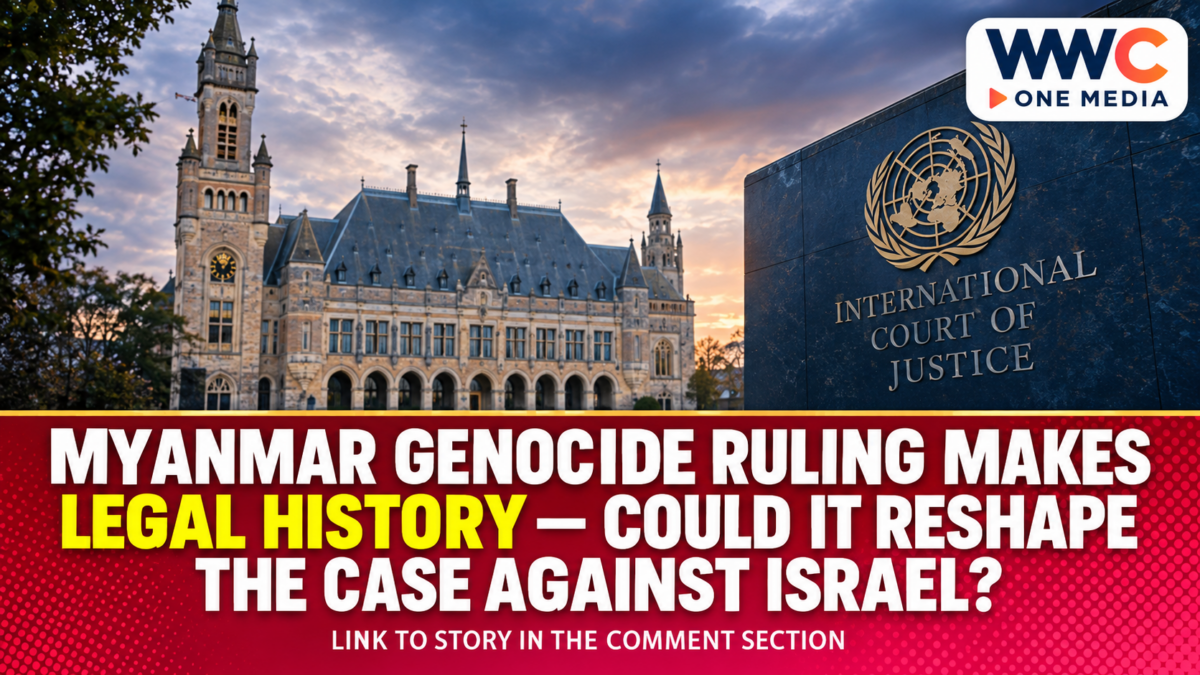
THE HAGUE, NETHERLANDS — November 27, 2026 — The landmark Myanmar genocide ruling has opened a significant chapter in international law, raising questions about how the International Court of Justice (ICJ) could assess separate allegations of genocide against Israel over its military operations in Gaza.
On November 19, 2026, the world’s highest court found Myanmar responsible for committing genocide against the Rohingya in northern Rakhine State during military operations in 2017.
The judgment represents the first instance in which the ICJ has found a state responsible for committing genocide.
Beyond its significance for the Rohingya community, the decision could influence future legal arguments concerning the relationship between military objectives, genocidal intent and state responsibility.
South Africa has welcomed the judgment and indicated that it will examine its implications for ongoing and future proceedings under international law.
However, the ruling does not automatically establish that Israel has committed genocide. The two cases remain legally distinct and require separate assessments of evidence.
Myanmar genocide ruling establishes historic state responsibility
By a vote of nine to six, the ICJ determined that Myanmar had committed genocide against the Rohingya in northern Rakhine State, violating its obligations under the 1948 Genocide Convention.
The proceedings were initiated by The Gambia in November 2019.
The judgment addressed not only the commission of genocide but also Myanmar’s failure to fulfil its obligations concerning prevention and punishment.
The decision now moves the question of accountability beyond the establishment of state responsibility towards implementation and reparations.
As examined in WWC ONE MEDIA’s earlier coverage of Myanmar’s obligations following the Rohingya genocide judgment, obtaining a favourable international judgment and ensuring that its requirements are implemented are two different challenges.
Myanmar’s government continues to dispute allegations that its military operations were motivated by genocidal intent, maintaining that they were conducted in response to armed attacks.
The Court nevertheless reached its findings after examining the evidence presented in the proceedings.
Why military objectives do not automatically rule out genocide
One of the judgment’s most consequential legal issues concerns whether genocidal intent can exist alongside another objective.
Under the Genocide Convention, establishing genocide requires more than demonstrating that serious violence or widespread civilian suffering occurred.
It requires establishing the specific intention to destroy a protected group, either entirely or partially.
The Myanmar judgment explains that the existence of another intention does not necessarily exclude genocidal intent.
When intent is inferred from circumstantial evidence, the Court retains a demanding legal standard. Its assessment must consider whether the evidence, examined collectively, can reasonably be explained without inferring an intention to destroy the protected group.
This distinction is significant.
A government may argue that military operations were undertaken for security or counterterrorism purposes. However, the existence of such an objective does not, by itself, resolve whether prohibited conduct was also accompanied by genocidal intent.
Equally, the presence of civilian casualties or destruction does not automatically establish genocide.
The legal determination depends on the evidence and the applicable requirements of the convention.
Could the ruling influence South Africa’s case against Israel?
South Africa initiated proceedings against Israel on December 29, 2023, alleging violations of the Genocide Convention in Gaza.
Israel disputes the genocide allegations and maintains that its military operations are directed against Hamas and undertaken in the exercise of self-defence.
South Africa’s case and the proceedings involving Myanmar concern the interpretation and application of the same international treaty.
The November 19 judgment could therefore become relevant when lawyers address how genocidal intent should be established and whether alternative explanations adequately account for the evidence presented.
However, the factual circumstances surrounding the two conflicts are different.
The Myanmar judgment cannot substitute for an independent examination of Israel’s conduct, official statements, military operations and other relevant evidence presented before the Court.
WWC ONE MEDIA’s previous examination of the Gaza genocide debate and international investigative findings also highlights the importance of distinguishing investigative conclusions from a final judicial determination.
The potential significance of the Myanmar judgment lies in its legal reasoning rather than an assumption that both proceedings must produce identical outcomes.
What the judgment means for Rohingya refugees and Asia-Pacific
For Rohingya survivors and displaced communities, the judgment raises an immediate practical question: how will legal recognition translate into meaningful remedies?
The Court’s ruling addresses restitution, compensation and measures intended to prevent further violations.
South Africa has called for Myanmar to implement the decision and pursue accountability for individuals suspected of prohibited conduct.
The humanitarian and diplomatic implications extend beyond Myanmar’s borders.
Bangladesh remains particularly important to discussions concerning displaced Rohingya communities and their future. Regional diplomacy will also remain relevant to efforts addressing Myanmar’s broader humanitarian crisis.
WWC ONE MEDIA has previously examined Bangladesh’s efforts to build international pressure following the ICJ ruling, alongside ASEAN’s efforts to strengthen civilian protection in Myanmar.
For Asia-Pacific governments, the judgment provides an important legal reference when considering diplomatic engagement, humanitarian assistance and obligations under international law.
A judicial decision alone, however, does not guarantee safe conditions for returning refugees or immediate compensation for survivors.
What happens next?
The Rohingya proceedings now face the challenge of turning the Court’s findings into effective remedies.
For South Africa, the Myanmar judgment offers additional legal reasoning to examine as its separate proceedings against Israel continue.
For Israel, the case remains an opportunity to contest South Africa’s allegations and present its legal and factual defence.
The Court must ultimately evaluate the evidence specific to that dispute rather than simply reproduce its conclusions concerning Myanmar.
The wider significance of the Rohingya judgment is that establishing a state’s responsibility for genocide is possible under international law, even when the proceedings involve complex disputes over military objectives and intent.
Whether that reasoning will materially influence the outcome of the Gaza case remains an open legal question.
For survivors and affected civilian communities, the ultimate measure of international justice will extend beyond courtroom decisions to meaningful protection, accountability and effective remedies.