
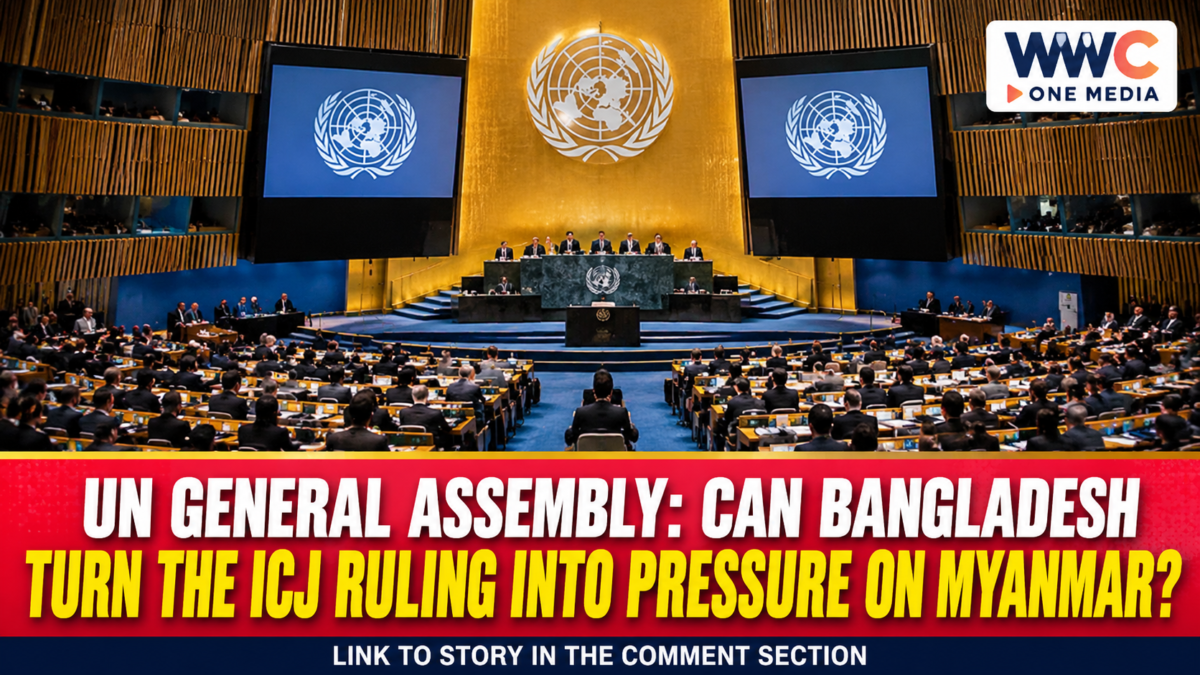
Bangladesh has a new legal development to bring into international diplomacy after the International Court of Justice (ICJ) found Myanmar responsible for genocide against the Rohingya on Nov. 19, 2026. The challenge now is turning that judgment into sustained international pressure, particularly if the United Nations Security Council cannot agree on measures to secure compliance.
The ruling is binding on Myanmar, but the institutions that can respond to non-compliance do not have identical powers. Bangladesh can help mobilise the UN General Assembly, build a wider coalition and push for continued scrutiny. It cannot, however, use the Assembly to impose Security Council sanctions or automatically compel Myanmar to carry out the Court’s orders.
That distinction will determine how much diplomatic value Dhaka can extract from the judgment.
The ICJ ruling establishes obligations, not an enforcement force
The case, formally titled The Gambia v. Myanmar, began in November 2019 when The Gambia brought proceedings under the Genocide Convention. The Court delivered its judgment on the merits on Nov. 19, 2026, finding by nine votes to six that Myanmar had committed genocide against the Rohingya in northern Rakhine State during the 2017 clearance operations. Refworld+1
The judgment also found that Myanmar had failed to meet its obligations to prevent genocide, punish genocide and enact the necessary legislation to give effect to the Convention. By contrast, the Court found by 14 votes to one that Myanmar had not directly and publicly incited genocide against the Rohingya through private persons in northern Rakhine State. The different voting results matter because the decision was not unanimous and its separate findings should not be treated as interchangeable. Refworld
The Court ordered Myanmar to investigate people reasonably suspected of committing acts prohibited by the Convention and prosecute and punish them where warranted. It also required legislation, guarantees against repetition, restitution measures and compensation for damage that restitution cannot repair.
Those restitution measures include facilitating the safe, voluntary and dignified return of displaced Rohingya and the reunification of families. The Court has not yet fixed the amount or arrangements for compensation. Myanmar must submit a report on restitution and compensation measures within two years of the judgment. Refworld+1
The ruling is final, without appeal and binding on the parties. But the ICJ has no police force that can enter Myanmar and enforce its orders. The next stage therefore depends on compliance, diplomacy and the procedures available under the UN Charter.
The Gambia has the formal route to the Security Council
Article 94 of the UN Charter sets out the framework for compliance with ICJ judgments. Under its first paragraph, every UN member undertakes to comply with a Court decision in a case to which it is a party.
The second paragraph provides that if a party fails to perform its obligations under a judgment, the other party may refer the matter to the Security Council. The Council may then make recommendations or decide on measures it considers necessary to give effect to the judgment. United Nations
That wording has an important consequence for Bangladesh. The Gambia, as the applicant state in the ICJ proceedings, is the party with the direct route under Article 94(2). Bangladesh can support the process diplomatically, coordinate with The Gambia and encourage other governments to press for compliance, but it is not a party to this case and cannot replace The Gambia in invoking that provision.
The Security Council route also carries a political obstacle. Under Article 27, substantive decisions require at least nine affirmative votes and no negative vote from any of the five permanent members. A veto by one of those members can therefore block a proposed substantive measure even when most Council members support it. United Nations
Myanmar has already responded to the judgment. In a statement dated Nov. 20, its Foreign Ministry said the decision was reached by nine votes to six and criticised the Court’s treatment of evidence and the standard of proof. It said the government would study the judgment. That is Myanmar’s official position; it does not suspend or overturn the binding decision. Ministry of Foreign Affairs+1
What the UN General Assembly can actually do
The General Assembly offers Bangladesh a different route: diplomatic pressure through the wider membership of the United Nations.
Articles 10 and 11 of the Charter allow the Assembly to discuss matters within the organisation’s scope and make recommendations to member states or the Security Council. Article 14 also allows recommendations concerning situations that may affect international welfare or relations among nations. Article 22 permits the Assembly to establish subsidiary organs needed to perform its functions. United Nations+1
These powers provide room for a structured response to the ICJ judgment. Member states could debate implementation, recommend coordinated diplomatic steps, request regular reporting and consider a monitoring arrangement that tracks Myanmar’s progress on investigations, restitution and safe return.
But the distinction between recommendations and enforcement must remain clear. The General Assembly cannot independently impose mandatory Chapter VII sanctions, order a military operation or compel the Security Council to reverse a veto. Its resolutions can carry significant political weight without having the same binding enforcement authority as Security Council decisions.
This is why a carefully drafted resolution could matter even if it cannot force immediate compliance. It could establish common expectations, make gaps in implementation more visible and keep the Rohingya issue on the international agenda.
Two existing UN procedures could keep pressure alive
Bangladesh could also encourage member states to consider two established General Assembly procedures if Security Council action becomes blocked.
The first is Resolution 377A(V), commonly known as Uniting for Peace. Adopted on Nov. 3, 1950, it provides a route for the Assembly to consider a situation when the Security Council fails to exercise its primary responsibility for international peace and security because its permanent members cannot agree.
Under the procedure, an emergency special session may be convened within 24 hours if the required request comes from the Security Council or a majority of UN member states. The Assembly may then recommend collective measures. The procedure does not transform those recommendations into binding Security Council enforcement decisions. United Nations+2
The second is Resolution 76/262, adopted in April 2022. It established a standing mandate for a General Assembly debate when a permanent member casts a veto in the Security Council. The debate is to take place within ten working days, subject to the resolution’s provisions.
This mechanism gives the wider membership an opportunity to examine and discuss the reasons behind a veto. It does not remove the veto or automatically produce a new enforcement decision. Digital Library+1
Used carefully, the two procedures could prevent a blocked Security Council initiative from becoming the end of international discussion. They would give Bangladesh and other states additional opportunities to maintain attention on compliance.
Bangladesh’s diplomatic role is separate from the Assembly presidency
Bangladesh has two distinct positions in this process. As a state, it can conduct its own foreign policy, work with The Gambia and other governments, and seek support for a General Assembly initiative. Separately, Dr Khalilur Rahman serves as President of the Assembly’s 81st session, after being elected on June 2, 2026. United Nations+1
On Nov. 20, Rahman issued a statement from Rohingya refugee camps in Cox’s Bazar addressing the ICJ judgment. He called for implementation, safe return, reparations and prevention of recurrence, and said he intended to bring the issue to the wider membership of the United Nations. General Assembly of the United Nations
The presidency can help create space for discussion, facilitate consultations and keep attention on the matter during the Assembly session. It does not give Bangladesh a special vote, allow the president to dictate the Assembly’s decisions or turn the office into an enforcement authority.
That separation is important for credibility. Bangladesh’s national diplomatic proposals must secure support from other governments, while the Assembly president must conduct the work of the office in a manner consistent with the responsibilities of the position.
Existing UN commitments provide a starting point
Bangladesh would not be introducing the Rohingya issue to the General Assembly for the first time. Resolution 80/221, adopted on Dec. 18, 2025, already addresses the human rights situation of Rohingya Muslims and other minorities in Myanmar.
The resolution records continuing concerns about forced displacement, violence, humanitarian access and the conditions required for voluntary, safe, dignified and sustainable return. It provides an existing institutional basis for further Assembly attention. Digital Library+1
The judgment gives that continuing agenda a new legal dimension. A follow-up initiative could connect the Court’s specific orders with the Assembly’s existing work rather than create a disconnected diplomatic process.
The regional situation also remains relevant. ASEAN’s recent decisions have maintained restrictions on Myanmar’s political representation at the bloc’s highest-level meetings while keeping channels for engagement open. WWC has examined ASEAN’s continuing approach to Myanmar’s political participation and the bloc’s demands for civilian protection.
The question of return is equally important. Malaysia’s proposed talks with Myanmar over the return of refugees illustrate why a legal requirement for safe and voluntary repatriation must be assessed against actual conditions, not simply diplomatic announcements. WWC previously examined Malaysia’s proposed discussions on Rohingya repatriation.
What happens next
The immediate diplomatic test is whether The Gambia invokes Article 94(2) and whether Bangladesh and other governments build a coordinated position around the judgment.
The next steps could include consultations on a draft General Assembly resolution, requests for regular implementation updates and proposals for monitoring the Court’s orders. These remain possible diplomatic options, not actions that should be described as already approved.
The decisive measures will be practical: whether Myanmar changes its laws, conducts credible investigations, protects evidence, provides remedies and creates conditions for safe, voluntary and dignified return.
The General Assembly can help keep those obligations in view. It cannot guarantee that they will be fulfilled. Bangladesh’s influence will depend on its ability to turn the judgment into a sustained coalition rather than a one-time diplomatic statement.
Frequently asked questions
1. Can the UN General Assembly force Myanmar to obey the ICJ judgment?
No. The Assembly can debate the issue, make recommendations and establish subsidiary bodies, but it cannot independently impose Security Council-style enforcement measures.
2. Which country can refer Myanmar’s non-compliance to the Security Council under Article 94(2)?
The Gambia is the applicant state in the ICJ case and is the other party entitled to invoke Article 94(2) if Myanmar fails to comply.
3. What is the Uniting for Peace procedure?
It is a mechanism under General Assembly Resolution 377A(V) that allows the Assembly to consider a situation and recommend collective measures when the Security Council is blocked under the conditions set out in the resolution.
4. Does Resolution 76/262 remove the Security Council veto?
No. It provides for a General Assembly debate after a permanent member casts a veto. It does not cancel the veto or compel the Council to adopt a measure.
5. When must Myanmar report to the ICJ on restitution and compensation?
The Court ordered Myanmar to submit a report within two years of the Nov. 19, 2026 judgment, making the reporting deadline Nov. 19, 2028.










