
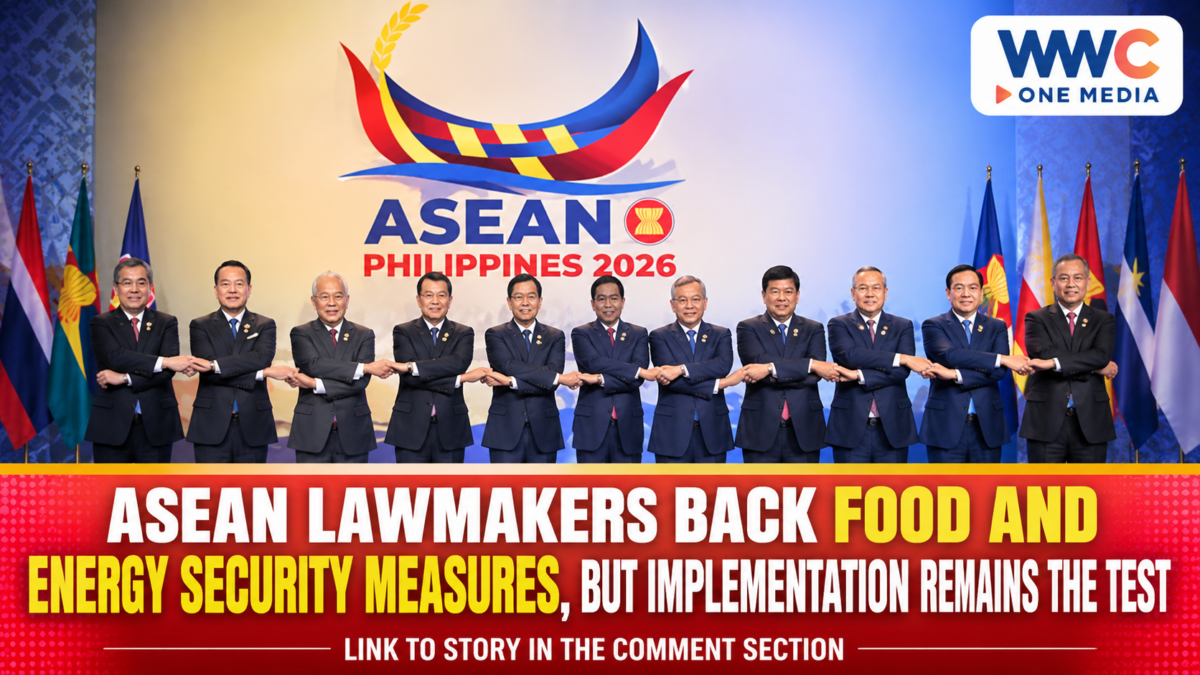
Southeast Asian lawmakers adopted 36 resolutions at the 47th ASEAN Inter-Parliamentary Assembly (AIPA) General Assembly in Manila on Nov. 20, 2026, including proposals to strengthen food reserves, improve agricultural resilience and coordinate responses to energy supply disruptions. The resolutions set out priorities for regional cooperation, but their impact will depend on how national governments turn parliamentary commitments into policies, funding and operational arrangements.
For the Philippines, the debate has immediate relevance: food supply, fuel availability and electricity reliability are closely connected to household expenses and the cost of doing business. The Manila gathering also highlighted an important distinction between calling for stronger regional safeguards and having mechanisms that can already deliver assistance when a disruption occurs. House of Representatives Philippines+2
Food security needs more than emergency rice stocks
The food-security resolution calls for stronger national and regional reserves, emergency food assistance and wider use of climate-smart farming. It also encourages greater agricultural trade within ASEAN, responsible investment in food production, sustainable fisheries and efforts to reduce food losses and waste. House of Representatives Philippines+1
These proposals matter because food security is not determined by harvest volumes alone. Countries also need storage facilities, transport networks, functioning markets and systems that can move supplies to communities when production or distribution is disrupted.
Southeast Asia already has a regional mechanism for emergency rice assistance: the ASEAN Plus Three Emergency Rice Reserve (APTERR). Its framework distinguishes between rice that member governments earmark for emergencies and rice contributed to a shared stockpile.
APTERR lists 787,000 tonnes of earmarked emergency rice stocks across participating countries. These stocks are not simply one central warehouse that can be opened whenever a member requests assistance. Earmarked rice remains under the ownership or control of the government that designated it, while releases follow specific emergency arrangements. apterr.org+1
The Philippines also had 400 metric tons listed under APTERR’s Tier 3 stockpiled system for fiscal year 2025. Tier 3 is intended for humanitarian assistance during severe emergencies, with rice distributed through the affected country’s public food-aid agency. apterr.org+1
That existing arrangement provides a foundation for regional cooperation, but it also shows why the details of any expanded reserve matter. Governments must determine how much rice is available, where it is stored, how quickly it can be released and how it will reach households.
The domestic side is just as important. The National Food Authority’s procurement, storage and distribution responsibilities remain central to the country’s ability to manage its own rice supply. WWC previously examined the agency’s effort to manage its inventory ahead of the wet-season harvest in its report on the NFA’s rice buffer stocks and plans to replenish reserves.
Energy cooperation faces its own implementation gap
The AIPA economic resolutions also call for more diversified energy sources, stronger oil stockpiles and joint contingency planning. Lawmakers backed closer cross-border energy links through the ASEAN Power Grid and the Trans-ASEAN Gas Pipeline. House of Representatives Philippines+1
The proposals address a regional vulnerability: energy supply disruptions can affect electricity generation, transport, manufacturing and the movement of essential goods. Higher fuel or power costs can also feed into food production and distribution.
There has already been a separate development in regional electricity cooperation. On Nov. 15, ASEAN announced that all member states had signed an enhanced memorandum of understanding on the ASEAN Power Grid, a step intended to advance cross-border electricity trade and regional connectivity. ASEAN Main Portal
However, signing a cooperation framework does not mean that every proposed power connection is already built or that electricity can move freely across the region. Projects still require technical coordination, investment, regulatory arrangements and infrastructure.
Oil security has a similar distinction. The ASEAN Framework Agreement on Petroleum Security, signed in Kuala Lumpur on Oct. 16, 2025, is listed in ASEAN’s legal-instrument database as not yet in force. The agreement requires the deposit of 10 instruments of ratification, approval or acceptance before it enters into force, followed by a further 90-day period. ASEAN Agreement+1
That status is important because a regional call for stronger oil stockpiles is not the same as an operational system that guarantees access to emergency fuel. The agreement’s entry into force and the development of practical arrangements will be important steps in determining how countries can cooperate during a supply crisis.
The Philippines has also pursued bilateral discussions on petroleum stockpiling with Japan. Those efforts form part of a wider regional energy-security agenda, but they should not be confused with an already operational ASEAN-wide fuel reserve. WWC has previously examined the Japan-Philippines discussions on petroleum stockpiling.
Why the Philippines has a direct stake
For the Philippines, stronger regional food and energy arrangements could provide additional options when domestic production, imports or transport networks come under pressure.
Rice is particularly important because the country relies on both local harvests and imported supplies. Regional emergency mechanisms may help during severe disruptions, but they do not replace the need to maintain domestic production, improve farm productivity and manage national inventories.
WWC has previously examined the relationship between rice imports and the country’s exposure to supply risks in its report on the Philippines’ potential rice imports and food-security concerns.
Energy security also has consequences beyond fuel availability. Electricity and petroleum are essential to irrigation, cold storage, food processing, fishing, shipping and retail distribution. A disruption in one part of the system can therefore affect several industries at once.
The regional agricultural agenda is also developing alongside other efforts to make farming more resilient. ASEAN agriculture ministers adopted an implementation plan in October covering water-efficient rice systems, soil management, climate-smart fisheries and support for smallholder farmers. The new parliamentary resolutions add political support for stronger food reserves and cooperation, but they do not replace the work required to carry out those agricultural programmes. WWC One Media+1
AIPA resolutions set priorities, not automatic obligations
The 47th AIPA General Assembly adopted 36 resolutions covering regional security, food and energy security, artificial intelligence, climate change and social protection. The Philippine House of Representatives said all member delegations signed the Joint Communiqué, reaffirming their commitment to regional cooperation. House of Representatives Philippines+1
AIPA is a parliamentary body. Its resolutions provide a platform for lawmakers to agree on shared priorities and encourage national legislative action, but they should not be treated as equivalent to laws automatically taking effect in every member country.
The communiqué itself points to the importance of national legislation, budget allocations and parliamentary oversight. Those are the channels through which regional priorities can be translated into domestic action. House of Representatives Philippines
This distinction will matter as the Philippines hands the AIPA presidency to Singapore, which is set to host the 48th General Assembly in 2027. The next phase will give member parliaments an opportunity to assess whether the Manila commitments are being reflected in national programmes and regional cooperation. House of Representatives Philippines+1
What happens next
The immediate challenge is to move from agreed priorities to practical arrangements. For food security, that means strengthening national storage, improving emergency rice-release procedures, supporting farmers and ensuring that regional assistance can reach affected communities.
For energy, governments will need to advance cross-border electricity projects, develop workable contingency plans and move petroleum-security arrangements through the necessary legal and institutional steps.
The Philippines can benefit from these efforts, but the results will depend on implementation at home and cooperation with neighbouring countries. More resilient regional systems could help reduce exposure to future shocks; they cannot guarantee that food and fuel will remain affordable or that every emergency will be avoided.
The measure of progress will ultimately be whether households, farmers and businesses can rely on essential supplies when the region faces its next major disruption.
Frequently asked questions
What did ASEAN lawmakers agree on during the 47th AIPA General Assembly?
They adopted resolutions calling for stronger food reserves, support for farmers and fisherfolk, improved energy security, regional trade and closer cooperation on other economic and social issues.
Did ASEAN create a new regional rice reserve in November 2026?
The AIPA resolutions called for stronger national and regional reserves. They did not, by themselves, establish a new rice reserve. ASEAN Plus Three already operates APTERR, an existing emergency rice cooperation mechanism.
What is the ASEAN Power Grid?
The ASEAN Power Grid is a regional initiative to improve electricity connectivity and cross-border power trade among Southeast Asian countries. All ASEAN member states signed an enhanced memorandum of understanding on the initiative on Nov. 15, 2026.
Is the ASEAN Framework Agreement on Petroleum Security already in force?
No. ASEAN’s legal-instrument database lists the agreement, signed on Oct. 16, 2025, as not yet in force.
Will the AIPA resolutions immediately change food and fuel prices in the Philippines?
No immediate price changes are guaranteed. The resolutions establish regional priorities, while actual effects depend on national policies, funding, infrastructure and the implementation of cooperation arrangements.










