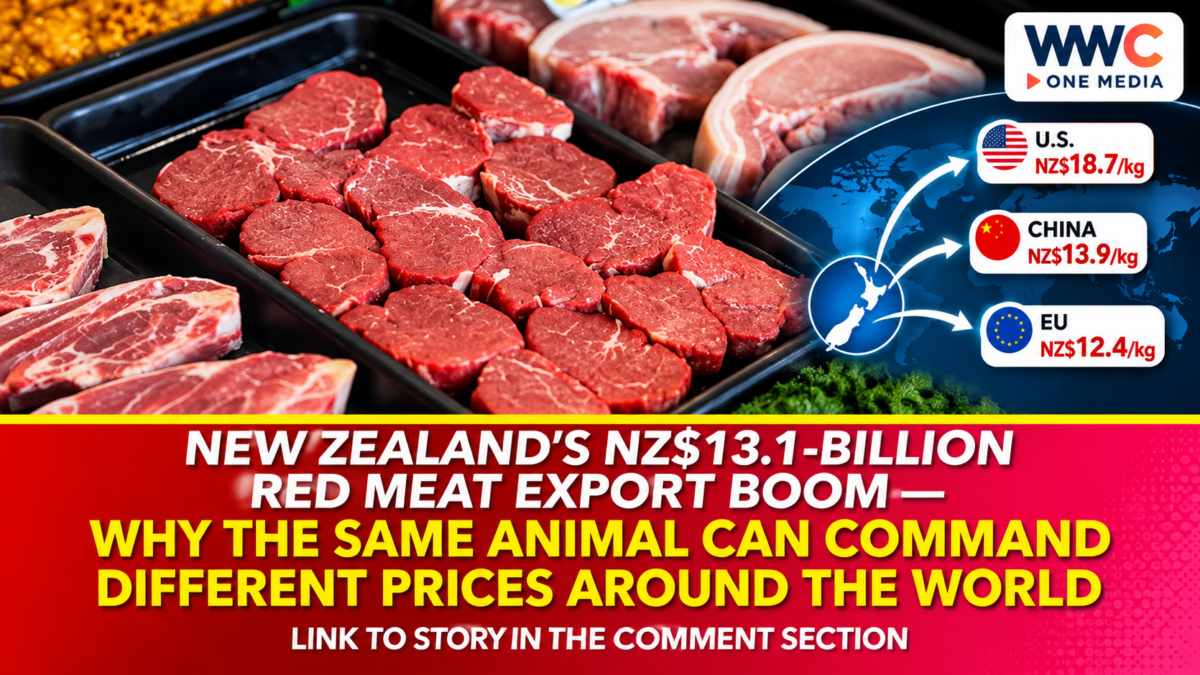
WELLINGTON, NEW ZEALAND — New Zealand meat exports reached a record NZ$13.1 billion in the financial year ended June 30, 2026, rising 21% annually as international demand and higher-value meat products strengthened the country’s agricultural earnings.
Behind that multibillion-dollar industry is a commercial strategy that goes beyond raising livestock and selling meat overseas.
Different countries value different parts of the same animal, creating opportunities for New Zealand exporters to maximise revenue by matching individual products with international consumer preferences.
From American hamburgers to British lamb roasts, the country’s agricultural economy is closely connected to what consumers around the world put on their dinner tables.
New Zealand Meat Exports: Selling Value Instead of Volume
New Zealand’s red meat industry has increased its export earnings despite operating with a smaller livestock base over time.
Approximately 97% of exported products now consist of higher-value chilled or frozen cuts, while frozen carcasses represent around 3% of trade.
The transformation reflects a commercial emphasis on product processing, customer preferences and international market access.
Nick Beeby, chief executive of the Meat Industry Association, has highlighted the importance of generating greater value from individual animals rather than relying exclusively on production growth.
Figures published on Aug. 5, 2026, showed that annual sheepmeat export volumes increased only 1% to 371,748 tonnes, while export earnings rose 26% to NZ$5.2 billion.
Annual beef shipments remained relatively stable at 461,496 tonnes, but their value increased 21% to NZ$5.8 billion.
These figures demonstrate why export revenue can rise substantially without an equivalent increase in production.
For processors, the commercial opportunity lies in improving the value generated by each animal rather than simply exporting larger quantities.
Why American Hamburgers Depend on International Beef Suppliers
The United States occupies an important position in New Zealand’s meat export strategy.
Annual industry figures published in August placed American purchases of New Zealand red meat products at NZ$3.8 billion, making the United States the country’s largest overall export destination during the period.
The relationship is particularly significant for beef processing.
New Zealand’s beef industry has previously reported that more than 85% of its beef exports to the United States consisted of lean cuts used in combination with fattier American beef to produce ground beef.
This arrangement illustrates how imported meat can complement domestic agricultural production.
American processors can combine products with different fat contents to manufacture ground beef that meets their commercial specifications.
For New Zealand exporters, supplying lean beef creates an opportunity to serve a market where demand extends beyond premium steaks.
The commercial pressures facing international meat processors are also examined in WWC ONE MEDIA’s coverage of JBS and the impact of Chinese beef quotas on global meatpacking operations.
British Consumers Create a Different Opportunity for Lamb Exporters
The United Kingdom offers a different example of how consumer preferences influence meat exports.
New Zealand’s sheepmeat industry has historically supplied predominantly lamb leg cuts to British customers, reflecting purchasing preferences within that market.
Annual red meat exports to the United Kingdom reached approximately NZ$1 billion during the financial year ended June 2026, representing growth of 51%.
However, stronger demand for lamb legs does not necessarily create an equally attractive market for every other part of the animal.
Processors must therefore identify additional destinations for products that British consumers may purchase less frequently.
This distinction is important when comparing supermarket prices across countries.
A retail price for an individual lamb cut does not represent the total commercial value of the animal or the amount ultimately received by the farmer.
China Remains Central to Asia-Pacific Meat Trade
China was New Zealand’s second-largest overall red meat export market in the financial year ended June 2026, with shipments valued at approximately NZ$2.7 billion.
Its importance was also reflected in August 2026 trading activity.
During that month, New Zealand’s sheepmeat exports to China increased 46% in value to NZ$71 million.
Beef exports to China reached NZ$79 million, representing an annual increase of 12%.
The size of the Chinese market creates considerable commercial opportunities, although exporters must also consider competition from other international suppliers.
WWC ONE MEDIA’s examination of China’s agricultural trade relationships with Latin America provides further context on the competitive environment facing international food exporters.
Maintaining access to multiple markets becomes particularly valuable when purchasing patterns, consumer spending or import regulations change.
The Multibillion-Dollar Opportunity Beyond Traditional Meat Cuts
The commercial value of livestock is not limited to steaks, roasts and other familiar meat products.
New Zealand’s meat industry also generates export revenue from additional products collectively described as fifth-quarter products.
These include commercially useful animal co-products that can serve different consumer and industrial markets.
Annual fifth-quarter export earnings reached approximately NZ$2.2 billion in the industry figures published in August 2026, increasing 11% from the preceding financial year.
Finding customers for these products can improve the overall commercial return from livestock processing.
The international importance of animal co-product markets is also illustrated in WWC ONE MEDIA’s coverage of British animal protein exports and Vietnam’s reopening of its market to processed animal protein.
Together, conventional meat cuts and additional animal products provide exporters with different opportunities to generate revenue across international supply chains.
India’s Free Trade Agreement Opens Another Market
New Zealand has also secured improved access to India through a bilateral free trade agreement that entered into force on Oct. 20, 2026.
The agreement eliminated India’s previous 33% tariff on qualifying New Zealand sheepmeat imports.
For exporters, the removal of that tariff reduces a significant barrier to entering the Indian market.
However, preferential access does not automatically translate into higher sales. Exporters still need to develop commercial relationships, identify suitable products and understand local purchasing preferences.
The distinction between securing market access and achieving sustained export growth is also explored in WWC ONE MEDIA’s coverage of the Peru–Thailand free trade agreement and its commercial opportunities.
India could provide an additional destination for New Zealand sheepmeat, supporting the industry’s efforts to reduce its dependence on individual overseas markets.
What Happens Next for Meat Prices in 2027?
Despite record export earnings, New Zealand’s agricultural sector faces a more challenging outlook for the 2026–2027 production season.
Industry forecasts anticipate an 8% decline in average lamb farmgate prices and a 4.5% reduction in average beef cattle prices.
Farm expenditure is projected to increase 4.2%, creating additional pressure on agricultural profitability.
These figures are forecasts rather than confirmed future price movements.
For exporters, stronger international competition, exchange-rate changes and household spending pressures remain important commercial considerations.
New Zealand’s ability to match individual meat products with international demand will continue to influence the performance of its agricultural economy.
The industry’s next challenge is maintaining strong export earnings while protecting farm profitability in an increasingly competitive global food market.
Frequently Asked Questions
How much are New Zealand’s red meat exports worth?
Red meat and fifth-quarter exports reached approximately NZ$13.1 billion in the financial year ended June 30, 2026, representing annual growth of 21%.
What is New Zealand’s largest red meat export market?
The United States was the largest overall market during the financial year ended June 2026, followed by China.
Why does New Zealand export different meat cuts to different countries?
Consumer preferences and commercial requirements vary between markets. Selling different products to suitable customers can improve the overall value generated from individual animals.
What are fifth-quarter meat products?
Fifth-quarter products are additional commercial products obtained through livestock processing beyond conventional meat cuts, including edible offal and other animal co-products.
Will New Zealand meat prices fall in 2027?
Industry forecasts anticipate modest reductions in average farmgate prices, but actual prices will depend on global demand, production levels, exchange rates and trade conditions. Farmgate forecasts do not necessarily predict supermarket prices.