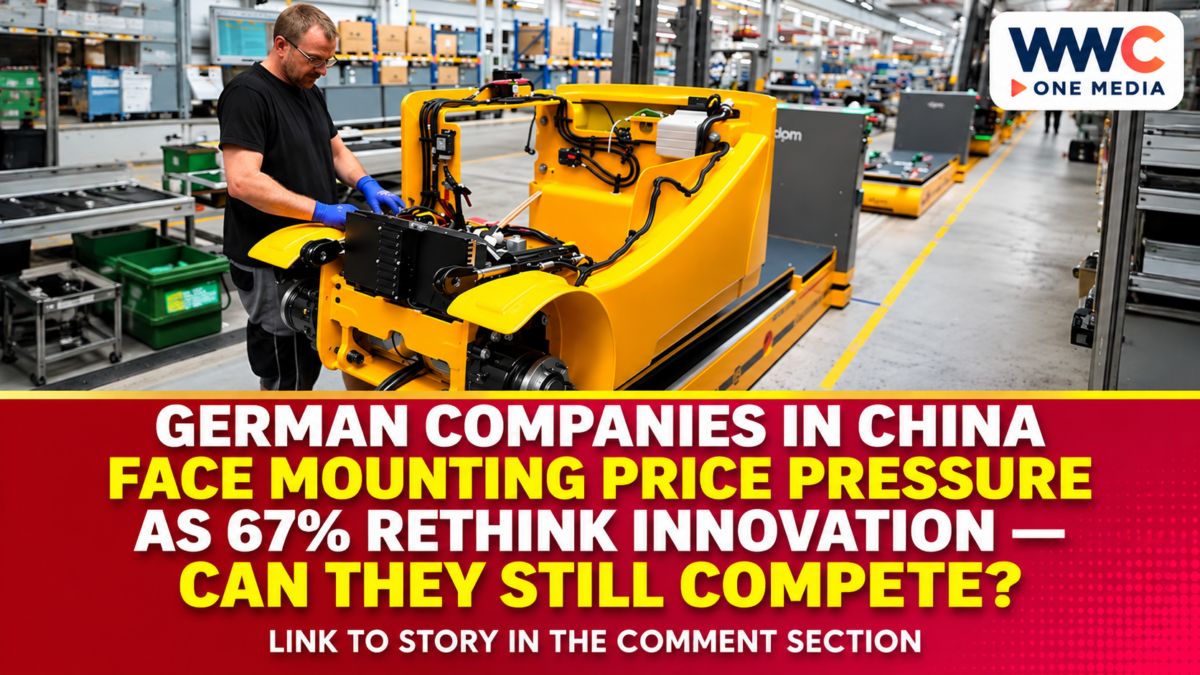
SHANGHAI, CHINA — German companies in China are facing growing pressure to redesign their innovation strategies as cost-conscious customers, increasingly capable domestic competitors and shorter product development cycles reshape the country’s industrial landscape.
New survey findings released on Nov. 26, 2026, show that 67% of participating German businesses identify customers’ growing sensitivity to costs as a significant influence on innovation decisions, compared with 52% in 2024.
Rather than relying exclusively on technologies developed in Germany, companies are increasingly exploring local research capabilities and partnerships with Chinese businesses.
The transformation raises a fundamental question for German manufacturers: can they preserve their reputation for engineering excellence while competing against businesses capable of developing and commercialising products more quickly?
German Companies in China Face a Different Competitive Reality
Price competition has become a central concern for German enterprises operating in the Chinese market.
A business confidence survey involving 627 German Chamber of Commerce members in 2025 identified price pressure as a major challenge for 60% of respondents, while 52% highlighted weak domestic demand.
The November 2026 innovation report provides further insight into how businesses are adapting to these conditions.
Among its 335 participating companies, 55% identified the increasing innovation capabilities of Chinese competitors as a substantial influence on their own innovation strategies.
The findings suggest that reducing prices alone may no longer be sufficient to maintain competitiveness.
German companies must also consider whether their products meet changing customer expectations, whether their development processes are efficient and whether their technologies can be introduced commercially at competitive costs.
This represents a continuation of the broader industrial transformation examined in the growing competitive pressure facing German businesses from Chinese rivals.
Local Research Is Helping German Businesses Develop Products Faster
One of the most significant findings concerns the commercial benefits of conducting research and development within China.
Approximately 65% of surveyed companies reported that localising R&D had enabled them to conduct research and development more quickly in China than in Germany over the previous two years.
Joint research initiatives with Chinese partners have also produced financial benefits for some participants.
Reduced manufacturing or operating expenses were identified by 38% of respondents as an outcome of such collaboration, while 32% reported shorter product development-to-launch timelines.
However, 36% reported no measurable impact from their joint R&D activities.
These results demonstrate that partnerships can create commercial advantages, but their effectiveness depends on implementation.
Businesses must consider the quality of prospective partners, intellectual property arrangements, management responsibilities and whether collaborative projects address genuine market requirements.
Volkswagen Demonstrates the Shift Towards Chinese Technology Partnerships
Volkswagen provides a concrete example of how German manufacturers are adapting their development strategies.
On March 13, 2026, Volkswagen confirmed the start of series production of its ID.UNYX 08 electric SUV in Hefei, eastern China.
The vehicle was jointly developed with Chinese electric vehicle manufacturer XPENG and reached series production readiness within 24 months of the partnership’s commencement.
Volkswagen has also introduced a locally developed electronic architecture designed to support software-based vehicle functions across different powertrain technologies.
In January, the company reported that its revised development process could shorten overall vehicle development cycles by up to 30%.
Development expenses were reduced by up to 50% in selected projects through local engineering and earlier supplier involvement.
These figures are company-reported outcomes and should not be interpreted as universal savings across every Volkswagen development programme.
The importance of this strategy is also explored in Volkswagen’s efforts to rebuild its competitive position in China’s electric vehicle market.
China Is Becoming an Innovation Base for International Markets
German companies are increasingly considering how technologies developed in China could serve customers beyond the country’s borders.
In the 2026 innovation survey, 29% of respondents reported conducting research and development for both Chinese and international markets, compared with 23% in 2024.
Meanwhile, the proportion conducting R&D exclusively for China declined from 39% to 24%.
This changing orientation could have implications for multinational companies operating across Asia-Pacific.
A technology developed for customers in China could potentially be adapted for other markets, subject to local commercial requirements, technical standards and regulations.
At the same time, Chinese manufacturers are establishing their own international distribution and commercial partnerships, as examined in Li Auto’s expansion into Singapore and other Asian markets.
The resulting competition could encourage manufacturers to accelerate innovation while reassessing how their global research networks are organised.
China’s Industrial Indicators Reveal a Complex Pricing Environment
Official economic statistics provide additional context for the challenges confronting international manufacturers.
China’s manufacturing Purchasing Managers’ Index declined from 50.1 in September to 49.3 in October 2026.
A reading below 50 indicates contraction in the surveyed manufacturing activity.
The new orders index also declined to 49.4, suggesting softer manufacturing demand.
However, competitive pressure does not mean that industrial prices are falling across every sector.
China’s industrial producer price index increased by 5.7% year-on-year in October, while industrial producers’ purchasing prices increased by 7.9%.
Producer prices for consumer goods, by contrast, declined by 0.1%.
This divergence illustrates a potentially difficult commercial environment in which some manufacturers face higher input expenses while customers continue demanding competitively priced products.
These nationwide indicators do not establish the profitability of individual German businesses, but they provide important context for evaluating their operating conditions.
Competition Extends Across Asia-Pacific
The challenges facing German companies are not confined to the Chinese domestic market.
A separate international business outlook survey conducted in October 2026 collected responses from approximately 3,500 companies worldwide.
Across Asia-Pacific excluding China, 56% of participating German businesses expected their operations to improve over the following 12 months.
However, growing competition from Chinese businesses was identified by 65% of respondents in the Asia-Pacific region.
The combination of stronger commercial expectations and intensifying competition presents opportunities and risks for multinational enterprises.
European policymakers are also considering how to respond to international industrial competition, as examined in France and Germany’s proposed rapid-response European trade instrument.
For internationally active businesses, decisions concerning investment, technology partnerships and supply chains will increasingly need to accommodate different regulatory and commercial environments.
What Happens Next for German Businesses in China?
The latest innovation survey indicates that technical capabilities alone may not determine commercial success.
While 44% of participating companies identified product design as a strength relative to Chinese competitors, 63% acknowledged that German businesses were slower at bringing products to market.
Artificial intelligence has also yet to deliver widespread measurable productivity improvements among respondents.
Only 29% reported moderate or significant improvements in work efficiency and innovation productivity attributable to AI during the previous two years.
The next major test for German manufacturers will be whether local research, faster development and strategic partnerships can produce sustainable commercial returns.
China remains an important market and research environment for participating businesses. However, preserving competitiveness will require companies to demonstrate that their innovation strategies can deliver products customers are willing to purchase at commercially viable prices.
Frequently Asked Questions
Why are German companies in China facing price pressure?
They face increasingly cost-conscious customers, competitive domestic manufacturers and challenging market demand conditions.
What percentage of German companies identify customer costs as an innovation driver?
The 2026 Innovation Report found that 67% of respondents identified growing customer cost sensitivity as a significant influence on innovation decisions, compared with 52% in 2024.
Is localising research helping German businesses?
Yes, for many surveyed companies. Approximately 65% reported that localising research and development had helped them conduct R&D faster in China than in Germany.
How is Volkswagen adapting to Chinese competition?
Volkswagen is developing vehicles and software technologies locally and collaborating with Chinese partners, including XPENG.
Are German businesses abandoning their competitive markets?
Not generally among respondents to a separate September 2026 DIHK survey. Only 12% would consider withdrawing from their contested business activities entirely, although this does not specifically measure corporate exits from China.