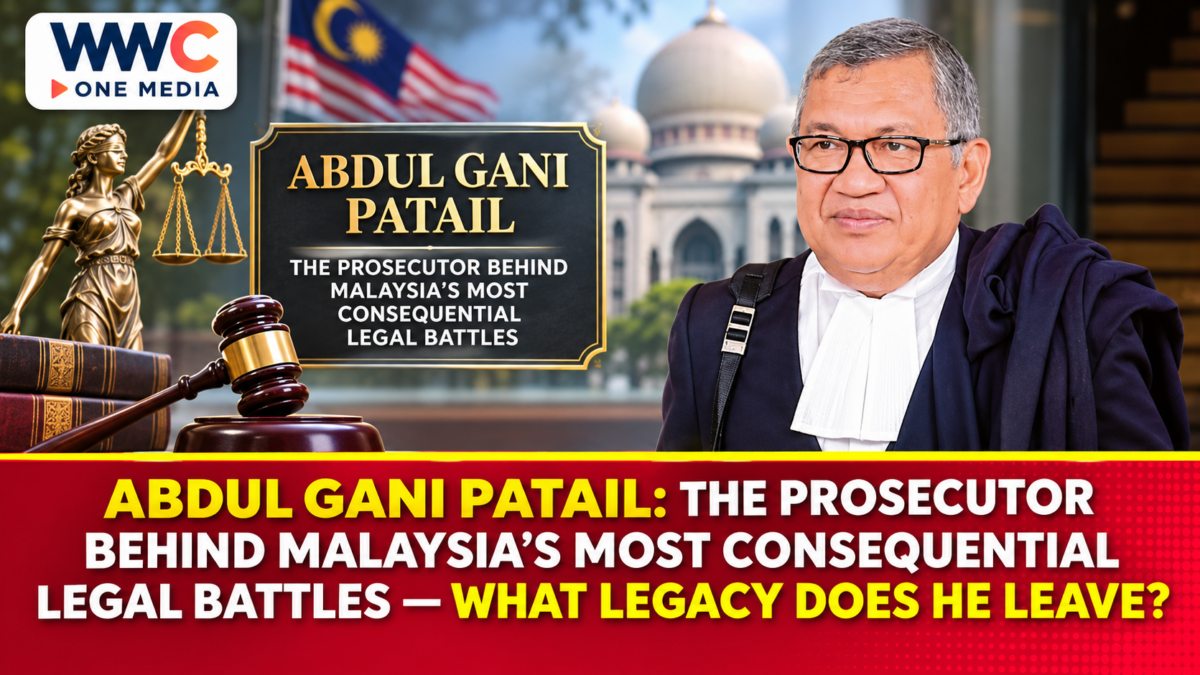
KUALA LUMPUR, MALAYSIA — Few positions within Malaysia’s legal establishment carry responsibilities as extensive as those of the attorney general, an office that Tan Sri Abdul Gani Patail occupied for more than 13 years between 2002 and 2015.
His professional journey from Sabah to the leadership of Malaysia’s Attorney General’s Chambers encompassed criminal prosecutions, government legal advisory work, international legal matters and initiatives to improve access to justice.
Beyond the prominent cases associated with his tenure, Abdul Gani’s career provides an important perspective on the relationship between prosecutorial authority, institutional accountability and the administration of justice.
His professional record also extends beyond government service, including private legal practice and corporate governance.
Abdul Gani Patail: From Sabah to Malaysia’s Highest Legal Office
Born on Oct. 6, 1955, in Lahad Datu, Sabah, Abdul Gani pursued his legal education at Universiti Malaya, graduating with a law degree in 1979.
He entered Malaysia’s judicial and legal service in 1980 as a deputy public prosecutor and subsequently advanced through several leadership positions within the Attorney General’s Chambers.
His responsibilities extended to criminal prosecution, international legal affairs, government advisory services and the revision of legislation.
On Jan. 1, 2002, he assumed office as Malaysia’s attorney general.
His appointment marked the beginning of a tenure that would continue until July 2015, placing him among the country’s longest-serving holders of the office at the time.
The breadth of his career demonstrates that the responsibilities of government legal officers extend considerably beyond courtroom prosecution.
They can also involve interpreting legislation, advising public institutions and addressing complex legal questions affecting national governance.
A Tenure That Included Politically Sensitive Legal Proceedings
Among the prominent matters handled by the Attorney General’s Chambers during Abdul Gani’s tenure were criminal proceedings involving Anwar Ibrahim.
In February 2015, Abdul Gani issued an official statement addressing the judicial proceedings involving Anwar following a Federal Court decision.
The statement defended the prosecution’s conduct and maintained that the judicial process had provided opportunities for the accused to exercise his legal rights.
That position represents the prosecution’s institutional assessment at the time and should not be confused with an independent evaluation of every allegation or controversy associated with the proceedings.
Cases involving prominent political figures can generate intense public scrutiny because of their implications for institutional credibility and public confidence.
The importance of distinguishing legal procedures from political interpretations remains relevant in Malaysia, including in the constitutional questions surrounding the country’s royal pardon system.
The individual circumstances differ, but both issues demonstrate why judicial outcomes, prosecutorial positions and constitutional responsibilities must be considered separately.
Understanding the Power of Malaysia’s Attorney General
Article 145 of Malaysia’s Federal Constitution establishes the attorney general’s principal legal responsibilities.
The position encompasses legal advice to the country’s executive leadership and considerable authority over the commencement, conduct and discontinuation of criminal proceedings, subject to constitutional limitations.
These responsibilities place the office at the intersection of government administration and criminal justice.
The distinction between providing legal advice and determining criminal prosecutions is particularly important.
Although the same institution performs both functions under the traditional constitutional framework, each involves different professional responsibilities and considerations.
Malaysia’s continuing public debate over these institutional relationships is reflected in the government’s account of legal advice provided before Najib Razak’s royal pardon decision.
For the public, understanding these distinctions helps clarify the respective roles of government officials, prosecutors, judges and constitutional institutions.
A prosecutor’s decision is not equivalent to a judicial finding, just as legal advice does not automatically determine the outcome of an independent court proceeding.
Abdul Gani’s Contribution to Legal Aid and Professional Reform
Abdul Gani’s professional record also includes significant involvement in efforts to expand access to legal representation.
He chaired the National Legal Aid Foundation, known in Malaysia as Yayasan Bantuan Guaman Kebangsaan, or YBGK.
The initiative was designed to improve access to legal assistance, particularly for individuals facing criminal proceedings without sufficient financial resources to obtain representation.
His involvement was formally recognised by the Malaysian Bar when his tenure as attorney general ended in July 2015.
He also participated in consultations involving the liberalisation of Malaysia’s legal profession, vocational training for prospective lawyers and broader legislative reform.
These activities demonstrate another dimension of his career: improving the institutional framework through which legal services are delivered.
Access to representation is an important consideration because the ability to exercise legal rights can depend on whether individuals understand court procedures and obtain appropriate professional assistance.
Life Beyond the Attorney General’s Chambers
Abdul Gani’s tenure as attorney general ended in July 2015.
Mohamed Apandi Ali succeeded him, effective July 28 of that year.
However, Abdul Gani’s departure from the government’s senior legal office did not mark the conclusion of his professional involvement in the law.
In December 2016, he was admitted as an advocate and solicitor of the High Court of Malaya, allowing him to pursue another phase of his legal career.
His subsequent professional activities also extended into corporate governance.
Versatile Creative Berhad’s 2018 annual report recorded his appointment as an independent, non-executive director on Aug. 30, 2018.
The appointment illustrates how professional legal expertise can extend into corporate administration, regulatory compliance and governance responsibilities outside public service.
Why Abdul Gani Patail’s Career Remains Relevant
The legal and constitutional questions associated with senior prosecutorial appointments remain important within Malaysia’s public institutions.
High-profile criminal proceedings can have consequences extending beyond individual defendants, affecting political relationships, government administration and confidence in public institutions.
These wider consequences are illustrated by Anthony Loke’s resignation amid Malaysia’s dispute over Najib Razak’s house-arrest arrangement.
That development occurred long after Abdul Gani’s departure from the Attorney General’s Chambers and should not be attributed to him.
Nevertheless, it illustrates the continuing importance of understanding the boundaries between legal institutions and political decision-making.
Abdul Gani’s professional legacy encompasses both prominent criminal proceedings and less publicly visible work involving legal aid, professional development and institutional reform.
Assessing that legacy requires consideration of documented achievements, judicial records and the broader responsibilities attached to the office he held.
For Malaysia, the continuing challenge is ensuring that prosecutorial authority is exercised consistently, fairly and in accordance with the rule of law.
Frequently Asked Questions
Who is Abdul Gani Patail?
Tan Sri Abdul Gani Patail is a former Malaysian attorney general who held the office from 2002 to 2015 after beginning his government legal career in 1980.
Where was Abdul Gani Patail born?
He was born on Oct. 6, 1955, in Lahad Datu, Sabah, Malaysia.
What is Abdul Gani Patail known for?
His career encompasses high-profile criminal proceedings, government legal advisory responsibilities, legal aid initiatives and professional reform.
Who succeeded Abdul Gani Patail as attorney general?
Mohamed Apandi Ali succeeded him, effective July 28, 2015.
What did Abdul Gani Patail do after leaving office?
He entered private legal practice following his admission as an advocate and solicitor of the High Court of Malaya in December 2016 and subsequently participated in corporate governance.