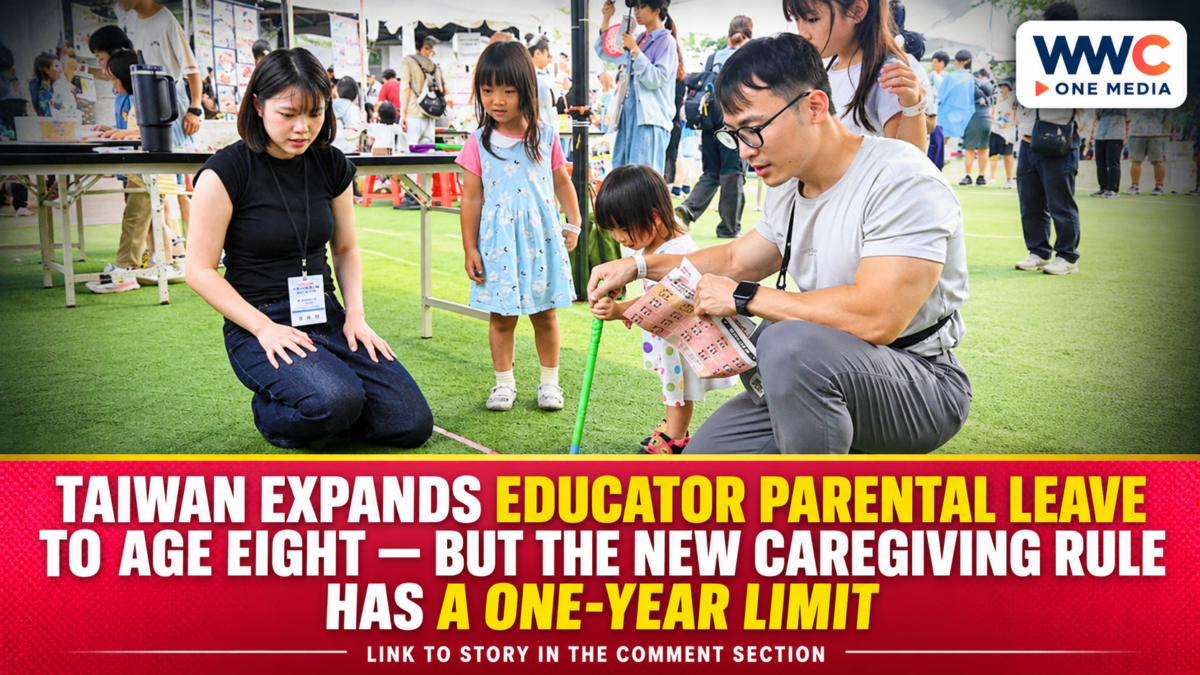
TAIPEI, Taiwan — Taiwan’s Ministry of Education has revised its rules on unpaid leave for education personnel, allowing eligible educators to apply for childcare-related leave for children and grandchildren up to age eight. The amendments were issued on November 20 and are scheduled to take effect on January 1, 2027.
The changes also introduce a new, limited ground for leave to care for a seriously ill brother or sister, while setting conditions that schools and education authorities must consider when deciding applications.
The revision matters because it changes more than the age at which an educator may seek time away from work. It also recognizes a wider range of family-care responsibilities, although not every application is automatically guaranteed approval.
Taiwan parental leave: What the new rules change
The revised Regulations for Unpaid Leave of Educational Personnel amend Articles 4, 5, 6, 8 and 13. The Ministry of Education issued the changes through Order No. 臺教人(三)字第1154203446A on November 20, with implementation set for January 1, 2027.
Under the revised Article 4, raising a child or grandchild who is eight years old or younger becomes a qualifying reason for unpaid leave that the employee’s school, institution or competent education authority generally cannot refuse.
The previous wording limited the relevant childcare provision to children under three. Raising the threshold to eight aligns the education-personnel rules with the amended Gender Equality in Employment Act, which Taiwan’s legislature passed on November 13.
The change is particularly relevant to educators whose caregiving responsibilities continue after a child enters preschool or primary school. It brings a wider part of childhood within the leave framework rather than restricting the provision to the earliest years.
The rule covers education personnel defined by the regulations, including principals and teachers at public schools at different levels, sports coaches, professional personnel at social education institutions and researchers at academic research institutions under education authorities.
Leave for a seriously ill sibling comes with conditions
One of the more significant additions concerns family members outside the usual parent-child relationship.
The amended rules allow an eligible education employee to apply for unpaid leave to care for a brother or sister with a serious illness, but the provision is not an unconditional entitlement. The school, institution or education authority may consider operational or school-affairs requirements when deciding whether to approve the request.
The regulation also limits this specific leave period to one year.
Eligibility is restricted. The revised text identifies circumstances involving the sibling’s family situation, including whether the sibling has a spouse or children, whether any children are minors, and whether a spouse or child has a serious illness or disability. The provision is therefore not a blanket right to take leave for any sibling’s illness.
The rules also require medical documentation for serious-illness cases. The relevant authority must assess the submitted evidence with reference to the serious-illness categories under Taiwan’s National Health Insurance framework.
This distinction is important: the regulation creates a route to request leave, but approval can depend on the applicable conditions and the institution’s operational assessment.
Childcare leave can extend until a child turns nine
The amended Article 5 sets the maximum period for childcare-related unpaid leave. For qualifying care of children, grandchildren or adopted children, leave may continue until the child reaches nine years old, but the total period cannot exceed three years.
Where an educator is caring for more than one child, grandchild or adopted child at the same time, the periods are combined. The maximum is calculated by reference to the youngest child and remains capped at three years.
This means the age threshold for qualifying care and the maximum endpoint for leave are not identical. The revised provision allows an application for a child aged eight or younger, while the permitted leave period can run until the child turns nine, subject to the three-year ceiling.
The new one-year limit for qualifying sibling-care leave is separate from the childcare period.
A separate 60-day option for teachers
The leave amendments should also be read alongside changes to Taiwan’s Rules Governing Teachers’ Leave, issued on November 20 under a separate Ministry of Education order.
Those changes allow teachers to take childcare leave by the day, up to 60 days for each child, where a child aged eight or younger needs personal care for reasons such as illness, suspension of childcare or classes, vaccination, or parent-related activities organized by childcare institutions or schools.
The 60 days are counted as part of the childcare unpaid-leave period. The amended rules state that salary is deducted by the day and that teachers may apply for the relevant childcare unpaid-leave allowance under applicable rules.
This is not the same as taking several years of continuous unpaid leave. It offers a more flexible way to respond to specific care needs without necessarily taking a full semester or a long block away from school.
The revised teacher-leave rules also specify that private schools must follow the relevant provisions on childcare leave, with schools responsible for substitute-teaching hourly costs.
Why the change matters beyond schools
The amendments reflect a broader policy question: how workplaces respond when family care does not fit neatly into the first few years of a child’s life or the traditional parent-child household.
Taiwan has been confronting demographic pressure, including population ageing and low birth numbers. WWC previously examined the country’s long-term population projections in its report on Taiwan’s shrinking population and changing age structure.
The new leave rules do not, by themselves, resolve those demographic challenges. But they do address one practical barrier: the difficulty of remaining employed while meeting care responsibilities at home.
The expanded sibling-care provision also connects with a wider discussion about how caregiving is shared among relatives. In an earlier report on Taiwan’s Care Handover Plan for family caregivers, WWC looked at efforts to prevent care duties from falling entirely on one person.
Family-support policy has also become part of Taiwan’s wider public debate about birth rates and the cost of raising children. WWC’s coverage of the government’s family-support message at a Taipei mass wedding examined that broader policy backdrop.
For comparison, teacher welfare is also being debated elsewhere in the region. In the Philippines, DepEd’s protected wellness break for teachers highlighted a different part of the same workplace question: whether education systems can make formal protections meaningful in day-to-day school operations.
The central implementation test in Taiwan will be whether schools can apply the new rules consistently while maintaining classroom and institutional operations.
What happens next
The amended regulations are scheduled to take effect on January 1, 2027. Schools and education authorities will need to apply the revised age thresholds, leave-duration calculations and documentation requirements from that date.
Educators considering an application should check the final amended text and consult their school’s personnel office. In particular, applicants should distinguish between leave that the institution generally cannot refuse and requests that remain subject to operational approval.
The separate 60-day teacher childcare-leave provision also needs to be understood alongside the rules on unpaid leave, salary deductions and any applicable allowance.
Frequently asked questions
When do Taiwan’s revised educator leave rules take effect?
The amendments were issued on November 20, 2026, and are scheduled to take effect on January 1, 2027.
What is the new childcare age limit for education personnel?
The revised rules cover the care of children or grandchildren aged eight or younger as a qualifying ground for unpaid leave.
Can educators take leave to care for a seriously ill sibling?
Yes, subject to eligibility conditions and the school or authority’s assessment of operational needs. The specific leave period is capped at one year.
How long can childcare-related unpaid leave last?
For qualifying childcare, the period may extend until the child reaches nine years old, but it cannot exceed three years. Periods for multiple children are combined under the revised calculation rules.
Do teachers also receive a 60-day childcare leave option?
The separately amended teacher-leave rules provide up to 60 days per child, taken by the day for specified childcare needs involving a child aged eight or younger. The days count toward the childcare unpaid-leave period, and salary is deducted for the days taken.