
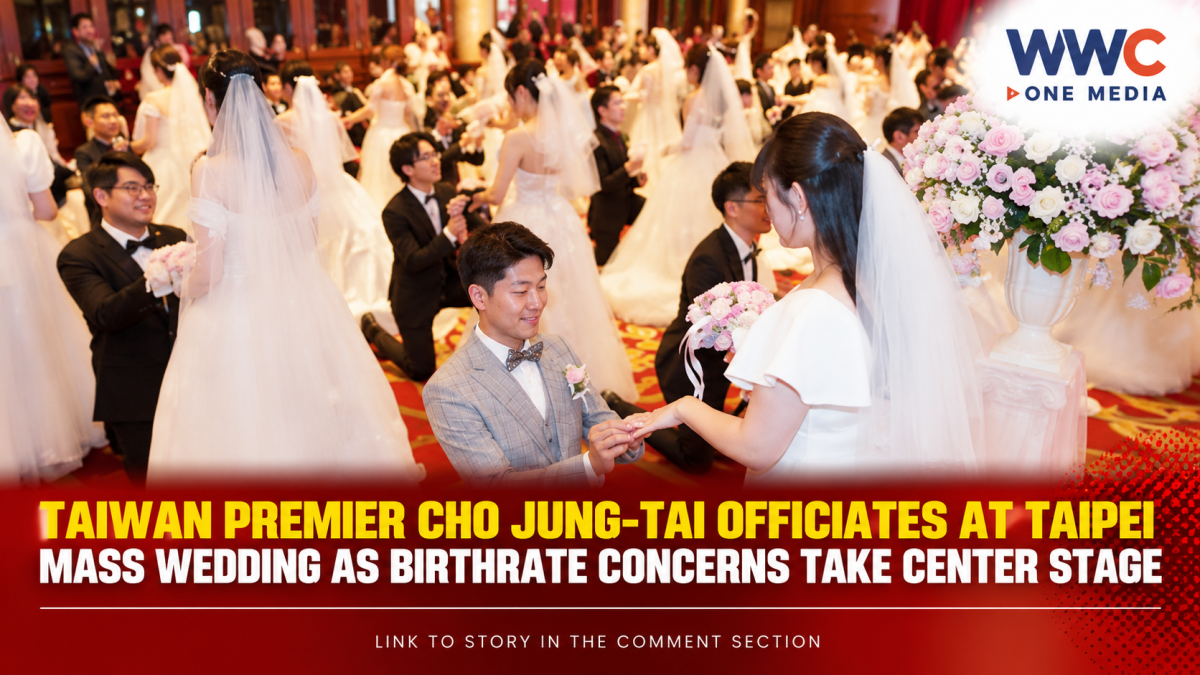
TAIPEI, Taiwan — Taiwan Premier Cho Jung-tai stepped into an unusual role Sunday, serving as a witness at a mass wedding for 72 couples as the government continues efforts to confront the island’s deepening demographic challenges.
The ceremony, organized by Chunghwa Telecom, was held at Taipei’s Grand Hotel, bringing dozens of newlyweds together for a celebration that also placed Taiwan’s declining birthrate firmly in the spotlight.
Cho congratulated the couples and encouraged those who plan to start families to make use of government support programs. At the same time, he stressed that having children remains a personal decision.
“Marriage is everyone’s right, and having children is everyone’s choice,” Cho said, emphasizing that parenthood is not a responsibility or obligation.
72 couples tie the knot
At least one person in each of the 72 couples works for Chunghwa Telecom, Taiwan’s largest telecommunications company. In five couples, both spouses are company employees.
Chunghwa Telecom Chairman Alex Chien said the company has organized mass weddings since 1963, with about 800 couples participating since 2010.
The event continues a decades-old corporate tradition while also highlighting how employers are adapting to Taiwan’s demographic pressures.
Taiwan’s birthrate hits another warning point
The wedding comes as Taiwan faces one of the world’s lowest fertility rates.
Data from Taiwan’s Ministry of the Interior showed that the country’s total fertility rate fell to 0.695 in 2025, while the number of births dropped for a 10th consecutive year to a record-low 107,812.
Those figures have made population decline a major policy issue for the Taiwanese government.
Rather than simply urging people to have children, authorities have increasingly focused on reducing some of the financial and practical pressures associated with raising a family.
Government promises more family support
Cho highlighted the government’s population strategy, which covers childbirth, childcare, education, family-friendly workplaces and housing.
The government plans to introduce a NT$5,000 monthly child-rearing allowance beginning in 2027, alongside expanded childcare services and other measures intended to ease the costs of raising children.
Cho urged newlyweds who eventually decide to have children to take advantage of those programs.
But his message also attempted to draw a clear line between government support and personal choice: marriage and parenthood should not be treated as obligations imposed on individuals.
Chunghwa Telecom expands workplace family support
Chunghwa Telecom has also introduced policies aimed at making it easier for employees to balance careers and family life.
The company provides an NT$80,000 childbirth subsidy and operates workplace childcare facilities. It also offers family-friendly working arrangements for employees with young children.
The company currently has 18 childcare classes across 10 workplace childcare centers, according to Taiwan News.
Chunghwa Telecom also provides maternity and paternity-related leave beyond the basic statutory requirements and allows employees with children under six to reduce working hours without losing pay or other labor rights, according to the report.
Newlyweds say support still has limits
For some couples at the ceremony, government assistance is welcome but does not eliminate the financial concerns surrounding parenthood.
One newlywed, Chunghwa Telecom senior engineer Lin Kuan-nan, said he and his wife planned to have a child. He described the proposed monthly allowance as appealing but said it would not be enough to cover the realities of today’s living costs.
Another employee, Dino Chen, said he and his wife were considering having a child within the next year or two.
But he identified housing costs as a major concern, noting that mortgage payments could place significant pressure on young families.
Cho wants more companies to follow
The premier also called for more state-owned enterprises to organize large-scale mass weddings.
He pointed to Taiwan Power Co., which is planning to hold its own mass wedding, as an example of how state-owned companies could help support employees and encourage family-friendly workplace cultures.
The broader objective is clear: Taiwan is attempting to address its demographic crisis not simply through financial incentives, but through a combination of childcare, workplace and housing policies.
A wedding becomes a demographic conversation
The Grand Hotel ceremony therefore became more than a celebration of 72 couples.
It offered a snapshot of a much larger challenge facing Taiwan: how to make marriage and family life more financially sustainable at a time when fewer people are choosing to have children.
Cho’s appearance reflected that balancing act.
He encouraged couples to consider starting families, but repeatedly emphasized that the decision ultimately belongs to them.
For Taiwan, the question now is whether expanded government support and family-friendly workplace policies can do enough to reverse a demographic trend that has already produced record-low births.
The 72 couples celebrated the beginning of their marriages Sunday. For Taiwan, their ceremony also highlighted a much bigger question: can the island make starting a family easier for the next generation?




Leave a Reply