SABAH, Malaysia — Nov. 24, 2026. Road safety remains an infrastructure priority in Sabah, where the Public Works Department has published procurement notices covering slope protection in Keningau and along Federal Route 500 during 2026.
The department’s published service charter also establishes response standards for landslides, emergency road closures and other incidents affecting public safety.
Together, these records provide a framework for understanding Keningau road safety and the importance of distinguishing verified road restrictions from unconfirmed information circulating online.
For motorists, residents and businesses, accurate road information can be as important as the infrastructure itself. An incorrect closure announcement could disrupt travel unnecessarily, while overlooking a legitimate warning could expose road users to hazards.
Keningau Road Safety: Understanding Sabah’s Response Standards
The Sabah Public Works Department, locally known as Jabatan Kerja Raya or JKR Sabah, outlines several responsibilities relating to road maintenance and emergency response in its official client charter.
When a landslide interferes with traffic or threatens public safety, the department commits to taking appropriate action within 24 hours of receiving a complaint.
Its charter also provides for emergency road closures to be publicly announced within 24 hours of receiving the relevant report.
Scheduled closures, meanwhile, are subject to an advance notification standard of at least three days.
These commitments establish a distinction between planned maintenance activities and emergencies that require intervention without lengthy advance notice.
Importantly, the response period does not mean that every damaged road must be fully repaired within 24 hours. The nature of the required intervention and the time needed to restore normal access may vary.
Official Records Show Attention to Slope Protection
On July 8, 2026, JKR Sabah published a procurement notice covering slope protection and associated works at kilometre 10.780 of Jalan Apin-Apin Bundu Kampung Tiga in Keningau.
A separate notice published on Oct. 30 covered first-stage prequalification for a slope construction project at kilometre 31.90 of Jalan Kota Kinabalu–Keningau–Tenom, part of Federal Route 500, in Penampang.
The notices demonstrate that slope-related infrastructure works have formed part of Sabah’s procurement activities this year.
However, procurement announcements should not be confused with project completion certificates. They do not independently establish that construction has been completed or that a particular road is currently free of hazards.
The distinction matters when evaluating infrastructure announcements. A proposed project represents a different stage of development from an awarded contract, active construction or completed rehabilitation.
Similar questions about infrastructure resilience were examined in WWC ONE MEDIA’s coverage of Malaysia’s highway vulnerability to flooding.
Although flooding and landslides involve different hazards, both illustrate the importance of maintaining reliable transport connections during adverse conditions.
Why Accurate Road Information Matters
From a public-safety perspective, motorists should distinguish between an official road closure notice, a weather warning and an unverified social media post.
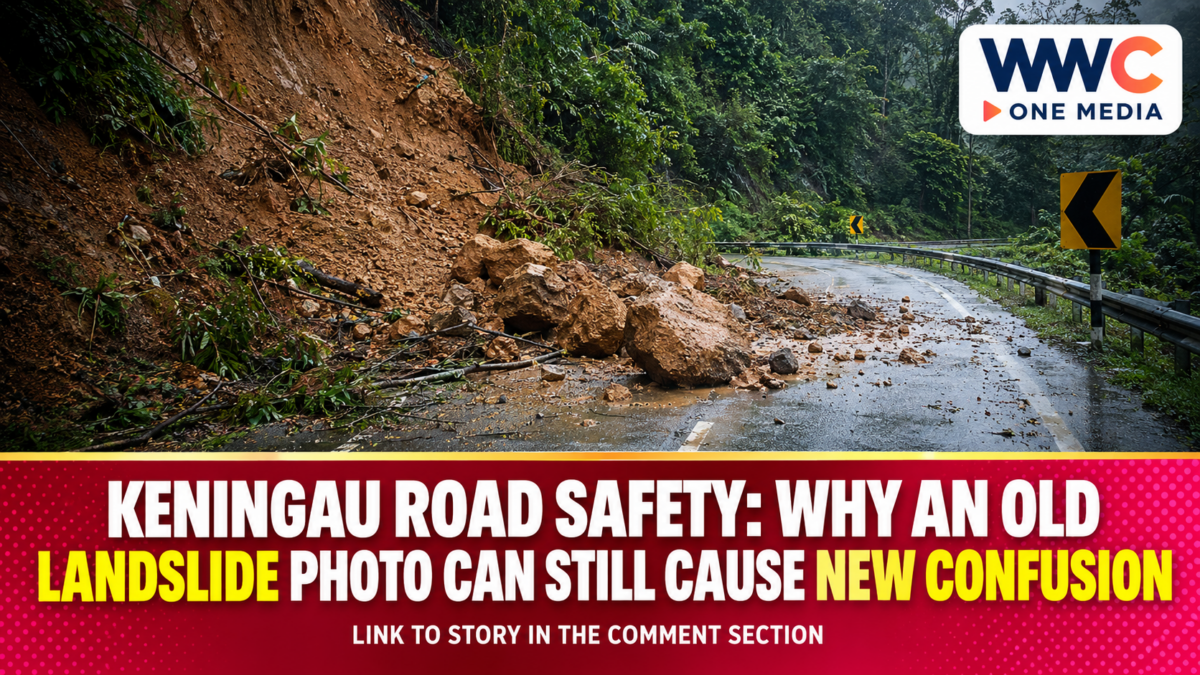
A photograph of road damage does not necessarily establish when the incident occurred, whether the road remains obstructed or whether authorities have imposed restrictions.
Even a genuine photograph may become misleading when circulated without its original date or location.
A useful road advisory should identify the affected route, the relevant section, the time of the update and any restrictions imposed by the responsible authority.
Motorists should also avoid treating the absence of a closure announcement as an unconditional guarantee of safety. Conditions may change, and new information may become available.
WWC’s previous examination of Selangor’s flood risk and changing river warnings highlighted the broader importance of interpreting disaster information within its proper geographical and chronological context.
The same principle applies to road reports: information about one location or date should not automatically be applied to another.
The Economic Importance of Reliable Road Connections
Malaysia’s parliamentary proceedings on July 16, 2026, included discussions concerning bridge infrastructure in Keningau.
During those proceedings, the Ministry of Rural and Regional Development acknowledged the importance of safe rural roads and bridges in improving access to schools, healthcare facilities, economic centres and essential services.
The discussion provides broader context for understanding why infrastructure reliability is more than a transport issue.
WWC analysis: Uncertainty over road accessibility could complicate delivery schedules, increase travel costs and make it harder for businesses to coordinate workers and suppliers.
For households, unnecessary detours could also create additional expenses and inconvenience.
These are potential consequences rather than measured losses attributable to a specific Keningau incident.
Reliable infrastructure planning should therefore consider both physical improvements and the quality of information available to road users.
Clear communication can help residents make informed decisions without relying entirely on informal reports.
What Motorists Can Learn From Disaster Preparedness
Road users should consult current information from the responsible road authorities before travelling through areas where hazardous conditions may be present.
When encountering a circulating closure announcement, checking its publication date and original issuer can help establish whether it remains relevant.
Motorists should also respect official restrictions and avoid attempting to cross sections that authorities have declared unsafe.
WWC’s coverage of flood preparedness and emergency response in Sabak provides additional regional context on the importance of timely public information.
For public agencies, issuing clear, geographically specific updates could reduce confusion and improve coordination between residents, emergency responders and transport operators.
What Happens Next
The next meaningful developments for Keningau road safety will include updated departmental road advisories and documented progress on relevant infrastructure projects.
Procurement notices alone cannot establish whether individual projects have been completed, while historical road incidents cannot determine present driving conditions.
Motorists should base immediate travel decisions on the latest official information rather than undated photographs or forwarded messages.
For policymakers, the wider challenge is ensuring that infrastructure investment, maintenance and public communication work together to support dependable transport connections.