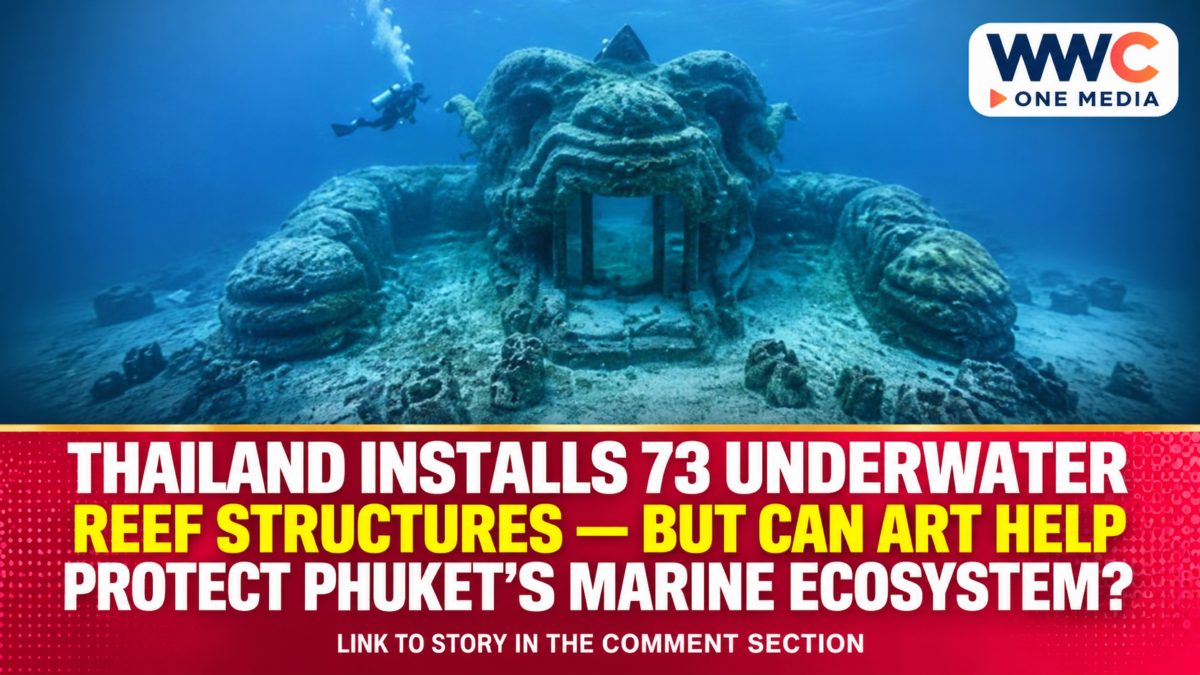
PHUKET, Thailand — Thailand is bringing cultural heritage into marine conservation through its Hanuman Reef project, with 73 underwater structures installed at Siam Bay off Racha Yai Island in April 2026. The country’s marine authorities subsequently confirmed in September that additional sculptures were under development as part of a broader underwater museum initiative.
The undertaking offers Phuket an opportunity to diversify its marine tourism attractions while supporting efforts to protect natural coral reefs. Its long-term value, however, will depend on structural durability, environmental monitoring and responsible tourism management.
Rather than measuring success solely through visitor numbers, the project raises a more significant question about whether underwater art can deliver measurable ecological benefits.
Hanuman Reef combines mythology with marine conservation
Thailand’s Department of Marine and Coastal Resources began overseeing the placement of underwater sculptures at Siam Bay on April 11, 2026.
An official operational report documented the installation of 73 components, consisting of:
- 47 components forming the Hanuman sculpture.
- 15 three-dimensional printed fence structures.
- 11 three-dimensional coral-shaped structures.
The project draws inspiration from the Ramakien, Thailand’s adaptation of the Ramayana epic.
Hanuman serves as the first major character in an underwater museum concept that also incorporates Rama, Tosakanth and Suphannamatcha.
The initiative involves cooperation between marine authorities, local artists, Rotary organisations and other participating groups.
Its purpose extends beyond creating an unusual tourist attraction. Authorities intend to provide additional marine habitats and reduce pressure on natural coral ecosystems.
However, the installation of artificial structures should not automatically be interpreted as successful coral restoration. That outcome requires separate environmental assessment.
Why artificial reefs require long-term monitoring
The distinction between an underwater sculpture and a functioning marine habitat is important.
Installing a structure represents the completion of an engineering task. Establishing its ecological contribution requires evidence of biological development over time.
Before the Hanuman installation, Thai marine officials conducted surveys around Racha Yai and Racha Noi between March 31 and April 4, 2026.
Their work included identifying suitable locations for coral settlement structures and examining existing artificial reefs.
Officials documented natural coral formations, sandy seabed areas and several groups of reef-associated fish during their surveys.
These observations provide an environmental starting point for conservation planning, although they do not establish the ecological performance of the newly installed Hanuman structures.
From a conservation perspective, future monitoring should distinguish between marine organisms attracted to the site and measurable improvements in reef health.
Without that distinction, increased underwater activity could be mistaken for successful ecosystem restoration.
Structural durability deserves equal attention
Siam Bay has accommodated artificial reef installations before.
An earlier government assessment examined underwater structures placed in the area in 2006. Officials found that several decorative installations had deteriorated, while 55 cube-shaped artificial reef units remained in normal condition at the time of inspection.
Marine organisms and fish were also observed around the older artificial reef units.
Although that assessment concerned a different installation, it highlights the importance of design, materials and maintenance when developing permanent underwater attractions.
Thailand’s marine authorities reiterated the importance of examining current direction, physical surroundings and installation suitability in their September 2026 update on the new sculpture project.
For diving businesses, structural safety should remain a priority alongside the attractiveness of a destination.
WWC’s separate coverage of southern Thailand’s seasonal weather and marine safety risks provides additional context on why changing weather conditions matter to coastal tourism operators.
An underwater museum cannot be managed solely as an artistic attraction. Its physical condition must also form part of its continuing assessment.
Can Phuket turn cultural heritage into sustainable tourism?
The underwater museum offers a distinctive concept by incorporating Thai mythology into marine conservation planning.
In principle, artificial attractions could help distribute diving activity across more locations rather than concentrating visitors around existing natural reefs.
Whether this happens at Racha Yai will depend on how tourism operators use the site, how visitors behave and whether appropriate environmental safeguards are maintained.
The conservation of culturally significant attractions also requires continuing investment beyond their initial construction, a broader consideration explored in WWC’s coverage of Okinawa’s restored Shuri Castle landmark.
For Phuket, the potential economic benefits could include additional opportunities for diving operators, guides and tourism-related businesses.
These remain potential benefits rather than confirmed financial outcomes.
The project’s contribution should ultimately be evaluated through environmental performance and community participation, not simply its ability to attract publicity.
Responsible diving remains essential
On Sept. 11, 2026, Thailand’s marine authorities conducted an operation around Racha Yai to examine mooring practices and compliance with measures governing recreational diving.
The operation formed part of preparations to implement coral protection measures issued in 2025.
Officials also worked to improve awareness among tourism businesses and visitors.
The broader challenge is ensuring that new coastal developments remain compatible with environmental protection. Similar questions about environmental oversight arise in WWC’s examination of coastal development and land reclamation in the Maldives.
Visitors planning to explore the Hanuman Reef should confirm current access conditions with local authorities and qualified diving operators.
The existence of underwater structures does not, by itself, establish that every section is currently safe or authorised for recreational diving.
What happens next
Thailand’s Sept. 7, 2026, project update confirmed that additional sculptures representing other Ramakien characters were under construction.
Future developments will be important in assessing whether the underwater museum can achieve its conservation and tourism objectives.
Three areas deserve particular attention: structural inspections, documented ecological outcomes and clear information regarding visitor access.
The project’s most meaningful achievement would not simply be the creation of an impressive underwater landmark. It would be demonstrating that cultural tourism can operate without compromising the marine environment it depends on.
Frequently asked questions
What is Thailand’s Hanuman Reef?
It is an artificial reef and underwater sculpture initiative designed to combine Thai cultural heritage, marine habitat development and conservation-oriented tourism.
Where is the Hanuman Reef located?
The structures were installed at Siam Bay off Racha Yai Island in Phuket province, Thailand.
How many underwater structures were installed?
The April 2026 operational report documented 73 components, including 47 Hanuman sculpture components, 15 printed fence structures and 11 coral-shaped structures.
Can tourists currently dive at the Hanuman Reef?
Current site-specific access and safety clearance have not been independently established. Visitors should consult local authorities and their diving operators before arranging a visit.
Will the sculptures restore Phuket’s coral reefs?
Marine habitat development is an official project objective. Its actual ecological contribution will require continuing assessment and documented results.