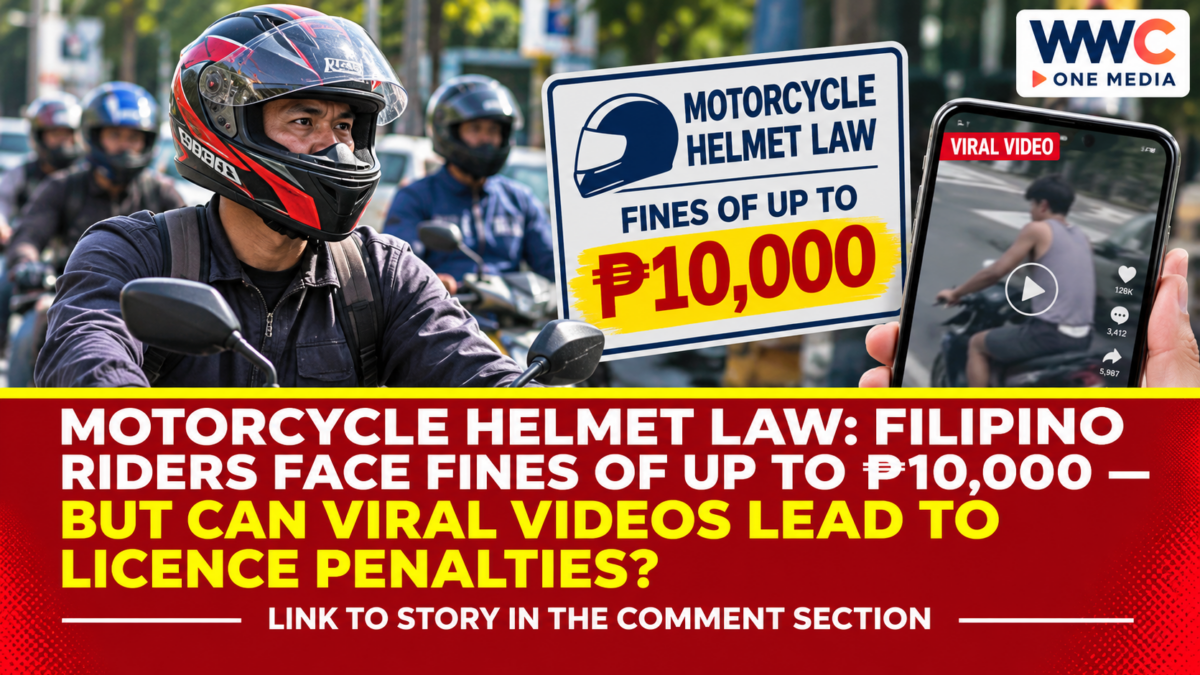
MANILA, Philippines — Filipino motorcycle riders who fail to wear compliant protective helmets face escalating financial penalties under Republic Act No. 10054, including driver’s licence confiscation for repeated violations. The motorcycle helmet law establishes responsibilities that extend to everyday commuters, professional riders and social media content creators.
As driving footage becomes increasingly accessible through social media, questions surrounding traffic enforcement, individual accountability and the responsible production of online content deserve closer examination.
For motorists whose livelihoods depend on their ability to drive, the consequences of established traffic violations can extend beyond the payment of fines.
Motorcycle Helmet Law: What Filipino Riders Must Know
Republic Act No. 10054, approved on March 23, 2010, requires motorcycle drivers and their passengers to use protective helmets that meet government standards.
Section 3 establishes that the requirement applies regardless of journey length or road type.
A brief trip within a neighbourhood does not automatically exempt a motorcycle rider from the requirement.
The statute identifies tricycle drivers as exempt from its mandatory helmet provision.
For motorcycle users, however, the obligation is clear: protective equipment is a legal requirement rather than a discretionary accessory.
The legislation also establishes progressively higher penalties for repeated violations.
The first offence carries a ₱1,500 fine, increasing to ₱3,000 for the second offence and ₱5,000 for the third.
A fourth or subsequent offence carries a ₱10,000 fine together with confiscation of the driver’s licence.
These penalties must be distinguished from any separate sanctions that may arise from other established traffic violations.
Viral Driving Videos and Administrative Accountability
Social media footage can raise questions about whether motorists are complying with applicable traffic regulations.
However, a video circulating online should not automatically be treated as a conclusive determination of administrative or criminal liability.
Important considerations include the identity of the person operating the vehicle, the circumstances surrounding the recording and the applicability of the relevant law.
A show-cause order provides an opportunity for the concerned party to respond to allegations before authorities determine the appropriate action.
WWC’s earlier coverage of the LTO investigation involving BINI member Mikha Lim and alleged distracted driving examined the distinction between a pending administrative investigation and a final determination of responsibility.
That distinction remains important when reviewing any driving incident involving online personalities.
Public criticism should not substitute for evidence, and social media popularity should neither shield an individual from legitimate enforcement nor justify unequal treatment.
Wearing Just Any Helmet Is Not Enough
The Motorcycle Helmet Act also addresses the quality of protective equipment available in the Philippine market.
The Department of Trade and Industry, through its standards authority, is responsible for implementing product testing and certification requirements.
Consumers should check whether motorcycle helmets carry the appropriate Philippine Standard (PS) mark or Import Commodity Clearance (ICC) certification.
Section 7(c) of the law establishes penalties for using, selling or distributing substandard or improperly certified helmets.
The statutory penalty starts at ₱3,000 for a first offence and increases to ₱5,000 for a second offence.
The legislation also requires motorcycle dealers to make compliant helmets available when customers purchase new motorcycle units, although customers retain the option of whether to purchase the offered helmet.
These provisions demonstrate that road safety involves responsibilities across the supply chain, including manufacturers, importers, retailers and consumers.
A helmet’s appearance, price or popularity should not replace proper verification of its compliance with applicable standards.
Why Content Creators Should Separate Filming From Driving
Content creation can involve promotional campaigns, commercial partnerships and entertainment productions.
However, producing material for an online audience does not create an exemption from traffic regulations.
WWC’s previous report examining an LTO investigation into a Tesla’s licence plate during a production shoot explored how vehicle-related requirements remain relevant when motorists participate in filming activities..
Practical measures include assigning filming responsibilities to someone other than the driver, recording stationary promotional segments in appropriate locations and checking protective equipment before travelling.
These precautions can help creators maintain their production schedules without introducing unnecessary risks to themselves or other road users.
Commercial partners can also encourage responsible practices by establishing road-safety expectations for sponsored content.
The objective should be prevention rather than simply avoiding public criticism after an incident.
Licence Penalties Can Have Economic Consequences
For delivery riders, field personnel and entrepreneurs who depend on motorcycles for transportation, the ability to operate a vehicle can be closely connected to income.
A financial penalty may create an immediate household expense. Restrictions on driving privileges, where lawfully imposed, could also interrupt work and increase transportation costs.
This makes compliance particularly relevant for individuals whose businesses depend on mobility.
WWC’s earlier report on administrative proceedings involving a motorcycle rider and a Ceres bus driver in Cebu provides additional context on how road incidents can progress from public controversy to formal regulatory proceedings.
Each investigation must nevertheless be assessed independently.
The consequences applicable to one motorist should not automatically be assumed to apply to another, particularly where the alleged violations and supporting evidence differ.
What Happens Next?
For any pending traffic investigation, the decisive developments are the official findings and any resulting administrative orders.
Until these are available, claims concerning an individual’s guilt, final penalties or permanent loss of driving privileges should not be presented as established facts.
For Filipino motorcycle users, the existing legal responsibilities do not depend on the outcome of a particular viral incident.
Wearing compliant protective equipment and operating vehicles responsibly remain essential obligations.
The challenge for motorists and content creators is ensuring that commercial opportunities, entertainment objectives and everyday convenience never take precedence over legitimate road-safety requirements.
Frequently Asked Questions
How much is the fine for riding a motorcycle without a helmet in the Philippines?
Under RA 10054, the fine is ₱1,500 for a first offence, ₱3,000 for a second, ₱5,000 for a third and ₱10,000 for fourth and succeeding offences.
Are motorcycle passengers required to wear helmets?
Yes. Section 3 covers both motorcycle drivers and passengers.
Can a motorcycle helmet violation lead to licence confiscation?
Yes. The statute expressly provides for licence confiscation for fourth and succeeding offences.
What helmet certification should Filipino riders check?
Riders should check for the appropriate Philippine Standard mark or Import Commodity Clearance certification.
Does an LTO show-cause order establish guilt?
No. An order requiring an explanation is distinct from a final determination of liability.