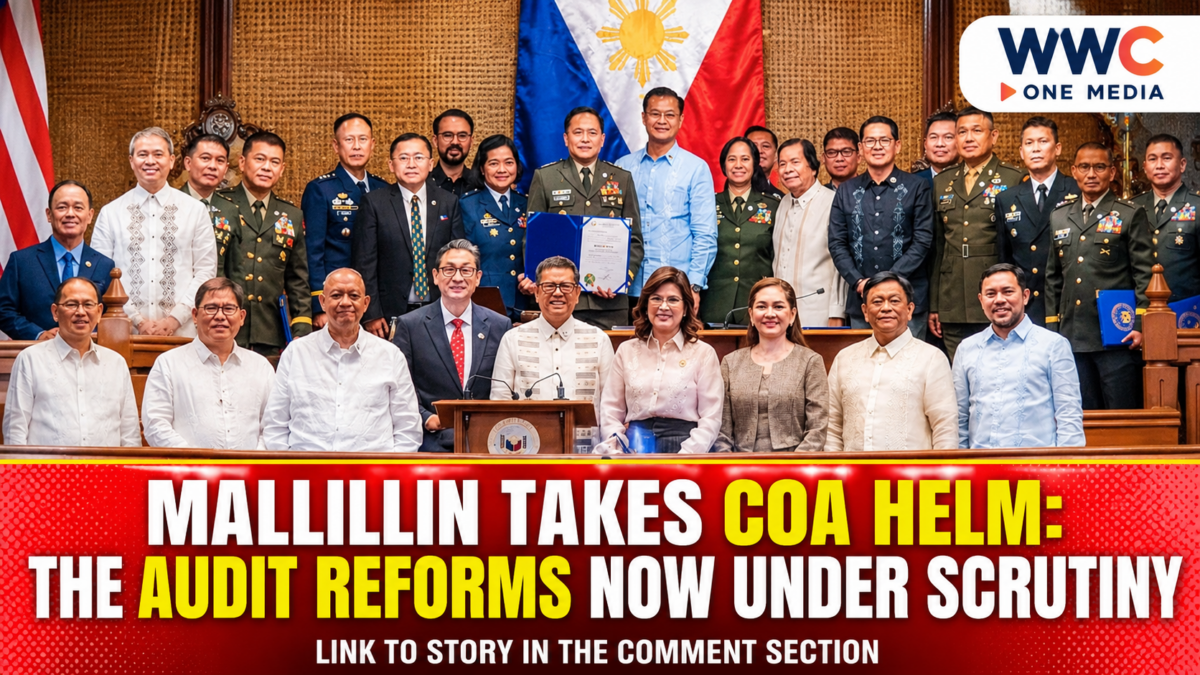
Douglas Michael Nocum Mallillin is now listed as chairperson of the Commission on Audit (COA), following the Commission on Appointments proceedings on November 23, 2026. The Senate committee handling his nomination recommended that the CA give its consent, with the proposed term set to expire on February 2, 2029. Commission on Audit+1
The appointment places a new leader at the head of the constitutional body responsible for examining how public money and government property are managed. Mallillin has outlined a modernization agenda involving artificial intelligence, paperless auditing and public access to audit information. But the larger measure of his leadership will be whether technology strengthens the institution’s independence and ability to hold public agencies accountable.
What the confirmation record establishes
The Senate’s published sponsorship speech for Mallillin’s nomination identifies him as the nominee for COA chairperson and records the recommendation of the Committee on Constitutional Commissions and Offices.
The committee said it had reviewed his qualifications and fitness for the post before recommending that the Commission on Appointments give its consent. The sponsorship speech also specified that the term would expire on February 2, 2029. Senate of the Philippines
The COA’s directory, updated November 23, lists Douglas Michael N. Mallillin as chairperson. This provides an official agency record of his current position. Commission on Audit
The distinction between a committee recommendation and the completed appointment process matters. A committee endorsement is part of the confirmation process; the constitutional framework requires the President’s appointment with the consent of the Commission on Appointments. The agency’s updated directory now identifies Mallillin as its chairperson.
Why the COA position carries constitutional weight
The Commission on Audit is not an ordinary executive department. Article IX-A of the 1987 Constitution identifies the COA, the Civil Service Commission and the Commission on Elections as independent constitutional commissions.
Article IX-D sets out the COA’s composition and appointment process. It provides for a chairperson and two commissioners, appointed by the President with the consent of the Commission on Appointments. It also states that appointments to vacancies are for the unexpired portion of a predecessor’s term. Official Gazette of the Philippines
The same article gives the COA authority to examine, audit and settle accounts involving government revenue, receipts, expenditures and the use of public funds and property. Its jurisdiction extends to national government agencies, local government units and other entities covered by the Constitution.
In practical terms, the commission checks whether public resources have been accounted for and whether government spending complies with applicable rules. Its findings can inform corrective action, administrative decisions and further proceedings by the appropriate authorities.
That mandate explains why the independence of the chairperson is not simply a matter of institutional reputation. Audit decisions must be based on records, applicable standards and evidence—not political alignment or pressure.
Mallillin’s professional background and proposed direction
COA’s official profile describes Mallillin as a certified public accountant and lawyer. Before becoming commissioner, he served as Director IV under the Office of the COA Chairperson, Deputy Commissioner of the National Telecommunications Commission and Associate Prosecutor at the Department of Justice. The agency also records his experience in private legal practice. Commission on Audit+1
The Senate sponsorship speech highlighted his background in accountancy, law and technology. It also outlined several proposals associated with his leadership agenda: artificial intelligence tools to help detect possible fraud, paperless audit processes and an open audit data portal for Congress and the public. Senate of the Philippines
These proposals point toward a more technology-assisted audit system. Artificial intelligence could help auditors identify unusual patterns in large volumes of transactions, while digital records could make it easier to trace documents and monitor the progress of an audit.
However, automated systems cannot independently determine whether a transaction is lawful or whether an official has committed wrongdoing. Technology can flag patterns for examination, but auditors must still assess the supporting documents, consider explanations and apply the relevant rules.
Why audit independence must remain central
Modernization can improve the speed and reach of government auditing, but it cannot replace independent judgment.
The Constitution’s designation of COA as an independent commission is intended to protect its work from improper influence. Its authority to examine public spending would have limited value if audit decisions could be directed by the officials or institutions being examined.
The Senate sponsorship speech itself placed emphasis on this principle, stating that technology must go hand in hand with independent judgment. It also described the responsibilities of COA leadership in terms of following evidence, hearing those concerned and applying consistent standards. Senate of the Philippines
For the public, the issue is straightforward: an audit system must be capable of examining government transactions regardless of which agency, official or political group is involved.
That does not mean every audit finding automatically proves wrongdoing. An audit observation, a notice of disallowance or a referral for further investigation has its own legal and administrative process. The commission must distinguish between documentation gaps, questioned transactions and matters that require additional action.
What happens next
Mallillin’s stated modernization proposals provide a direction for the new leadership, but the public will need measurable evidence of implementation.
Important indicators include whether audit reports become more accessible, whether digital systems reduce delays, whether auditors receive adequate training and whether technology improves the detection and documentation of irregular transactions.
The proposed open audit data portal will also require clear rules on public access, data accuracy, privacy and the handling of confidential information. Greater transparency should make public spending easier to examine without exposing information that must lawfully remain protected.
The term specified in the Senate committee’s sponsorship speech runs until February 2, 2029. That gives the new chairperson a defined period in which to pursue reforms while carrying out the commission’s existing constitutional responsibilities. Senate of the Philippines
The immediate challenge is therefore larger than introducing new software or automating paperwork. It is to demonstrate that modernization can make public auditing more effective while preserving the independence that gives COA its authority.
Frequently asked questions
Who is the new COA chairperson?
The Commission on Audit directory updated November 23, 2026, lists Douglas Michael N. Mallillin as chairperson. Commission on Audit
Until when will Mallillin serve as COA chairperson?
The Senate committee sponsorship speech states that his term will expire on February 2, 2029. Senate of the Philippines
What are Mallillin’s proposed reforms for COA?
The Senate sponsorship speech identifies artificial intelligence-assisted fraud detection, paperless audit processes and an open audit data portal as parts of his proposed agenda. Senate of the Philippines
Why is COA considered independent?
The 1987 Constitution identifies the Commission on Audit as an independent constitutional commission and gives it authority to examine and audit government accounts and public resources. Official Gazette of the Philippines
Does an audit finding automatically mean that an official committed wrongdoing?
No. Audit findings and observations must be assessed under applicable rules and procedures. A finding or referral should not automatically be treated as proof of criminal liability.