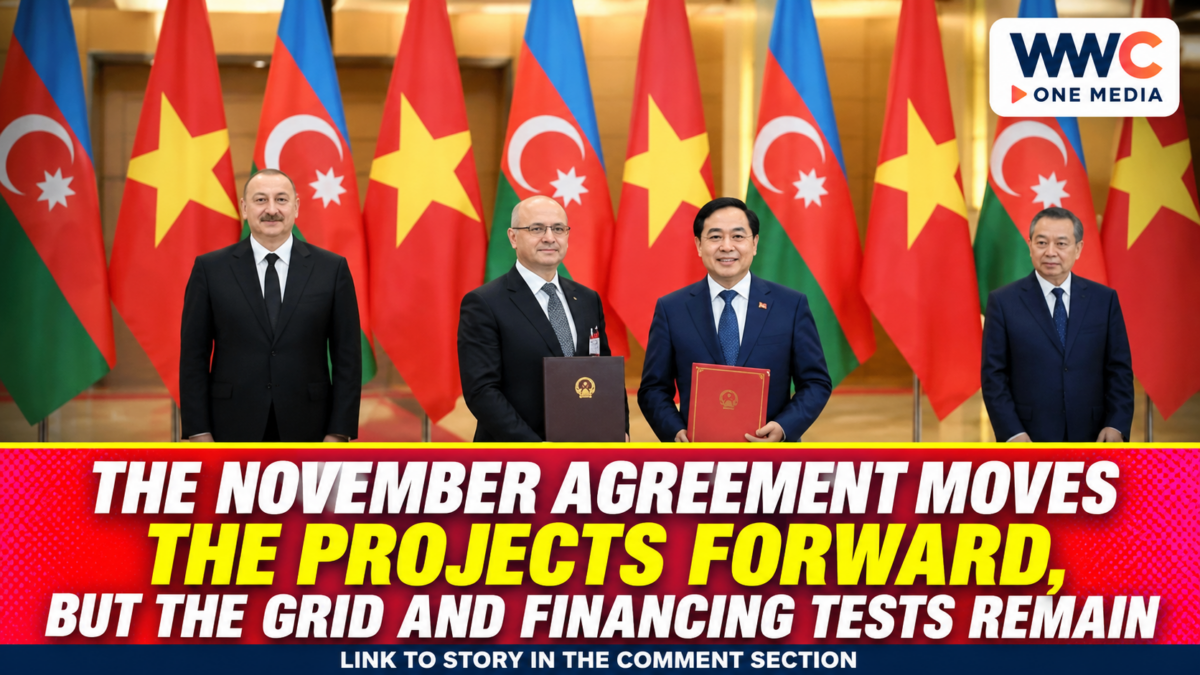
The November 21 implementation agreement gives the Azerbaijan–ROX Group partnership a more formal project-development framework. Azerbaijan’s Ministry of Energy and ROX Group exchanged the document in Hanoi during Azerbaijani President Ilham Aliyev’s official visit to Vietnam. Its stated scope covers the assessment, development and implementation of a solar power plant project and a wind power plant project in Azerbaijan.
The agreement follows a September memorandum that identified potential development of a 600-megawatt onshore wind project in Azerbaijan and a 200-megawatt solar project in the Nakhchivan Autonomous Republic. That earlier document also envisaged feasibility studies, an assessment of available grid capacity and examination of how some of the electricity could be integrated into Azerbaijan’s power network.
The distinction between the two documents matters. The September memorandum identified potential project capacity, while the November agreement advanced the cooperation framework. Neither announcement, by itself, establishes that the proposed plants have reached financial close or entered construction.
Azerbaijan’s October discussions with Vietnam’s Deputy Minister of Industry and Trade also identified wind opportunities near Baku and solar development in Nakhchivan. These discussions provide additional geographical context, but a final project site and completed permitting process should not be assumed without further documentation.
The partnership also sits within a wider renewable-energy investment environment. Vietnam’s domestic supply-chain development is illustrated by the wind turbine blade manufacturing project in Khanh Hoa Province, while the country’s broader investment requirements are examined in WWC’s coverage of green financing and electricity-grid expansion.
The commercial test for the Azerbaijan projects will be whether the parties can turn the framework into technically viable and financeable assets. That means verified project locations, completed feasibility work, grid-connection arrangements, financing commitments, permits and, eventually, construction milestones.
For regional context, Vietnam is also pursuing other international energy partnerships, including the Vietnam–Russia energy cooperation programme. These arrangements have different partners and project structures, but they illustrate how Vietnam is seeking to broaden its energy relationships.
For now, the Azerbaijan–ROX agreement is a documented step in project development, not evidence that the proposed wind and solar capacity is already generating electricity.