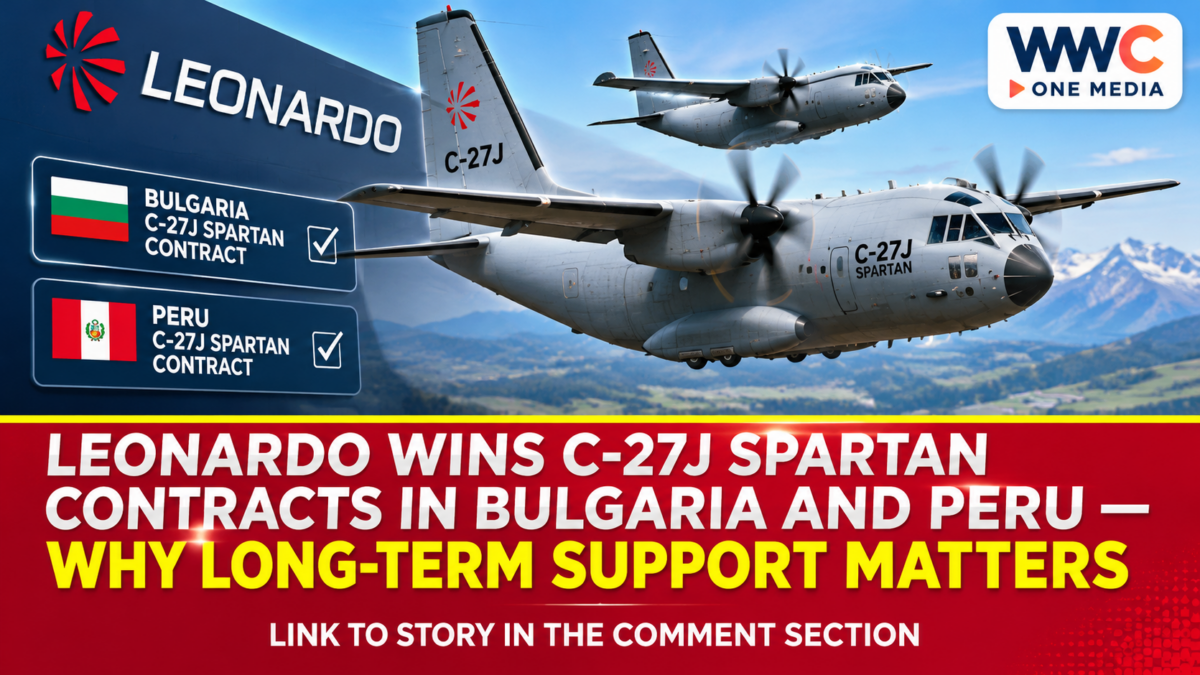
ROME — Leonardo S.p.A. announced two C-27J Spartan contracts on Nov. 23, 2026, covering aircraft modernisation in Bulgaria and long-term fleet support in Peru. The agreements extend the Italian aerospace group’s commercial relationships with existing customers without representing additional aircraft orders.
The announcements highlight a business opportunity that extends beyond the factory: maintaining and updating aircraft throughout their working lives. Neither announcement disclosed a contract value, leaving the financial contribution of the agreements uncertain.
C-27J Spartan contracts address different customer needs
Bulgaria has awarded Leonardo a modernisation contract covering its three Spartan transport aircraft. The programme focuses on updating onboard electronic systems, collectively known as avionics.
Leonardo says the changes are intended to improve safety and compatibility with evolving aviation standards. The announcement does not establish a completion date or provide a detailed payment schedule.
Peru, meanwhile, has signed a continuing support agreement for its existing fleet. The emphasis is on keeping aircraft serviceable through maintenance assistance, replacement components, repairs and personnel training.
The distinction matters for public procurement. An upgrade changes existing equipment, whereas a support agreement provides services intended to preserve its usefulness. Neither should be counted as a new aircraft delivery.
For public-sector customers, the relevant question is not merely whether a contract has been awarded. It is whether the services ultimately delivered meet the requirements for which public funds were committed.
Peru’s investment extends beyond buying aircraft
Leonardo’s May 14 announcement confirmed that Peru had ordered its fifth Spartan, with delivery expected in 2027. The manufacturer also reported that Peru had been using the aircraft since 2015.
The November support arrangement is separate from that acquisition. It illustrates why expanding a fleet creates a corresponding need to consider staffing, maintenance facilities and access to replacement components.
WWC analysis: A customer may benefit from retaining familiarity with an existing aircraft family rather than introducing a completely different platform. However, the actual savings depend on contractual pricing, training requirements and the condition of the equipment.
A larger fleet does not automatically translate into a proportionate increase in available transport capacity. Aircraft must undergo inspections and maintenance, and qualified personnel must be available to operate them safely.
This consideration also applies to the Philippines, as discussed in WWC’s coverage of the Philippine Air Force’s Black Hawk fleet expansion. The helicopter acquisition is a separate programme, but both cases illustrate the difference between acquiring equipment and sustaining it.
Why long-term aircraft services matter to Leonardo
The company’s previous contracts demonstrate that fleet support is an established part of its aerospace business. In December 2025, Leonardo announced a logistics agreement for Italy’s Spartan fleet and associated simulator, covering 2026 through 2028.
For manufacturers, service agreements can extend commercial relationships after the original sale. They may also provide opportunities to retain technical expertise and plan workloads over longer periods.
WWC analysis: The financial attraction of this business depends on the terms of each agreement. A multiyear arrangement can improve revenue visibility, but it can also expose the contractor to rising labour costs, component shortages and unexpected repair expenses.
The Bulgarian and Peruvian announcements do not establish whether payments depend on individual services, fixed contractual milestones or other performance measures. It would therefore be premature to estimate the profitability of either agreement.
The distinction between an announced commitment and its subsequent implementation is also relevant to WWC’s reporting on Japan’s expanding defence cooperation with the Philippines.
Leonardo’s financial results put the deals in perspective
Leonardo reported new orders of €23.3 billion and revenue of €15.3 billion for the first nine months of 2026. Its Nov. 5 results announcement placed the group order backlog at €60.4 billion.
The company raised its full-year order forecast to approximately €29.5 billion, from its previous estimate of around €28.2 billion. These are management projections, not completed annual results.
The reported growth also reflects the consolidation of the acquired Iveco defence business, meaning that not all of the increase represents organic expansion.
The November aircraft agreements were announced after the September reporting period. Their undisclosed values cannot be added to the published order backlog or used to calculate a revised revenue forecast.
WWC analysis: Investors should distinguish between order intake, outstanding contractual work and revenue earned through delivery. Even a substantial backlog does not guarantee a particular profit margin or cash-flow outcome.
The public value of dependable air transport
Leonardo identifies humanitarian assistance and disaster response among the roles performed by Peru’s Spartan fleet. Maintaining transport availability can therefore have consequences beyond defence procurement.
For governments, the challenge is balancing acquisition spending with the continuing resources needed to keep equipment safe and usable. Public accountability should encompass the cost of maintaining an asset as well as its original purchase price.
The wider regional importance of maintaining transport and support capabilities is also explored in WWC’s coverage of Australia–Philippines defence cooperation. These are distinct national programmes, rather than evidence that either country participates in the latest Leonardo contracts.
What happens next
Peru’s previously announced fifth-aircraft delivery remains expected in 2027. For the November agreements, further disclosures on contract duration, financial terms and implementation would help establish their commercial significance.
Until those details become available, the clearest conclusion is that Leonardo has expanded its work with two existing customers through different kinds of services.
The lasting measure of these investments will be the quality of the services delivered, not simply the number of contracts announced.
Frequently asked questions
What did Leonardo announce on Nov. 23, 2026?
It announced a Bulgarian Spartan avionics upgrade and a separate long-term support agreement with Peru.
How many Bulgarian aircraft are covered?
Leonardo identified Bulgaria’s three-aircraft fleet in its announcement.
When is Peru’s fifth Spartan expected?
The May 2026 announcement indicated delivery in 2027.
How much are the November contracts worth?
The two corporate announcements reviewed did not disclose their financial values.