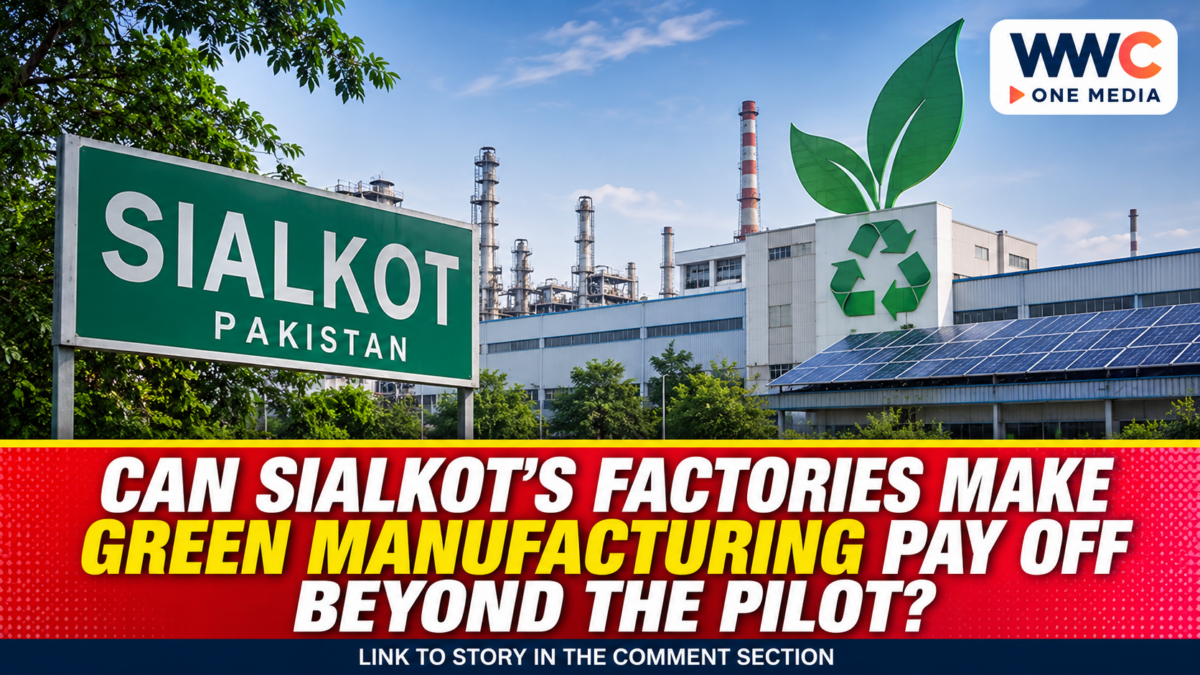
SIALKOT, Pakistan — A six-month industrial improvement programme involving six sports goods factories in Sialkot began on November 23, 2026, bringing together local industry organisations and productivity specialists to examine how manufacturing operations can use resources more efficiently.
The initiative, titled Development of Model Factories: Introducing Green Manufacturing in the Sports Goods Industrial Sector, involves the Sialkot Chamber of Commerce and Industry (SCCI), the National Productivity Organization (NPO), the Asian Productivity Organization (APO) and the Pakistan Sports Goods Manufacturers and Exporters Association (PSGMEA).
The programme puts a practical question before one of Pakistan’s established manufacturing communities: can factories reduce waste, energy and water consumption while maintaining the output, quality and delivery standards required by overseas buyers?
That question matters because environmental improvements are increasingly tied to the economics of manufacturing. Lower material losses and more efficient production can reduce operating costs, while better documentation of production practices may help suppliers respond to buyer requirements. But those benefits depend on implementation and evidence—not simply the announcement of a programme.
Green manufacturing moves from policy language to factory assessments
The initiative is designed around six selected manufacturing units. Its initial activities include on-site assessments by an APO project expert and the NPO technical team, with the stated purpose of identifying production bottlenecks, operational inefficiencies and opportunities to use resources more effectively.
The areas identified for attention include waste reduction, energy and water conservation, lean manufacturing and recycling. These are operational issues rather than abstract environmental targets: they concern how materials move through a factory, how production is organised and where avoidable losses occur.
The distinction is important. A factory may reduce waste by improving material handling, production planning or quality control. It may also lower energy use by reviewing equipment operation and production schedules. However, the scale of any improvement can only be established by comparing reliable measurements before and after changes are introduced.
The programme’s announced scope does not yet provide quantified targets for electricity, water, waste or emissions. Nor does the public information reviewed provide a baseline against which the six factories’ performance can be measured.
That leaves the project at an early implementation stage. Its assessments may identify opportunities, but they should not be presented as proof that participating factories have already become more sustainable.
Why the export industry has a commercial reason to pay attention
Sialkot has a long-established role in Pakistan’s sports goods manufacturing sector. PSGMEA says it was established in 1945 to represent sports goods and sportswear manufacturers and exporters, with its head office in Sialkot. The association describes its role as connecting local manufacturers with international commercial opportunities.
The export figures show why improvements in factory operations can matter beyond individual businesses. Pakistan Bureau of Statistics data for fiscal year 2023–24 recorded sports goods exports of US$396 million, down 2.09% from the preceding fiscal year. Football exports reached US$254 million, while gloves accounted for US$56 million.
A separate Pakistan Bureau of Statistics quarterly review for October–December 2025 reported sports goods exports, excluding toys, at approximately Rs58.58 billion, compared with Rs52.02 billion in the corresponding quarter a year earlier. The table recorded a 12.60% increase for that category.
These figures cover different reporting periods and measures, so they should not be treated as a single continuous growth trend. They do, however, demonstrate that sports goods remain a measurable part of Pakistan’s merchandise export activity.
For manufacturers competing for orders, production efficiency can influence the cost and reliability of fulfilling contracts. A business that uses materials more carefully may be better placed to manage input costs. A factory with fewer defects and less rework may also improve delivery performance.
Analysis: Green manufacturing becomes commercially meaningful when environmental improvements reinforce production discipline. If a factory spends less on wasted material, water or electricity while maintaining product quality, sustainability can become part of its cost-control strategy rather than a separate compliance exercise.
The real challenge is measuring improvements
The six-factory model offers a contained setting in which technical teams can examine production processes and recommend changes. Yet the value of the exercise will depend on what happens after the initial assessments.
A credible evaluation would compare each factory’s performance before and after interventions. Useful indicators could include electricity consumed per unit produced, water use per production batch, material waste as a share of inputs, defect rates, recycling volumes and production time.
Those measures would help distinguish genuine efficiency gains from changes caused by production volume, product mix or other operating conditions. For example, a factory using less electricity overall may simply have produced fewer goods. Energy use per unit of output offers a more meaningful comparison.
The same principle applies to water and material consumption. Absolute reductions can be useful, but production-adjusted indicators provide a clearer view of whether the manufacturing process itself has improved.
The programme announcement does not publish a monitoring framework or numerical performance targets. Public reporting of those details would help buyers, manufacturers and other industry participants assess whether the model can be replicated.
Skills and university participation could extend the impact
The project also includes students from partner universities, with the stated aim of strengthening links between academic institutions and industry.
That element could help connect classroom learning with practical factory problems. Students exposed to production systems may gain experience in process analysis, quality management, resource monitoring and industrial problem-solving.
The potential value is not limited to the six participating businesses. If technical knowledge is documented and shared, other manufacturers could learn from the methods tested during the programme.
Sialkot already has an institutional base for industry support. The Sports Industries Development Centre identifies itself as a facilitation centre of the Small and Medium Enterprise Development Authority under Pakistan’s Ministry of Industries and Production. It lists manufacturing facilities, technical advisory services, laboratory facilities, workshops and manpower training among its functions.
This wider support environment matters because a pilot programme is easier to scale when companies can access technical assistance, training and facilities after the initial project team has completed its work.
For a broader view of how production networks affect regional competitiveness, WWC has examined the changing structure of ASEAN supply chains and the competition for manufacturing investment. The lesson for export-oriented industries is that market access and manufacturing capability must develop together.
A model factory is only useful if other businesses can follow
The programme’s six-factory scope is a starting point, not evidence of an industry-wide transformation. The next challenge is to determine whether the methods can be adopted by manufacturers with different sizes, equipment, product lines and financial resources.
Some improvements may require little more than better workflow planning or staff training. Others could involve investment in machinery, water systems, energy controls or waste-treatment facilities. The cost and payback period will differ from one factory to another.
That is why transparent results matter. If participating factories can demonstrate lower resource use per unit of output without compromising quality, the findings could provide a practical case for wider adoption. If improvements require substantial capital, manufacturers will need clear information about costs, financing and expected operating benefits.
Pakistan’s broader trade environment also makes it important to distinguish business discussions from actual commercial outcomes. WWC’s report on Pakistan’s trade engagement with ASEAN and the role of business-to-business links examines how institutional cooperation needs to translate into practical opportunities for companies.
What happens next
The announced project activities include factory assessments from November 23 to 28, 2026. The wider initiative is described as a six-month programme, but the public information reviewed does not provide a detailed timetable for later interventions, final evaluations or publication of results.
The most useful next milestone would be the release of factory-level findings that explain what was measured, what changes were introduced and whether performance improved against an established baseline.
The participating organisations could also clarify whether the six factories will serve as demonstration sites for other manufacturers and how the lessons will be shared across the sector.
For now, Sialkot’s initiative is a structured attempt to connect productivity with more responsible resource use. Whether it becomes a model for the wider sports goods industry will depend on measurable factory results, practical costs and the ability of other businesses to reproduce the improvements.
Frequently asked questions
What is the green manufacturing programme in Sialkot?
It is a six-month initiative involving SCCI, NPO, APO and PSGMEA to introduce resource-efficient manufacturing practices in six selected sports goods factories.
Which factories are participating?
The public information reviewed identifies six selected factories but does not publish their names.
What improvements will the programme examine?
The announced areas include waste reduction, energy and water conservation, lean manufacturing, recycling and the identification of production bottlenecks.
Has the programme already reduced pollution or production costs?
No verified reduction figures were published in the material reviewed. The initial factory assessments are intended to identify opportunities for improvement; measurable results would need to be reported separately.
Why does green manufacturing matter to sports goods exporters?
More efficient use of materials, energy and water can help manufacturers manage operating costs and production processes. Documented environmental performance may also help suppliers respond to buyer requirements, although commercial benefits depend on actual implementation and market conditions.