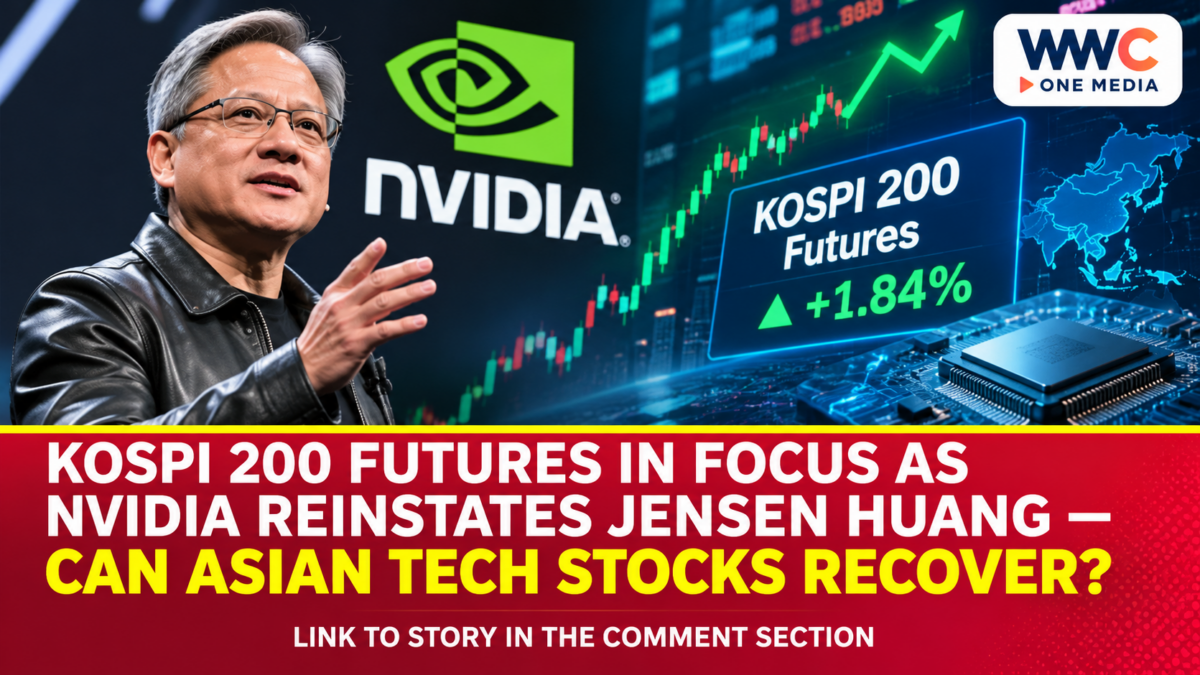
NVIDIA Corporation has reinstated Jensen Huang as its chief executive officer, bringing fresh attention to South Korea’s KOSPI 200 futures and the wider outlook for Asian semiconductor investments. The company announced his return on Nov. 23, 2026, following a board decision that took effect on Nov. 22.
The leadership reversal introduces another important development for investors assessing the commercial outlook for artificial intelligence infrastructure.
However, the restoration of executive continuity and the recovery of technology stock valuations remain separate economic questions.
While Huang’s return could influence market confidence, a lasting recovery would require evidence that semiconductor demand, corporate profitability and infrastructure spending remain sustainable.
KOSPI 200 Futures and the Importance of Market Confidence
South Korea’s equity derivatives market provides a useful framework for examining how changing investment expectations can translate into rapid price movements.
KOSPI 200 futures allow market participants to obtain exposure to changes in the value of the underlying stock index through financial contracts.
The Korea Exchange also operates safeguards designed to limit the immediate impact of substantial futures price movements on programmed stock market orders.
An official exchange notice dated Nov. 6, 2026, recorded a 6.77% decline in the relevant KOSPI 200 futures contract, prompting a temporary restriction on programmed selling.
The intervention lasted five minutes.
A separate exchange notice from June 1 demonstrates that comparable safeguards can also apply when futures prices rise sharply.
These mechanisms are relevant to understanding the earlier technology stock selloff and trading disruptions across Asian markets.
However, temporary trading restrictions cannot determine whether an underlying company’s shares are fairly valued.
Nor does a substantial movement in futures necessarily establish an equivalent change in the closing value of the underlying stock index.
What NVIDIA’s Board Has Actually Decided
NVIDIA’s latest Form 8-K confirms that its directors restored Huang to the positions of president, chief executive officer and board member.
The decision reverses the leadership arrangement established after the board accepted his resignation on Nov. 11.
Colette Kress, who subsequently served as interim chief executive, will continue as executive vice-president and chief financial officer.
Harvey C. Jones will remain board chair.
NVIDIA also disclosed that the reinstatement received unanimous board approval.
Nevertheless, the company indicated that an existing independent board investigation would continue.
It also confirmed plans to recruit a chief compliance officer and retain its national security and export control oversight structure.
For investors, the distinction is significant. Resolving an executive appointment does not automatically resolve every governance, regulatory or commercial uncertainty facing a corporation.
The continued oversight arrangements could therefore be as relevant to the company’s long-term operating environment as the identity of its chief executive.
Strong Earnings Provide a Separate Measure of AI Demand
NVIDIA’s latest financial performance offers additional context for evaluating the outlook for semiconductor investments.
For the third quarter of fiscal 2027, which ended Oct. 25, the company generated US$115.8 billion in revenue, representing an annual increase of 103%.
Its data centre operations accounted for US$107.6 billion in quarterly revenue, an increase of 110% from the corresponding period a year earlier.
NVIDIA also reported generally accepted accounting principles, or GAAP, net income of US$65.3 billion.
For the following quarter, management projected revenue of US$130 billion, subject to a margin of 3% in either direction.
That forecast excludes data centre computing revenue from China.
The financial disclosures indicate substantial business activity, but historical growth and management forecasts cannot guarantee future share price performance.
This distinction was examined in WWC’s earlier coverage of Asian AI market weakness despite NVIDIA’s strong quarterly earnings.
A technology company can continue expanding its revenue while investors simultaneously reassess the price they are prepared to pay for its shares.
Why a Market Rebound May Not Guarantee a Recovery
From an investment perspective, changes in executive leadership can influence expectations surrounding corporate strategy, business relationships and operational continuity.
However, those expectations must eventually be supported by measurable financial outcomes.
Consider a hypothetical semiconductor manufacturer whose shares appreciate following positive news from a major technology customer.
The manufacturer’s longer-term financial performance would still depend on production orders, operating costs, competitive conditions and the prices customers are prepared to pay.
If expectations increase faster than underlying profitability, the company’s valuation could become more vulnerable to subsequent disappointments.
WWC analysis: A sustainable recovery in technology shares would be more persuasive if accompanied by consistent earnings performance and evidence that customers can generate commercially viable returns from AI infrastructure.
A temporary improvement in investor confidence should not be mistaken for confirmation that all financial risks have disappeared.
The same principle applies to companies operating outside the semiconductor industry but benefiting from wider technology investment.
What Philippine Investors Should Understand
Developments in South Korea and other Asian technology markets offer useful context for Philippine investors evaluating international exposure.
Investors holding foreign equity funds may be exposed to semiconductor companies even when their investments are not directly concentrated in individual technology shares.
Currency movements, portfolio composition and fund expenses could also influence their eventual returns.
The recent discussion surrounding Taiwan’s stock market and emergency stabilisation measures illustrates why market safeguards and long-term investment performance should be assessed separately.
For Philippine businesses evaluating AI projects, the more practical consideration is whether investments in computing equipment and software can produce measurable operational improvements.
Share price movements abroad do not automatically establish changes in Philippine manufacturing orders, employment or corporate earnings.
Those consequences would require separate company disclosures and economic data.
What Happens Next?
NVIDIA’s reinstatement announcement establishes who will lead the company, but subsequent disclosures will be necessary to evaluate the effectiveness of its governance arrangements and commercial strategy.
Official Korea Exchange trading records will also be important in determining the magnitude and duration of any movement in South Korean equity futures.
Investors evaluating the wider semiconductor sector should distinguish confirmed financial results from earnings projections and short-term market reactions.
Ultimately, the durability of a technology market recovery will depend on business performance rather than executive appointments alone.
Frequently Asked Questions
What are KOSPI 200 futures?
They are financial derivatives that provide exposure to movements in South Korea’s underlying KOSPI 200 stock index.
Has Jensen Huang returned as NVIDIA CEO?
Yes. NVIDIA’s board reinstated him effective Nov. 22, 2026, and publicly announced the decision on Nov. 23.
What is a South Korean stock market sidecar?
It is a temporary restriction on certain programmed stock market orders following qualifying movements in equity index futures.
Does NVIDIA’s leadership change guarantee higher semiconductor stock prices?
No. Share prices remain dependent on earnings expectations, valuation, market conditions and other investment risks.
How much revenue did NVIDIA report in its latest quarter?
NVIDIA reported US$115.8 billion in revenue for the third quarter of fiscal 2027, which ended Oct. 25, 2026.