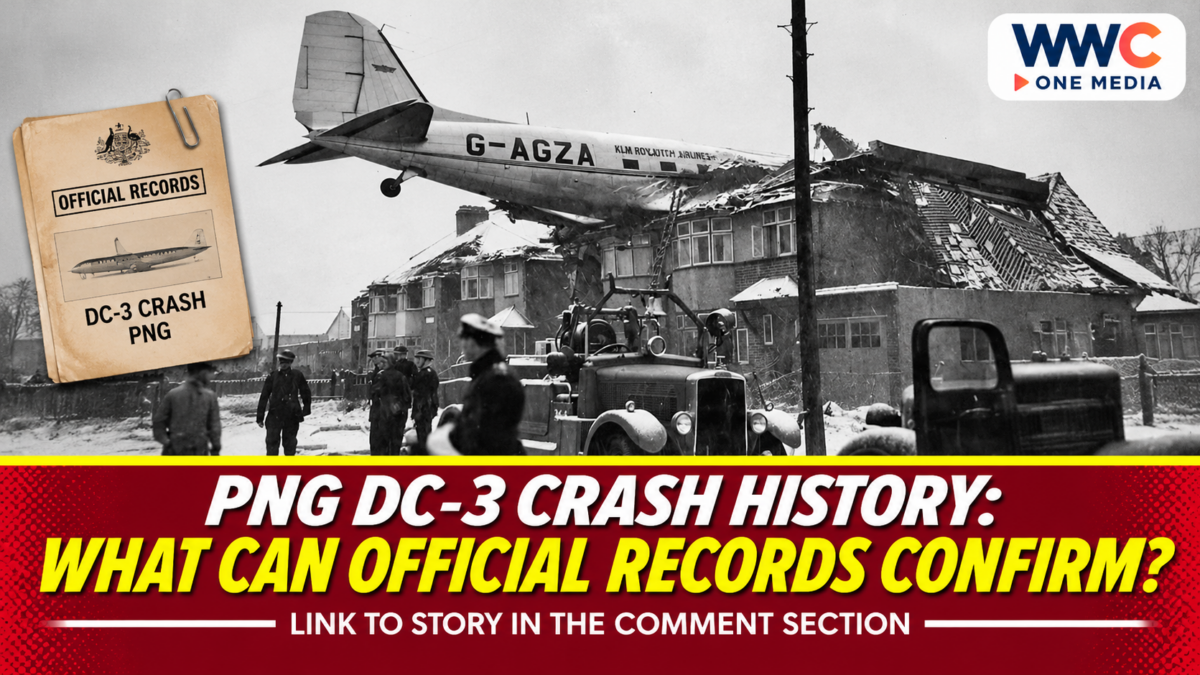
PORT MORESBY, Papua New Guinea — Nov. 22, 2026. A renewed account of a historic Papua New Guinea Defence Force DC-3 accident near Nadzab has raised a question that cannot be settled by a retrospective headline: where is the original accident record? The government investigation material available for this editorial review explains how aviation safety inquiries should be assessed, but an incident-specific military report has not been obtained.
That distinction is important. Aviation archives identify a Douglas C-47/DC-3 associated with a November 1987 event near Nadzab, yet their descriptions cannot substitute for a military occurrence report, aircraft movement record or contemporaneous official statement. The reported fate of the aircraft and the number of people aboard remain outside this article’s verified findings.
PNG DC-3 Crash: The Missing Primary Document
The immediate reporting challenge is to match the historical account with an authoritative incident record. A useful official file would identify the aircraft registration, operator, date, location and occupants. It would also distinguish the initial occurrence notification from any subsequent technical conclusions.
Those distinctions prevent a common error in anniversary reporting: treating details repeated over decades as though repetition itself establishes authenticity. Even where independent catalogues agree, their common account may ultimately derive from the same earlier report.
The accident described in the historical lead involved a military aircraft. That matters because a military inquiry and a contemporary civilian aviation investigation may operate under different legal powers and archival arrangements. Finding a current civil regulator’s investigation guidance does not demonstrate that the same agency conducted an inquiry into an earlier defence-force flight.
What Papua New Guinea’s Safety Framework Establishes
Papua New Guinea’s Accident Investigation Commission (AIC) describes itself in its published investigation reports as an independent statutory body responsible for investigating civil aviation accidents and other safety matters within its remit. The commission explains that the purpose of a safety investigation is to identify risks and support prevention, rather than apportion legal blame.
This is a valuable principle for understanding accident reporting, but it has a strict limit here. The AIC’s modern published explanation does not constitute a finding about an individual military DC-3 incident decades earlier.
An investigator may analyse aircraft performance, weather, maintenance, crew actions and airport conditions where the evidence warrants it. These are possible categories of examination, not explanations of what happened near Nadzab.
WWC has applied a comparable distinction in its coverage of the pending findings in an Air India crash investigation. That separate case demonstrates why an investigation’s existence and its final causal determination must not be confused.
Why Survival Accounts Need Careful Verification
A report that occupants survived an aircraft accident can be historically significant. But a claim about the number who walked away, the extent of injuries or the occupants’ identities needs an independently verifiable document before publication as fact.
A manifest, military incident statement or hospital record could establish different parts of that account. A photograph of wreckage alone would not establish a complete passenger count or prove that nobody required treatment.
There is also a difference between surviving impact, escaping the damaged aircraft and leaving without injury. These statements are not interchangeable. Without the original file, none should be chosen simply because it makes a more dramatic headline.
The editorial challenge resembles WWC’s examination of the Korean Air Flight 858 search: an initial report or suspected identification must be separated from what official evidence conclusively establishes. The two incidents are otherwise unrelated.
What Aircraft Records Could Reveal
Historical aircraft records can establish an airframe’s identity through its serial number and successive registrations. For military equipment, transfer and disposal files may also document when an aircraft entered or left a country’s inventory.
An incident report would answer a different question: what occurred on a particular flight, and what investigators concluded. A fleet history can help locate the correct archive, but it cannot independently confirm a mechanical failure or the pilot’s response.
The evidence should therefore be assembled in sequence. First comes authoritative identification of the aircraft and flight. Next are contemporaneous statements and technical records. Finally comes any formal investigation finding, with its date and scope clearly identified.
That approach guards against mistaking a suggested explanation for an official probable cause. It also leaves space for later corrections when an original record differs from frequently repeated accounts.
Why a Historical Crash Still Matters
Aviation safety depends on retaining lessons across generations of aircraft and operations. An event’s age does not eliminate the value of accurately documenting its circumstances, particularly when researchers or families are seeking a reliable history.
Analysis: A historical feature can contribute more than a dramatic survival narrative by showing readers what the archive confirms, what it cannot confirm and which records would resolve the gap. But the absence of a publicly located accident report is not evidence of a cover-up or improper conduct.
WWC’s report on a Jordanian military helicopter training accident likewise distinguishes an official occurrence announcement from a later technical conclusion. It is a separate incident, not evidence about the reported DC-3 flight.
What Happens Next
The next editorial step is to obtain an incident-specific record from a relevant Papua New Guinea Defence Force archive or an official historical aviation collection. A record should identify the flight unambiguously and show which details are contemporaneously documented.
Until that happens, the reported November 1987 date, registration, cause and account of four occupants should remain verification leads rather than published findings. The current evidence supports an explainer about the verification gap, not a definitive reconstruction of the flight.
A future update can describe the crash itself only when the supporting primary records are available to inspect. The priority is accuracy over a compelling but unproven narrative.
Frequently Asked Questions
Has WWC verified the original DC-3 accident report?
No. An incident-specific military investigation record was not obtained for this review.
Was the aircraft a civilian or military DC-3?
The historical account identifies it as a Papua New Guinea Defence Force aircraft, but that identification still requires an incident-specific primary record for publication as a verified fact.
Did four people survive the crash?
That is a claim in the historical lead, not independently confirmed here by an official manifest or accident report.
Did an engine failure cause the accident?
No official incident-specific cause finding was obtained, so a particular mechanical explanation is not presented as established.
What would allow WWC to publish a definitive history?
A contemporaneous military occurrence report, a formal investigation finding or another authenticated government record identifying the aircraft, date, occupants and outcome.