
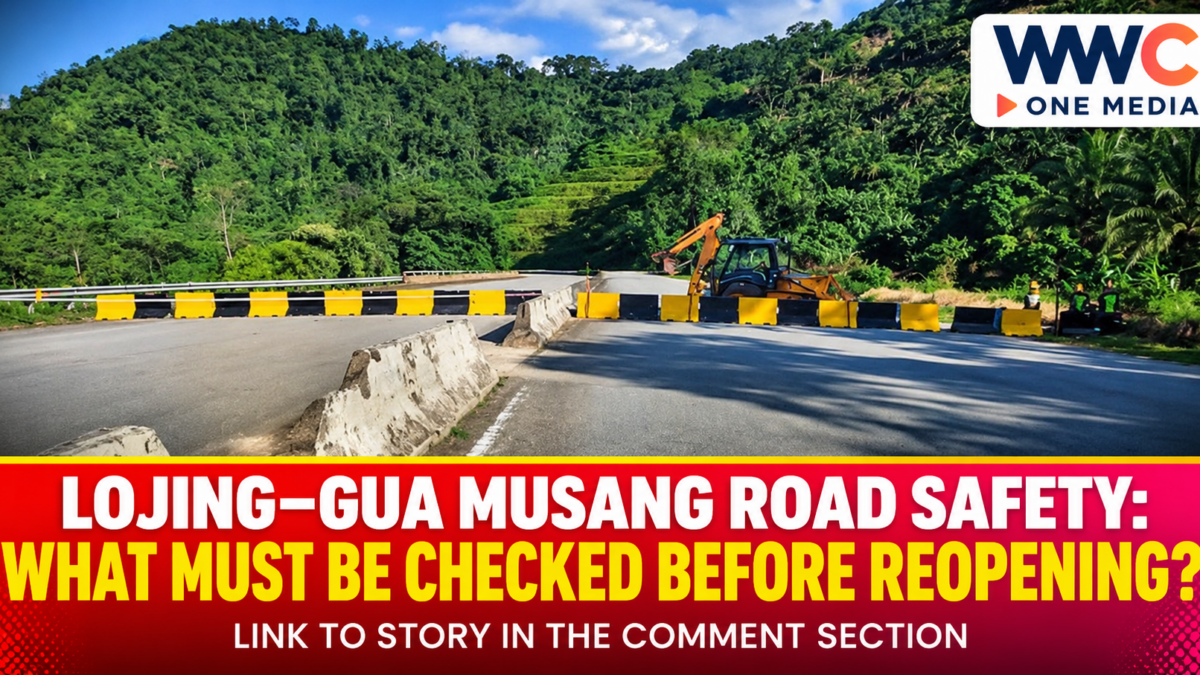
Editorial status: HOLD — not cleared for publication. The reported November closure at the Lojing–Gua Musang road has not been independently confirmed from a directly opened Public Works Department notice. An October account of damage at the same section also needs to be reconciled against the November reports.
Malaysia’s federal-road maintenance framework offers a clear test for evaluating any slope-related disruption: road managers must distinguish emergency traffic control from the structural work needed to restore safe use. The Ministry of Works identifies slope collapses and interrupted road access as events covered by emergency maintenance, alongside routine inspection and drainage work.
For motorists travelling through a hillside corridor, the most important question is not simply when barriers disappear. It is what technical inspection, remedial work and official reopening instruction support that change. The specific condition and present access restrictions on the Lojing–Gua Musang route still require a current original advisory.
Lojing–Gua Musang Road Safety Depends on Official Advisories
The reported issue concerns a road connecting communities in Kelantan with the Cameron Highlands area. However, the exact scope, direction and start time of the November traffic restriction must be checked against the public works authority’s original dated statement before those details enter the published news lead.
A lane closure is not interchangeable with a complete road shutdown. Neither should a previous warning be treated as proof of the road’s current condition. Traffic instructions can change after inspections, temporary stabilisation or the discovery of new damage.
This is particularly important when authorities are assessing a slope beside a carriageway. The absence of an immediate incident does not establish that nearby ground is stable, just as the presence of a visible crack does not, without examination, identify the precise cause.
WWC’s earlier report on Selayang roadside safety considered a different hazard. Its relevant lesson is that an emergency response record does not replace the technical findings needed to understand why road users were exposed to danger.
What Malaysia’s Road Maintenance Rules Require
The Ministry of Works divides federal-road maintenance into routine, periodic and emergency categories. Its official guidance describes routine activity such as repairing potholes, attending to shoulders and drains, and conducting scheduled inspections.
Periodic maintenance covers work on road surfaces and other road facilities, while emergency response can include clearing obstructions, managing traffic and providing temporary access following a slope failure or other disruption.
Signs protect motorists but do not certify a repaired slope as safe.
The ministry also recognises the role of concession companies in carrying out assigned maintenance work. That general framework does not establish the precise contractor responsibilities, work orders or completion status for this particular location. Those would require incident-specific documentation.
For comparison, WWC’s Bukit Raja highway flood assessment describes a separate Malaysian road-access risk. Flooding and slope movement differ physically, but both demonstrate the importance of dated operational advisories instead of assuming a route is available because it was open earlier.
What Slope Engineers Need to Establish
Malaysia’s Public Works Department has published project-risk guidance that recognises slope failure as a potential engineering hazard. Its recommended risk-management approaches include slope-stability analysis and measures for controlling surface runoff when appropriate.
Those are examples of engineering tools, not findings about the Lojing–Gua Musang site. The information reviewed does not identify the subsurface conditions, the origin of the reported cracking or whether a drainage defect caused a failure there.
A defensible engineering review would distinguish observed damage from the mechanism behind it. Ground movement, drainage performance, road foundations and changes over time may need different types of measurements. The appropriate tests must be selected by qualified personnel who can inspect the site.
The public should not be given an estimated reopening date merely because warning signs have been installed. A reasonable reopening decision should be supported by current conditions and documented safety measures, rather than inferred from publicity about an initial inspection.
Monsoon Conditions Add an Important Context
Malaysia’s Meteorological Department describes the northeast monsoon as normally running from November to March. The agency explains that this period brings heavy rain particularly to east-coast Peninsular Malaysia and parts of East Malaysia.
That seasonal pattern makes weather monitoring relevant, but does not establish the cause of this reported damage.
The Department of Irrigation and Drainage provides official rainfall observations through Public InfoBanjir. Such observations can contribute to an assessment, but a state-wide data feed should not be substituted for site-level investigation or a current road-use instruction.
The wider distinction between weather information and the actual condition of public infrastructure also features in WWC’s Bentong flood preparedness coverage. That article concerns another area; its measurements and evacuation information do not describe Lojing.
What the October and November Accounts Must Resolve
A particularly important verification issue is the chronology. Public reporting dated Oct. 22 described a slope failure at the same FT185 section, with measurements that match those being circulated in November. Those matching details raise a question about whether the latest reports describe a new event, a deterioration of an existing site or a later traffic-control decision.
This draft does not choose between those possibilities. A direct October inspection record, the dated November closure notice and any interim maintenance updates are needed to establish the sequence reliably.
Without the underlying records, it would be premature to claim negligence, to say officials ignored a warning, or to assign the damage to a particular weather event.
What Happens Next
The editorial requirement is a directly inspectable, dated notice from the Gua Musang Public Works Department or another responsible road authority establishing the current lane restriction and the timing of any change. The next useful records would identify the results of engineering assessments, the traffic-management arrangement and an authorised reopening notice.
Motorists should rely on current official road signs and instructions, not on an article describing a historical closure. Until the relevant original documents are verified, this explanatory draft should remain unpublished as an incident news report.
Frequently Asked Questions
Is the Lojing–Gua Musang road closed now? The current restriction could not be independently verified from a directly opened original road-authority notice in this review. Check the responsible road authority before travelling.
Does a lane closure mean the entire route is shut? No. Lane restrictions and complete closures are different traffic arrangements; the exact scope needs a dated official instruction.
What does emergency road maintenance cover in Malaysia? Ministry of Works guidance includes traffic management and temporary access arrangements after slope failures or other road disruptions.
Did monsoon rain cause the reported damage? No cause has been independently established from a site-specific original engineering record in this review.
What would justify reopening an affected lane? A current safety assessment, necessary remedial work and an explicit road-authority notice would provide the evidence needed to explain an authorised reopening.










