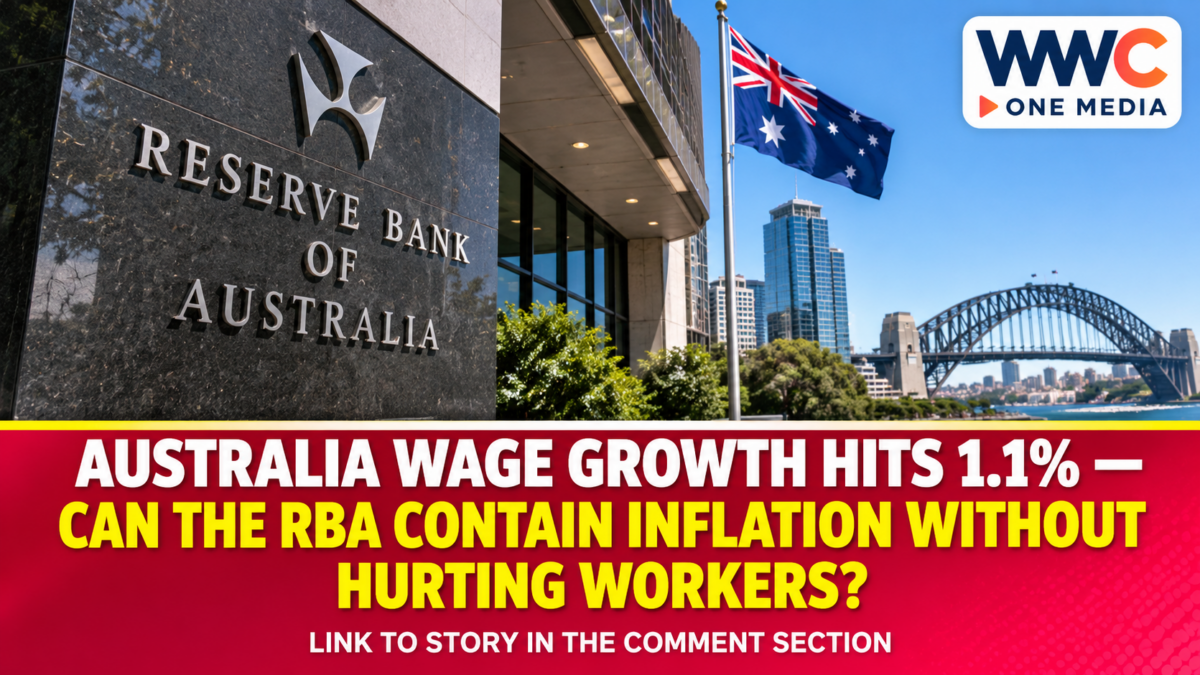
Australian wages rose at their fastest quarterly pace in nearly three years during the September 2026 quarter, with the Wage Price Index increasing 1.1%, the Australian Bureau of Statistics reported on Nov. 18. Annual wage growth accelerated to 3.5%, adding a fresh consideration for the Reserve Bank of Australia as it confronts consumer inflation above its target.
The rise gives some workers better nominal pay, but it also complicates the economic picture. Inflation was 4.3% in the year to September, so higher wages do not automatically mean households have recovered their purchasing power. Nor does one quarter of pay data establish that another interest-rate increase is inevitable.
Australia wage growth accelerates after a slower quarter
The seasonally adjusted Wage Price Index rose 1.1% from June to September, compared with 0.7% in the June quarter. It was the strongest quarterly increase since the December quarter of 2023. Annual growth reached 3.5%, compared with 3.2% in June 2026 and 3.4% in September 2025.
The index tracks changes in wage rates for a consistent set of jobs, rather than changes in total earnings caused by longer hours, promotions or shifts in the kinds of jobs people hold. That distinction makes it useful for analysing labour costs, but it does not describe every worker’s individual pay packet.
A strong quarter also should not be mistaken for a return to the fastest annual wage growth of recent years. The official series shows annual growth reached 4.3% in late 2023. September’s annual pace remains below that earlier peak.
Why it matters: Businesses making staffing and pricing decisions now have another sign that wage costs are rising. Whether those costs feed into customer prices depends on productivity, competition and how firms manage margins.
Public-sector pay rises faster than private wages
Public-sector wages increased 1.3% in the quarter and 3.9% over the year. Private-sector wages rose 1.0% in the quarter and 3.4% annually. Annual public-sector wage growth exceeded the private sector for a seventh consecutive quarter.
The difference matters because wage-setting processes are not uniform. Public and private employers operate under different contracts, bargaining arrangements and budget constraints, and wage changes can be concentrated in particular periods.
It would be inaccurate to claim that every public employee received a 3.9% raise or that every private employee received 3.4%. Those are index movements across measured jobs, not an individual pay guarantee.
Analysis: The split suggests policymakers should examine which wage changes reflect scheduled agreements and which signal broader competition for workers. A sector-wide statistic alone cannot distinguish a one-off timing effect from persistent acceleration in labour costs.
Inflation is still running ahead of annual pay growth
Australia’s Consumer Price Index rose 4.3% in the 12 months to September, up from 4.0% in August. Trimmed-mean inflation, which reduces the influence of large individual price movements, reached 3.6% annually. Both measures were above the RBA’s 2%–3% inflation target range.
The contrast with 3.5% annual nominal wage growth helps explain why workers can see higher pay without necessarily feeling better off. The wage and consumer-price measures cover different concepts and periods, so their simple percentage difference should not be advertised as an exact personal real-wage figure.
Household conditions also vary. Renters, borrowers and people with different spending needs face different costs. The September consumer-price release recorded annual housing inflation of 5.2% and transport inflation of 8.7%, illustrating why the headline inflation rate does not capture every family’s experience.
WWC previously examined Australia’s weak consumer-confidence reading. The wage release adds evidence about pay rates, but it does not establish that pessimism has already reversed or that household financial pressures have disappeared.
Why the RBA cannot read wages in isolation
The Reserve Bank increased its cash-rate target by 25 basis points to 4.85% on Nov. 3. Its published decision pointed to elevated, broadly based inflation, domestic capacity pressure and higher fuel and other commodity prices. The bank said inflation was expected to remain elevated through much of 2027.
That decision preceded the Nov. 18 wage release. The new figures can inform subsequent policy deliberations, but they were not the cause of an earlier decision.
WWC’s report on Australia’s November rate increase and the divided RBA vote details the policy debate. The central bank’s November outlook expects higher interest rates to slow spending while unemployment rises further, making the trade-off between inflation control and economic activity particularly important.
Analysis: Faster wage growth can support consumption and add to business costs simultaneously. The RBA must judge whether the pressure is persistent, whether businesses are passing it through to prices and whether slower demand is already reducing inflation risks. No published decision commits it to a new rate increase based on this release alone.
What rising pay could mean for spending and businesses
For households, a pay increase can support spending only to the extent it exceeds the costs they face and is not absorbed by other obligations. Borrowing costs, transport expenses and housing bills can still limit discretionary purchases.
WWC’s earlier coverage of Australia’s latest household-spending report offers another measure of demand. Actual spending and wage-price indexes answer different questions: one records expenditure, while the other tracks the price of labour.
For employers, higher labour costs need not translate into an equivalent increase in retail prices. Productivity improvements can absorb some costs, while competition may restrain price changes. Other firms may have less flexibility.
For Philippine businesses trading with Australia, these developments are relevant to their customers’ spending conditions and operating environment. The official Australian figures alone do not establish a particular peso exchange rate, contract adjustment or new Philippine inflation effect.
What happens next
The next Australian Wage Price Index release, covering December 2026, is scheduled for Feb. 23, 2027. Between now and then, further inflation, employment and spending figures will help assess whether September’s faster wage growth persists or proves temporary.
The RBA will have to assess those reports alongside its existing forecast and the impact of earlier rate increases. The verified conclusion on Nov. 18 is clear: wages have accelerated, but inflation remains higher and the direction of the next rate decision is not predetermined.
FAQ
How much did Australian wages rise in September 2026?
The seasonally adjusted Wage Price Index increased 1.1% in the September quarter and 3.5% over the preceding 12 months.
Were public-sector wages rising faster?
Yes. Public-sector wages increased 1.3% quarterly and 3.9% annually, versus private-sector increases of 1.0% and 3.4% respectively.
Did wages grow faster than inflation?
Annual wage-index growth was 3.5%, while annual consumer-price inflation was 4.3% in September. Those measures do not describe every individual’s circumstances.
Will Australia raise interest rates again because of the wage data?
No further move can be concluded from this release alone. The RBA considers inflation, labour conditions, demand and the effects of previous policy decisions.