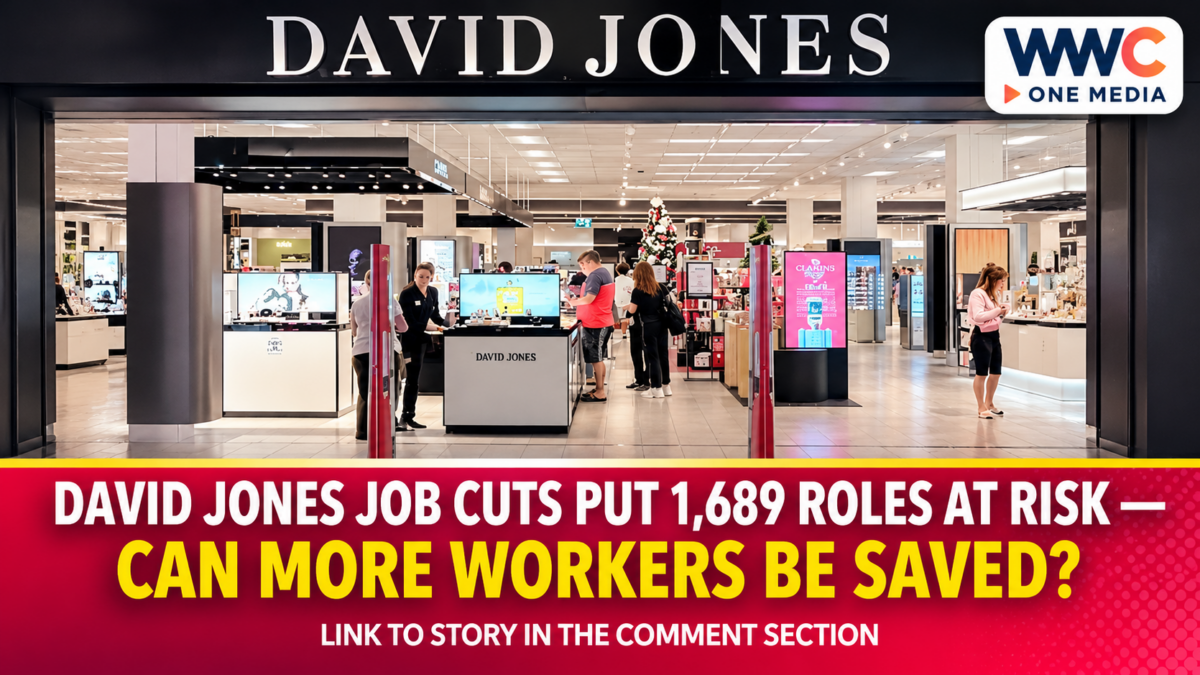
SYDNEY — Australia’s retail workers’ union said on Nov. 18 that 1,689 directly employed David Jones workers face job losses across 19 stores selected for closure, with only 170 redeployment opportunities offered within the company. The latest David Jones job cuts announcement puts employee rights and the future of the surviving stores at the centre of the department-store group’s insolvency process.
The figures describe positions at risk and offers made, not an independently verified list of completed dismissals. They also exclude any separately employed concession workers whose roles could be affected, making the actual employment consequences an important unresolved question.
David Jones Job Cuts: What the Union Confirmed
The Shop, Distributive and Allied Employees Association (SDA) identified 1,689 positions among direct employees in the 19 stores earmarked to close. It said the business was offering 170 redeployments to other David Jones stores, a fraction of the affected workforce.
Subtracting the offers from the jobs at risk produces 1,519 positions without an identified internal redeployment offer. That is a calculation, not a final confirmed redundancy total: offers may be accepted or declined, and other employment arrangements could change before individual separations occur.
Bernie Smith, the union’s national vice-president and New South Wales secretary, said its priority was to find new roles for affected employees and preserve employment in the continuing business. The union’s figures represent its account of consultations with the receivers; a named-by-store list of completed terminations was not available in the original records reviewed.
Analysis: A headline about 1,500 job losses conveys the approximate scale, but it should not obscure the distinction between staff facing redundancy and staff whose employment has already ended.
A Restructuring That Began Before This Week
David Jones entered voluntary administration on Nov. 5, 2026, as shown in the appointed administrator’s public creditor register. Separately, landlord Vicinity Centres confirmed the appointment of receivers and managers on that date.
The decision to close 19 stores was already public before the union released its detailed redeployment figures. That makes the Nov. 18 development a labour-market update, not the first announcement of the department-store closures.
WWC previously reported on David Jones’ plan to close 19 stores. The new, independently attributable figures clarify the likely effect on directly employed staff but do not establish the final trading date of every affected location.
The retailer’s own history traces the business to 1838. That heritage explains its prominence in Australian retail, but age and brand recognition do not exempt a company from the practical requirements of paying employees, suppliers and landlords.
Employee Entitlements Are a Separate Financial Question
The SDA estimates that workers are owed approximately A$11 million in accrued employee entitlements, before redundancy payments. The statement does not provide an audited person-by-person schedule or a complete estimate of the additional severance bill.
Australia’s corporate regulator explains that employee entitlements may involve wages, leave and other amounts depending on the applicable employment conditions. The treatment of those claims differs according to whether a business remains in administration, enters a deed of company arrangement or proceeds to liquidation.
The regulator also explains that the Fair Entitlements Guarantee is a scheme of last resort with eligibility requirements. It does not automatically pay everyone as soon as a company enters voluntary administration, and it does not cover unpaid superannuation contributions.
WWC’s separate investigation of David Jones’ creditors and landlord obligations considers the broader insolvency position. Employee claims need to be examined within that framework without assuming that every creditor has identical repayment rights.
Analysis: For workers, the most urgent disclosure is not a headline estimate of corporate debt. It is an accurate statement of what they are owed, which employer entity is responsible and when payments or redeployment decisions will be confirmed.
Other Employers May Offer a Partial Path Forward
The union said it had been talking with several other retailers about recruiting affected employees. It also described discussions with another employer that had up to 500 current customer-service vacancies.
Those positions are potential opportunities, not completed job placements. The union did not identify enough confirmed offers to establish that 500 former David Jones employees would receive jobs or that the vacancies matched their locations, skills or working arrangements.
The SDA also said it wanted to protect the employment of more than 4,000 directly hired workers outside the 19 affected stores. The statement does not establish that those jobs are guaranteed throughout a sale or restructuring process.
Analysis: Hiring interest from other businesses could reduce disruption, but outcomes will depend on vacancies, wages, travel distances and workers’ choices. Internal redeployment is only one way to preserve employment.
Landlord Disclosures Reveal Wider Pressure
Vicinity Centres’ Nov. 5 stock-exchange filing said David Jones operated four stores in its portfolio and owed approximately A$2.2 million in unpaid rent as of Oct. 31. The landlord disclosed approximately A$34 million in gross annual rent attributable to those sites, or 2.4% of its portfolio gross rental income.
These amounts concern Vicinity’s four locations, not the retailer’s total rent obligations. The filing explicitly warned that the eventual impact on leases and the landlord’s results could not yet be measured reliably.
Australia’s official household-spending indicator offers further context without identifying a single cause of David Jones’ difficulties. National household spending rose 0.6% month on month in September, while the volume measure increased 0.7% in the September quarter.
WWC has previously analysed Australia’s September household-spending figures. Those economy-wide increases cannot prove that department-store sales improved, or explain why a particular chain entered administration.
What Happens Next
The next key evidence will be individual redeployment outcomes, confirmed termination notices, a verified employee-entitlements schedule and updates from the administrators and receivers about the remaining business.
The SDA says it will continue seeking external employment options and protecting accrued entitlements. Whether additional workers are saved will depend on actual offers, decisions made during the restructuring and any subsequent transaction—not the number of potential vacancies mentioned in negotiations.
Frequently Asked Questions
How many David Jones jobs are at risk?
The SDA says 1,689 directly employed positions are at risk across the 19 stores selected for closure.
Has David Jones already dismissed 1,500 employees?
The original union statement identifies jobs at risk and 170 redeployment offers. It does not establish that 1,500 individual dismissals have already been completed.
How many workers have been offered redeployment?
The union reported 170 internal redeployment opportunities. The number of offers accepted and finalised was not verified.
What is David Jones said to owe its workers?
The union estimates about A$11 million in accrued entitlements before redundancy payments. That is not a final audited total of all employment liabilities.
Will the Australian government pay all outstanding entitlements?
Not automatically. Assistance through the Fair Entitlements Guarantee depends on eligibility and the insolvency circumstances; unpaid superannuation is excluded from that scheme.