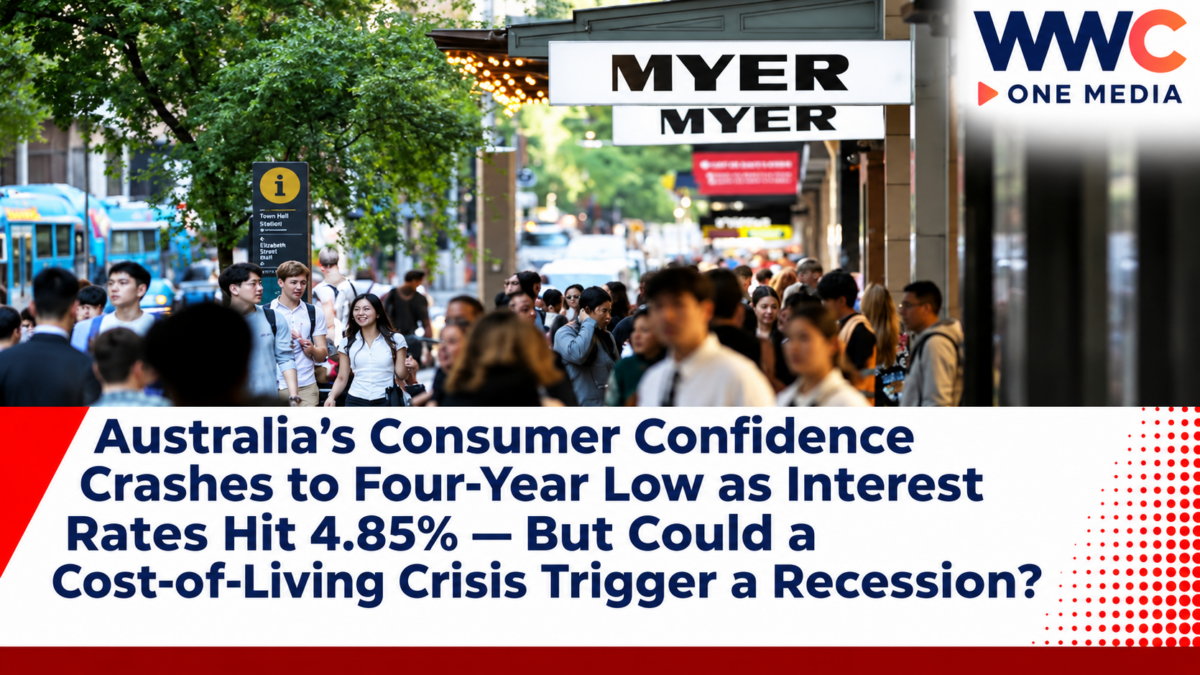
SYDNEY, AUSTRALIA — November 10, 2026 — Australia’s consumer confidence has plunged to its lowest level in four years as rising mortgage repayments, stubborn inflation and soaring household expenses push families deeper into financial pessimism, raising concerns about the outlook for consumer spending and economic growth.
The latest Westpac–Melbourne Institute Consumer Sentiment Index fell 2.7% to 78.2 in November, extending a three-month decline and reaching its weakest level since late 2022.
The survey reveals a troubling deterioration in Australian households’ expectations about the economy, particularly after the Reserve Bank of Australia (RBA) raised interest rates for the fifth time this year.
The central bank increased its benchmark cash rate to 4.85% on November 3, the highest level since 2008, as it struggles to contain inflation running well above its official target.
But the consequences are becoming increasingly visible.
Mortgage holders are reporting exceptionally weak confidence, expectations for the economy have deteriorated sharply, and Australians are becoming less optimistic about house prices.
Meanwhile, annual consumer inflation has climbed to 4.3%, squeezing purchasing power even as households face increasingly expensive borrowing.
As Australia’s central bank continues fighting inflation with higher interest rates, could the policy designed to stabilize prices end up weakening consumer spending, damaging the housing market and pushing the economy toward recession?
Australian Consumer Confidence Falls to Four-Year Low
The November Westpac–Melbourne Institute survey revealed that consumer sentiment dropped from 80.4 in October to 78.2.
The decline followed decreases of 4.7% in October and 5.2% in September.
Together, the three consecutive monthly falls demonstrate a significant deterioration in household confidence.
The index was also approximately 24.6% below its level a year earlier.
A reading below 100 indicates that pessimists outnumber optimists.
At 78.2, the result places Australia’s consumer sentiment deeply within negative territory.
Reuters reported that the November reading was the lowest in four years, reflecting the combined effects of higher interest rates and persistent cost-of-living pressures.
Westpac’s head of Australian macro-forecasting, Matthew Hassan, described sentiment as extremely weak and highlighted growing expectations of additional interest-rate increases.
The survey suggests Australians are becoming increasingly worried about their future finances, economic conditions and the affordability of major purchases.
However, consumer sentiment is not the same as actual spending.
It measures household attitudes and expectations rather than directly recording the amount of money consumers spend.
That distinction is important because Australia’s latest official household-spending figures have remained comparatively resilient.
RBA’s Fifth Rate Hike Sends Borrowing Costs to 18-Year High
The confidence slump follows a major monetary-policy decision.
On November 3, the Reserve Bank of Australia raised its cash rate by 25 basis points, from 4.60% to 4.85%.
The increase was the fifth of 2026.
It also lifted Australia’s benchmark interest rate to its highest level in approximately 18 years.
The decision was not unanimous.
Six members of the RBA’s Monetary Policy Board supported the increase, while three preferred keeping rates unchanged.
That division reflects the difficulty facing policymakers.
Inflation remains elevated, but the effects of higher borrowing costs are placing pressure on households and businesses.
Governor Michele Bullock has emphasized the importance of returning inflation sustainably to the central bank’s 2%–3% target range.
WWC ONE MEDIA previously examined the decision in Australia Raises Interest Rates to 18-Year High of 4.85% as Inflation Surges — But Could a Housing Crash Be the Price of Victory?.
The report explored how Australia’s monetary tightening is affecting housing affordability, financial conditions and household budgets.
The latest consumer-confidence survey provides further evidence that Australians are feeling the pressure.
Mortgage Holders Are More Pessimistic Than Ever
One of the most concerning findings involves homeowners with mortgages.
According to Westpac survey figures reported by Investing.com, sentiment among mortgage holders dropped 11.6% to 68.1, the lowest reading in the available series dating back to 1994.
The result suggests homeowners with mortgage debt are experiencing exceptional anxiety about their financial circumstances.
Higher interest rates generally increase repayments on variable-rate home loans.
They can also raise borrowing costs for homeowners refinancing existing mortgages.
When more household income goes toward mortgage repayments, less money may remain available for discretionary purchases.
Families may respond by reducing spending on restaurants, entertainment, travel, clothing and other nonessential items.
The survey also found that 72% of respondents questioned after the RBA’s latest decision expected mortgage rates to rise further over the following year.
That expectation could influence behavior even before another rate increase occurs.
Households worried about future repayments may increase savings or postpone large purchases as a precaution.
For the Australian economy, that creates a challenge because weaker household consumption can eventually affect businesses, employment and investment.
Australia’s Economic Outlook Suffers a 10.2% Collapse
Consumer concerns extend beyond immediate mortgage repayments.
The survey’s measure of expectations for the Australian economy over the following 12 months fell 10.2%, reaching an index reading of 70.3.
That was its weakest level since August 2020.
The deterioration suggests households are increasingly worried about the broader economic environment.
Potential concerns include job security, borrowing expenses, inflation and property values.
The survey also recorded a 3.7% decline in the measure assessing whether it was a good time to purchase a major household item.
This is significant for retailers selling furniture, appliances, electronics and other expensive products.
When consumers believe the economic outlook is deteriorating, they may delay purchases even when they can technically afford them.
That can create weaker sales for businesses that depend on discretionary expenditure.
But a decline in the sentiment index does not establish that consumer spending has already collapsed.
The next official spending reports will be needed to determine whether weaker confidence is translating into reduced purchases.
Inflation Climbs to 4.3% as Living Costs Remain Elevated
The latest inflation figures help explain why Australian households are becoming more pessimistic.
According to the Australian Bureau of Statistics, annual consumer inflation reached 4.3% in September, accelerating from 4.0% in August.
Trimmed-mean inflation, which reduces the influence of unusually large price movements, increased to 3.6%.
Both figures exceed the RBA’s 2%–3% target.
Housing costs increased 5.2% over the year, while transport prices rose 8.7%.
Food and nonalcoholic beverages increased 3.2%.
These figures illustrate why many households continue to feel financially squeezed.
Even if wage growth partially offsets rising prices, families may still struggle to afford housing, transportation and other essentials.
Higher inflation also means the RBA faces pressure to maintain restrictive monetary policy.
The problem is particularly difficult when expensive imported energy contributes to consumer-price increases.
Higher interest rates can slow domestic demand.
They cannot directly increase global oil supply or eliminate disruptions to international shipping.
As a result, the central bank must balance the danger of persistent inflation against the potential economic damage caused by further tightening.
Petrol Prices Add Another Blow to Household Budgets
Fuel costs have become an important contributor to Australia’s cost-of-living problem.
International energy markets have experienced substantial volatility amid the prolonged conflict involving Iran.
Disruptions to oil production and transportation have affected global petroleum prices.
Australia’s domestic fuel prices have also been influenced by changes to fuel excise arrangements.
Westpac reported that petrol prices had moved toward approximately A$2.40 a litre, intensifying pressure on household finances.
For people commuting to work, transporting children or operating small businesses, higher petrol prices can absorb money otherwise available for discretionary spending.
The impact can extend beyond motorists.
Higher transportation expenses may increase the cost of delivering products, operating services and maintaining supply chains.
WWC ONE MEDIA examined Australia’s exposure to the energy crisis in Albanese Urges Trump to End Iran War as Oil Shock Threatens Australia’s Economy.
The report explored how Middle East instability has complicated Australia’s inflation outlook and monetary-policy decisions.
A sustained reduction in international oil prices could ease some household costs.
However, retail fuel prices would still depend on exchange rates, taxes, refining costs and domestic distribution conditions.
Australia’s Housing Market Faces Another Confidence Shock
Australia’s residential property market is also facing increased uncertainty.
The Westpac survey found that expectations for house prices declined 13.4% to an index reading of 99.6.
That was the first reading below 100 since November 2022.
The result indicates that respondents have become less optimistic about future property prices.
Higher mortgage rates can discourage prospective buyers by increasing monthly repayments and reducing borrowing capacity.
They may also encourage existing homeowners to reconsider plans involving renovations, investment properties or upgrading to larger homes.
However, a decline in house-price expectations does not mean property values have fallen by the same percentage.
It is a measure of sentiment, not a direct change in actual property prices.
The Australian housing market varies substantially by city, property type and local economic conditions.
Nevertheless, the fall adds to concerns that monetary tightening is weighing on households’ financial expectations.
Australia’s Banks Face Increasing Pressure From Borrowers
Higher interest rates can create mixed effects for the banking industry.
Banks may earn additional income from certain lending activities.
But expensive borrowing can also increase the financial burden on customers.
If households or businesses struggle with repayments, the risk of arrears and credit losses can increase.
WWC ONE MEDIA previously reported on those pressures in Australia’s NAB Profit Crashes 13.4% to A$6.14 Billion as Bad Loans Surge 86% — But Could a Deepening Housing Slump Trigger a Bigger Banking Crisis?.
The report examined how higher borrowing costs and a softer housing market are affecting banking conditions.
The latest consumer-confidence figures add another warning sign.
Mortgage holders’ unusually low confidence suggests many households expect financial conditions to remain difficult.
However, pessimism alone does not prove that a wave of mortgage defaults or a banking crisis is imminent.
Actual loan arrears, employment conditions, household savings and banks’ capital positions must also be considered.
Retailers Face a Difficult Christmas Shopping Season
The timing of Australia’s consumer-confidence decline is especially concerning for retailers.
November marks an important period for holiday shopping plans, including preparations for Black Friday and Christmas.
When consumers become worried about future expenses, they may cut back on gifts, entertainment and other discretionary purchases.
The Westpac survey suggests that major household purchases are becoming less attractive.
Mortgage holders may be particularly inclined to reduce spending.
However, survey evidence also indicates that Christmas gift-spending intentions have held up better than the overall sentiment index.
This suggests the impact on retailers may be uneven.
Businesses offering essential products or strong discounts could experience different outcomes from those selling expensive discretionary goods.
The broader retail industry is already navigating a challenging environment.
WWC ONE MEDIA previously reported on the problems confronting David Jones, Australia’s Historic Department Store Chain, as Thousands of Jobs Faced Uncertainty.
That development illustrates the pressures facing traditional retailers in a difficult consumer environment.
The November confidence figures do not prove that weak sentiment caused the retailer’s difficulties, but they reinforce the challenging economic backdrop.
Why Stronger Spending Data Do Not Contradict Weak Consumer Confidence
One of the most important economic details is that Australian consumers have not stopped spending altogether.
Official figures released by the Australian Bureau of Statistics showed that household spending increased 0.6% in September to approximately A$82.6 billion.
The result exceeded economists’ expectations for a 0.2% increase.
Annual spending was 6.8% higher, and inflation-adjusted household consumption rose 0.7% during the September quarter.
Those figures appear inconsistent with the collapse in confidence.
But they measure different things.
Consumer sentiment reflects how households feel about their finances and the future.
Household-spending figures record actual expenditure.
Spending can remain elevated even when consumers are pessimistic, particularly if essential goods cost more.
WWC ONE MEDIA previously examined this distinction in Australia’s Household Spending Beats Forecasts at A$82.6 Billion as Fuel Costs Surge — But Could the Unexpected Rebound Trigger Even Higher Interest Rates?.
The report highlighted why nominal spending growth should not automatically be interpreted as improved purchasing power.
The latest confidence survey raises the possibility that households could become more cautious in the coming months.
Whether that happens will need to be tested against future official spending data.
Could Australia Be Heading Toward a Recession?
The sharp deterioration in consumer confidence has renewed discussion about recession risks.
Some economists believe sustained high interest rates could weaken household demand and economic growth.
The Financial Times reported that HSBC economist Paul Bloxham assigned a 50% probability to an Australian recession in the current environment.
That assessment reflects one economist’s forecast, not an official recession declaration.
Other analysts remain more cautious.
The RBA’s central economic forecast does not assume that Australia will enter recession.
The Australian economy also retains sources of resilience, including export industries, public investment and business activity.
Nevertheless, weaker household confidence matters because consumer spending contributes significantly to economic output.
If families begin reducing purchases, businesses may experience slower sales growth.
That can eventually affect investment and hiring decisions.
The risk becomes greater if weak demand coincides with rising unemployment or sustained pressure on mortgage repayments.
For now, the November sentiment reading indicates substantial economic anxiety rather than establishing that a recession has begun.
RBA Warns That Public Confidence in Inflation Control Is Weakening
The Reserve Bank is also concerned about how Australians perceive its ability to control inflation.
On November 5, Deputy Governor Andrew Hauser warned that public confidence in monetary policy was becoming increasingly important.
When households and businesses believe inflation will eventually return to target, they may make spending, wage and pricing decisions consistent with that expectation.
But if people lose confidence in the central bank, inflation expectations can become harder to manage.
That may force policymakers to maintain restrictive monetary conditions for longer.
Hauser emphasized that credibility must be supported through effective decisions and transparent communication.
His comments came after the RBA’s fifth rate increase of 2026.
For mortgage holders, that creates a difficult situation.
The central bank believes higher rates are necessary to restore price stability.
But the financial pain is often felt before the benefits of lower inflation become apparent.
The latest consumer-confidence figures suggest many Australians remain unconvinced that relief is approaching.
Will the RBA Raise Interest Rates Again in December?
The Reserve Bank’s next scheduled monetary-policy meeting is December 7–8.
Investors will be watching whether policymakers maintain the current 4.85% rate or decide further action is necessary.
Westpac economists expect the RBA to pause in December while assessing the cumulative effects of this year’s interest-rate increases.
They also do not currently expect another increase in February.
However, those are forecasts rather than official decisions.
A stronger-than-expected inflation report or renewed deterioration in inflation expectations could change the outlook.
Conversely, evidence that households are reducing spending and economic activity is slowing could strengthen the case for keeping rates unchanged.
The next Australian CPI report, covering October, is scheduled for November 25.
That release will provide important evidence ahead of the December meeting.
The RBA must consider inflation, employment, domestic demand and financial stability rather than respond to the sentiment survey in isolation.
The Bigger Picture: Australia’s Inflation Fight Is Becoming a Confidence Crisis
Australia’s November consumer-confidence collapse underscores the growing challenge facing its economy.
The Westpac–Melbourne Institute index has fallen to 78.2, its lowest level in four years.
Mortgage holders are reporting exceptionally weak confidence.
Economic expectations have deteriorated, and households increasingly believe borrowing costs could rise further.
Meanwhile, the central bank is attempting to control annual inflation of 4.3% with a cash rate of 4.85%.
The strategy is intended to restore price stability, but it is also increasing financial pressure on rate-sensitive households.
For Prime Minister Anthony Albanese’s government, persistent cost-of-living concerns create an additional economic and political challenge.
For retailers, the risk is that increasingly cautious consumers could reduce discretionary purchases during the holiday season.
For the RBA, the central issue is whether enough economic restraint is already in place to bring inflation down without causing unnecessary damage to employment and spending.
As Australian consumer confidence falls to its lowest level in four years and mortgage holders become deeply pessimistic, the question is whether the Reserve Bank can defeat inflation before the financial strain pushes households—and potentially the wider economy—toward a much more painful downturn.