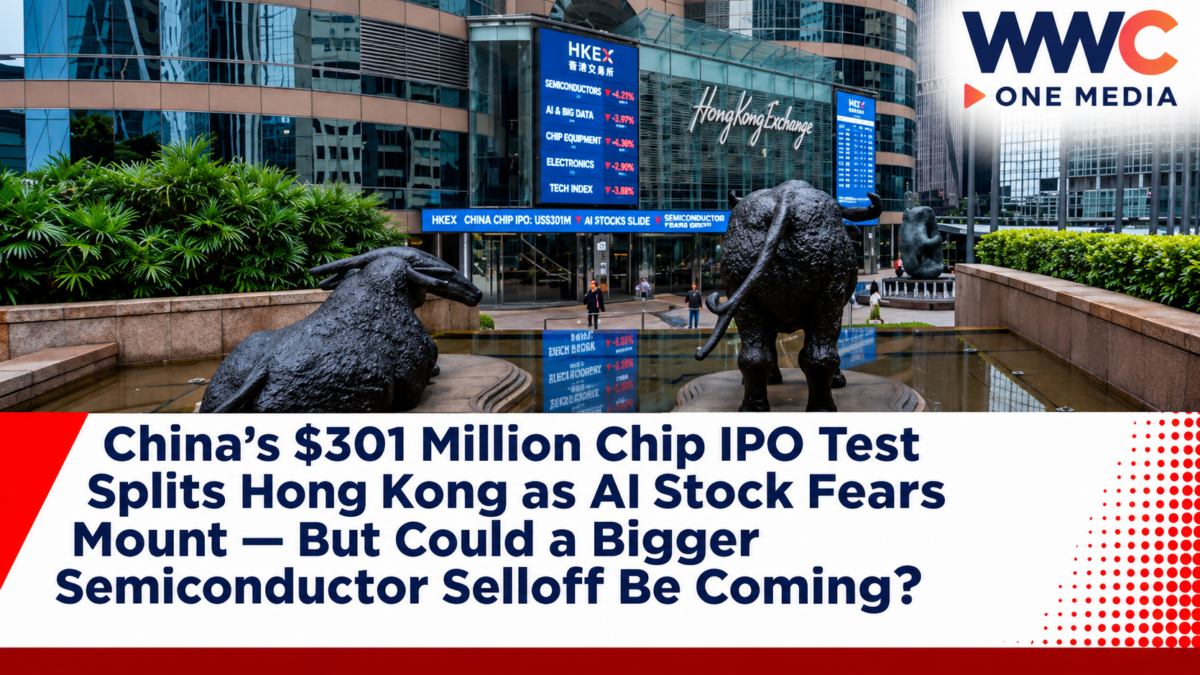
HONG KONG — November 10, 2026 — Two Chinese semiconductor companies have raised a combined US$301 million in Hong Kong initial public offerings, but their sharply different stock-market debuts have exposed growing investor uncertainty over China’s artificial intelligence ambitions.
Suzhou Denglin Technology, a developer of graphics processing units used in AI computing, opened 0.9% below its offering price on Tuesday.
Meanwhile, Jiangsu Xinde Semiconductor Technology, a supplier of semiconductor packaging and testing services, surged 20.5% at the opening bell.
The contrast came as Asian technology markets struggled to recover from a wave of selling driven by concerns about inflated AI valuations, uncertainty over American technology policy and the enormous cost of building next-generation computing infrastructure.
Bloomberg reported on November 9 that the two listings would provide an important test of investor appetite for Chinese semiconductor businesses.
Tuesday’s opening results delivered a mixed verdict.
Investors were willing to pay a substantial premium for one newly listed chip supplier while remaining cautious about the other.
The developments come as Hong Kong approaches a historic fundraising milestone, with initial public offerings already raising approximately US$51.9 billion in 2026, according to Bloomberg-compiled data.
But despite the extraordinary fundraising totals, a growing number of technology stocks have struggled after listing.
Could the contrasting debuts of Denglin and Xinde signal a healthier, more selective market—or reveal that investor enthusiasm for China’s AI chip revolution is beginning to unravel?
Two Chinese Chipmakers Raise $301 Million in Hong Kong
Suzhou Denglin Technology and Jiangsu Xinde Semiconductor Technology began trading on the Hong Kong Stock Exchange on November 10.
The companies raised a combined HK$2.36 billion, equivalent to approximately US$301 million.
Their offerings were among several technology-related transactions launched during Hong Kong’s late-October fundraising rush.
However, the companies operate in different areas of the semiconductor industry.
Denglin develops general-purpose graphics processing units, or GPUs, used in computing and artificial intelligence applications.
Xinde specializes in semiconductor packaging and testing, services that help transform manufactured chips into usable components.
Their business models expose them to different opportunities, competition and investment risks.
The first trading session demonstrated how significantly investors can differentiate between companies operating within the same industry.
Denglin Opens Lower Despite China’s Growing Demand for AI Chips
Suzhou Denglin Technology raised approximately HK$1.41 billion, or US$180 million, through its initial public offering.
The company sold approximately 6.1 million shares at HK$231 each.
That was the bottom of its originally marketed range of HK$231 to HK$288.
Denglin began trading under stock code 9917.
According to Reuters, its shares opened 0.9% below the offering price.
The modest decline may appear relatively small, but it is significant given the enormous investor attention surrounding China’s domestic artificial intelligence industry.
Denglin develops graphics processors designed for AI inference, enterprise computing and other demanding workloads.
AI inference involves using previously trained artificial intelligence models to generate responses, predictions or decisions.
As businesses adopt AI tools, demand for inference computing could expand.
However, building a commercially competitive GPU business involves major challenges.
Chip developers must invest heavily in hardware architecture, software compatibility, manufacturing arrangements and customer support.
Competition is intense, particularly from established international manufacturers and a growing number of domestic Chinese developers.
Denglin’s offering gave the company additional funding, but its opening performance suggests that investors are increasingly unwilling to reward AI companies simply because they operate in a strategically important industry.
Where Denglin Plans to Spend Its IPO Proceeds
Denglin’s offering documents outline how the company intends to use the money raised.
The proposed allocation includes:
- 35% for upgrading and commercializing existing GPU product lines.
- 25% for developing and commercializing new product categories.
- 20% for developing software tools supporting its chips.
- 10% for strengthening sales and marketing.
- 10% for general working capital.
The proposed spending demonstrates that competition in the AI processor market goes beyond designing faster hardware.
Software is particularly important because customers need tools that allow developers to deploy applications efficiently.
A chip with attractive technical specifications may struggle to gain market share if its software ecosystem is difficult to use or incompatible with widely adopted development frameworks.
Denglin must therefore demonstrate that it can convert investment in products and software into sustainable customer demand.
A successful IPO provides capital for that effort.
It does not guarantee technological leadership or profitability.
Xinde Semiconductor Jumps 20.5% in Stronger Market Debut
Jiangsu Xinde Semiconductor Technology experienced a markedly different reception.
The company raised approximately HK$946.3 million, equivalent to around US$121 million.
Its IPO shares were priced at HK$8.88 each.
Xinde began trading under stock code 7672.
Reuters reported that the shares opened 20.5% above their offering price.
That strong initial gain contrasts sharply with Denglin’s weaker debut.
Xinde focuses on semiconductor packaging and testing, an important stage of the global chip supply chain.
After semiconductor wafers are manufactured, chips must be packaged, connected and tested before they can be incorporated into electronic products.
Advanced packaging is becoming increasingly important as chip manufacturers seek ways to improve performance, power efficiency and integration.
However, not every packaging company provides the same level of advanced technology.
Investors must examine individual firms’ capabilities, customer relationships and financial performance.
Xinde’s strong opening does not automatically establish that its long-term earnings will outperform those of Denglin.
It does show stronger initial market demand relative to the price at which its shares were offered.
Hong Kong’s Earlier $765 Million Chip IPO Rush Sets the Stage
The two November 10 listings were part of a larger fundraising wave that began in late October.
On October 30, six companies launched Hong Kong share offerings targeting a combined approximately US$765 million.
The group included semiconductor developers, a memory-products company, an energy-storage business and companies from other industries.
WWC ONE MEDIA covered the development in Hong Kong Sees $765-Million IPO Rush as Chinese Chip Suppliers Race to Raise Cash — But Can AI Stocks Survive the Market Selloff?.
At that time, Denglin was marketing shares at as much as HK$288 apiece.
The final offering price of HK$231 demonstrates how the company ultimately priced the transaction at the bottom of its indicated range.
The distinction matters.
The earlier US$765 million figure represented an aggregate fundraising target across several offerings, not a completed amount raised by Denglin and Xinde.
The newly confirmed US$301 million represents the proceeds from the two completed IPOs.
Hong Kong Is Approaching a Historic IPO Fundraising Record
Despite recent turbulence, Hong Kong has staged a remarkable fundraising recovery in 2026.
According to Bloomberg-compiled data, companies have raised approximately US$51.9 billion through IPOs this year.
The amount is approaching the city’s 2010 record of roughly US$57.8 billion.
Chinese technology companies have been major contributors.
The pipeline has included semiconductor manufacturers, artificial intelligence developers, robotics companies and other businesses connected to China’s push for greater technological self-reliance.
For these companies, Hong Kong provides access to an international investor base while maintaining close connections to mainland China.
But high fundraising activity can coexist with disappointing stock-market returns.
Companies may successfully sell shares and still experience price declines afterward.
The challenge is not merely whether businesses can raise money.
It is whether investors will earn returns that justify the risks they take.
China’s $480 Billion AI Stock Meltdown Is Changing Investor Behavior
The latest listings took place against a difficult backdrop for Chinese technology shares.
Earlier in November, the market value of a major Chinese AI-related stock index had fallen approximately US$480 billion from its peak, according to Bloomberg reporting.
The correction reflected increasingly cautious attitudes toward technology valuations.
Investors have questioned whether the rapid growth in spending on artificial intelligence will translate into equally strong profits.
WWC ONE MEDIA examined the downturn in China’s $480-Billion AI Stock Meltdown Crushes Retail Investors as Tech Frenzy Collapses — But Could an Even Bigger Market Crash Be Coming?.
The report explored how the earlier enthusiasm for AI, robotics and semiconductors had given way to increasing concern about valuations.
For companies seeking public listings, these conditions create pressure to offer more attractive pricing.
Investors can compare newly issued shares with established technology companies whose valuations have already fallen.
That makes it harder for IPO candidates to command high premiums based solely on their future growth potential.
Denglin’s listing at the bottom of its marketed price range is consistent with that more demanding environment.
China’s Semiconductor Independence Push Remains a Powerful Driver
The growing number of chip listings reflects a broader national objective.
China wants to reduce reliance on imported semiconductor technology and expand its domestic chip supply chain.
US restrictions on certain advanced processors and semiconductor manufacturing technologies have made that goal more urgent.
Chinese companies are investing in processors, memory technology, chipmaking equipment, packaging and supporting software.
Denglin operates in the AI computing segment, while Xinde serves a different part of the semiconductor production process.
Both could benefit from long-term investment in domestic capabilities.
But government priorities do not automatically translate into profitable businesses.
Commercial success still depends on production costs, customer demand, technology quality and competition.
A semiconductor company may be strategically important while remaining financially risky for shareholders.
Beijing’s IPO Scrutiny Is Adding Pressure
The broader market environment has become more difficult because Chinese regulators are increasing scrutiny of new offerings.
The Wall Street Journal reported in early November that China’s securities regulator had instructed major banks and securities firms to pause new IPO submissions while continuing to review some existing applications.
The reported guidance came as authorities sought to reduce pressure on an already weakened stock market.
It should not be interpreted as a confirmed blanket ban on all Hong Kong listings.
The two November 10 IPOs proceeded despite the wider regulatory caution.
Bloomberg has also reported increased scrutiny of Hong Kong transactions involving complicated investor relationships and cornerstone allocations.
That attention matters because public offerings depend on trust in pricing, disclosures and allocation procedures.
WWC ONE MEDIA previously examined the risks in Hong Kong IPO Crisis Deepens as 1 in 4 Deals Collapse in Worst Withdrawal Wave Since 2008 — But Is Asia’s Biggest Fundraising Boom About to End?.
The report highlighted the contrast between record fundraising totals and the growing number of deals that have struggled to reach completion.
Regulatory caution may improve market quality over time.
But it can also make fundraising more difficult for companies already facing weaker investor demand.
Biren’s $515 Million Share Sale Shows How Chip Financing Is Changing
Another Chinese AI-chip company, Shanghai Biren Technology, recently raised approximately US$515 million in net proceeds through a Hong Kong share placement.
The transaction was separate from the Denglin and Xinde IPOs.
Biren sold additional shares at a discount to its market price to finance development and business expansion.
WWC ONE MEDIA covered the financing in China’s AI Chip Challenger Biren Raises $515 Million Again — But Its New Share Sale Comes With a Big Warning.
The transaction provides another example of how semiconductor companies are seeking substantial capital even during volatile market conditions.
But selling new shares can also dilute existing investors.
For both IPO candidates and established public companies, financing is becoming a delicate balance between raising enough capital and protecting shareholder value.
Baidu’s AI Chip IPO Could Be Delayed Until 2027
The pressure is also affecting larger planned transactions.
Bloomberg reported on November 3 that the Hong Kong listing of Baidu’s AI chip subsidiary, Kunlunxin, could slip into 2027.
The company had been considering an offering potentially worth approximately US$2 billion.
However, the transaction remained subject to regulatory approval and market conditions.
The possible delay illustrates the challenges facing ambitious Chinese AI businesses.
Even a strategically important semiconductor company backed by a large technology group may not be able to list on its preferred timetable.
Delays can reflect regulatory reviews, valuation concerns or other considerations.
They do not necessarily establish that a company’s business is failing.
For investors, however, prolonged uncertainty can weaken confidence in the broader IPO pipeline.
Hong Kong’s Stock Exchange Is Also Feeling the Slowdown
The consequences of weaker market activity extend to Hong Kong Exchanges and Clearing, the operator of the city’s stock market.
The company recently reported its first quarterly profit decline in more than two years.
Third-quarter net profit fell 0.8% from a year earlier to approximately HK$4.86 billion.
Average daily stock-market turnover declined 11%, reflecting more cautious trading activity.
At the same time, IPO activity remained an important source of revenue.
The exchange reported 31 third-quarter listings raising approximately HK$176 billion.
These figures show that Hong Kong’s market is not experiencing a complete collapse in fundraising.
Instead, extraordinary IPO activity is taking place alongside weaker secondary-market performance and increasingly selective investor demand.
That combination creates uncertainty for new listing candidates.
What the Two Chip Debuts Mean for Asian Investors
Denglin and Xinde’s contrasting openings provide a useful reminder that not all semiconductor companies are valued alike.
An AI processor designer may have substantial long-term growth opportunities but face expensive research, development and competition.
A packaging and testing company may offer a different risk profile based on manufacturing capacity and customer relationships.
Investors should therefore evaluate business fundamentals rather than rely on sector labels.
For Philippine investors following Asian technology markets, the listings also illustrate the importance of offering price, earnings prospects and market conditions.
Hong Kong-listed shares carry currency, liquidity and regulatory risks in addition to company-specific uncertainty.
The strong opening of one IPO does not guarantee future gains, just as a weak debut does not prove that a company lacks commercial potential.
What Happens Next for Hong Kong’s Semiconductor IPO Market?
The first-day performance of Denglin and Xinde will be closely watched by other companies preparing listings.
Attention will also turn to Hosin Electronics, a Chinese memory-products company expected to begin trading in Hong Kong on November 12.
Investors will be assessing whether the mixed reception for Tuesday’s chipmakers becomes a broader pattern.
Strong demand for well-priced companies could help restore confidence.
But repeated weak debuts could force issuers to reduce their fundraising targets, accept lower valuations or postpone offerings.
Another important factor will be the direction of global AI stocks.
Continued volatility involving major US semiconductor companies could affect investor demand across Asian markets.
The ultimate test will be whether Chinese chipmakers can demonstrate sustainable commercial performance rather than depend primarily on excitement about artificial intelligence.
The Bigger Picture: China’s Chip Boom Faces a Tougher Investment Reality
The November 10 listings illustrate the tension at the heart of China’s semiconductor expansion.
The country’s technological ambitions remain substantial.
Companies need funding to develop domestic processors, improve manufacturing capabilities and reduce reliance on foreign technology.
Hong Kong continues offering access to large pools of international capital.
But investors are becoming more selective.
Denglin’s subdued opening and Xinde’s strong initial rally show that companies within the same industry can receive dramatically different valuations.
Meanwhile, China’s AI stock correction, regulatory scrutiny and delayed listings are raising questions about how much additional risk markets are willing to absorb.
The combined US$301 million raised by the two chipmakers demonstrates that financing remains available.
It does not establish that the wider semiconductor selloff is over.
As China’s newest chip stocks make sharply contrasting Hong Kong debuts and the city’s record IPO boom approaches a crucial test, the biggest question is whether the market is entering a healthier phase of selective investing—or whether the AI semiconductor frenzy is finally running out of buyers.