TOKYO, JAPAN — Japan’s battle with rising prices has reached an extraordinary turning point: Even some of the country’s most recognizable low-cost brands are struggling to convince customers to pay more.
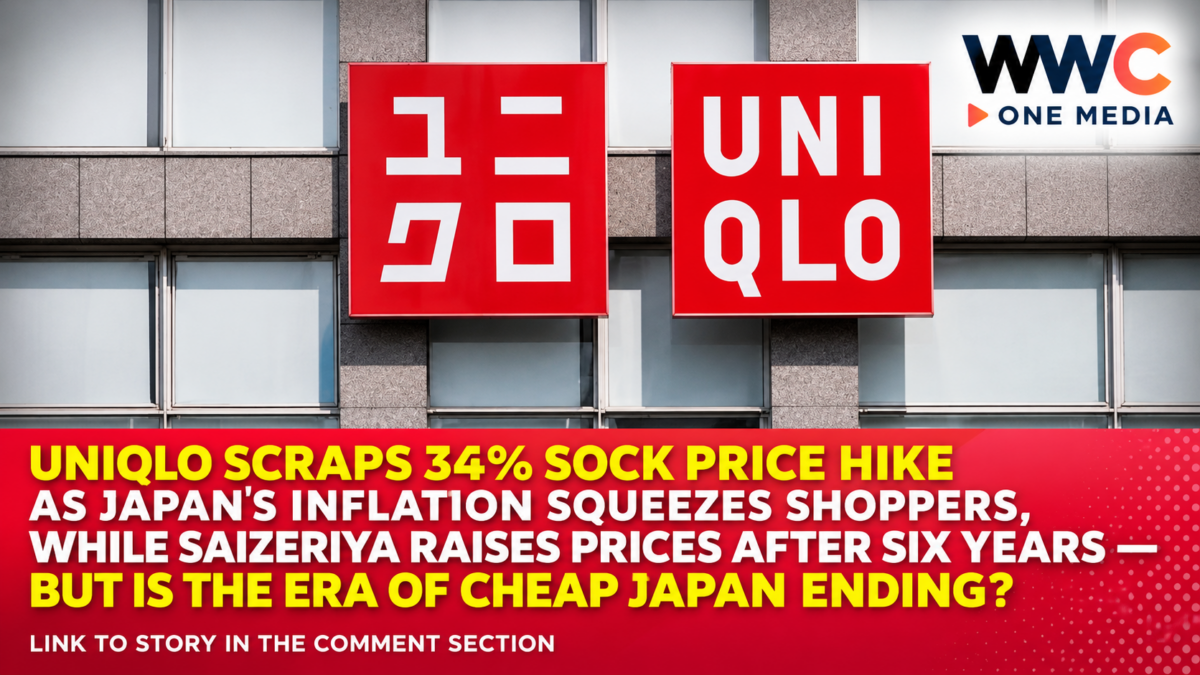
Clothing giant Uniqlo has abandoned a proposed increase in the price of its popular socks following a consumer backlash.
Meanwhile, budget Italian restaurant chain Saizeriya has raised prices across much of its menu for the first time in roughly six years, ending a prolonged effort to shield diners from rising business costs.
The developments have exposed an unusual problem facing Japanese companies.
After decades of deflation and stagnant prices, many consumers remain deeply resistant to paying more—even when businesses can no longer absorb rising costs.
For Uniqlo, that meant reversing a controversial decision involving one of its most affordable everyday products.
For Saizeriya, it meant publicly apologizing to customers while introducing increases that include an additional ¥20 for its famous Milanese Doria.
The changes may seem small individually.
But together, they reveal a broader struggle over wages, inflation, consumer confidence and the future of Japan’s economy.
And with the Bank of Japan moving away from decades of ultra-low interest rates, the pressure could intensify.
Uniqlo’s ¥290 Socks Spark a Consumer Backlash
Uniqlo, owned by Fast Retailing, has built its global reputation around functional clothing offered at accessible prices.
But the brand faced a difficult reaction after announcing plans to increase prices for selected products in Japan.
One particularly controversial proposal involved its popular ¥290 socks.
The company had planned to raise the price to ¥390, an increase of approximately 34.5%.
The proposal also involved changes to discounted multipair purchases.
Customers responded strongly on social media, questioning why such a basic everyday product needed to become more expensive.
Uniqlo subsequently reversed the planned increase for the popular sock line.
The decision underscored the importance of affordability to the retailer’s identity.
For many shoppers, inexpensive socks are not a luxury.
They are an ordinary household purchase.
A ¥100 increase may appear modest, but it represents a substantial percentage change on a low-cost product.
Uniqlo’s reversal shows that retailers must consider not only production costs but also how customers perceive the fairness of price increases.
Uniqlo Is Still Raising Prices on Other Clothes
The sock reversal does not mean Uniqlo has abandoned its broader pricing changes.
The company previously announced increases affecting selected autumn and winter clothing sold in Japan.
These include its Kando Jacket, which is scheduled to increase from ¥6,990 to ¥7,990 on November 10.
That represents an increase of approximately 14.3%.
Selected trousers are also affected.
Uniqlo has attributed the changes to higher raw-material expenses, logistics costs and the weakness of the Japanese yen.
The company says the adjustments are necessary to maintain product quality.
Importantly, the reported changes concern its Japanese market.
Uniqlo told The Straits Times that the October-announced price adjustments would not affect Singapore consumers.
The distinction matters because Uniqlo operates internationally, but retail prices differ between countries.
Japan’s specific cost pressures do not necessarily translate into identical increases across its global store network.
Saizeriya Raises Prices After Six Years of Resistance
Uniqlo is not alone in confronting consumers’ resistance to inflation.
Saizeriya, one of Japan’s best-known affordable restaurant chains, has also made a significant change.
Beginning October 29, the company increased prices across much of its menu by an average of approximately 6%.
At 24 locations facing higher operating costs, the average adjustment was around 10%.
The price of its signature Milanese Doria increased from ¥300 to ¥320 at standard-price locations.
Other dishes also became more expensive.
For example, some meals previously priced at ¥400 increased to approximately ¥420 or ¥430.
The changes marked Saizeriya’s first broad price revision in roughly six years.
Although it made a small price adjustment in 2020 to simplify cash transactions, its overall strategy had long centred on resisting widespread increases.
That made the October decision particularly noteworthy.
For a restaurant synonymous with low prices, increasing menu costs risks challenging the very reputation that attracts customers.
Why Saizeriya Apologized for Raising Prices
Perhaps the most revealing aspect of Saizeriya’s announcement was its apologetic tone.
The company described the increases as a reluctant response to costs it could no longer absorb.
Its explanation pointed to expensive ingredients, energy and other operating expenses.
President Shuji Matsutani also expressed a desire to lower prices again if circumstances allowed.
The response was striking because the company framed the increases almost as a failure to maintain its traditional commitment to affordability.
That attitude reflects a broader feature of Japan’s business culture.
Companies have historically worried that increasing prices would alienate loyal customers.
For smaller businesses, the concern can be especially powerful.
Long-standing relationships with regular customers may feel more important than the short-term financial benefit of passing on higher costs.
But refusing to increase prices indefinitely can damage profitability.
If ingredients, electricity and wages become more expensive while menu prices remain unchanged, businesses have fewer resources available to maintain their operations.
A Ramen Shop Owner Explains Japan’s Price Dilemma
In the original AFP report carried by Channel News Asia, a 68-year-old ramen shop owner identified as Sachi described the emotional difficulty of raising prices.
Operating in Japan’s Okayama region, she said increasing prices by ¥200 would leave her feeling guilty toward customers who had supported her business for years.
Instead, she preferred to absorb the pressure herself.
Her experience illustrates the dilemma facing many independent businesses.
A small restaurant may have limited opportunities to reduce ingredient costs.
It may also have little bargaining power over electricity, rent or distribution expenses.
But raising prices could discourage customers from visiting as frequently.
That creates an uncomfortable choice.
The business can accept shrinking margins, reduce portions, change ingredients or eventually increase prices.
None of those options is painless.
For Japan’s smaller businesses, inflation is therefore more than an economic statistic.
It is a daily struggle to remain financially viable without damaging customer relationships.
Japan’s Inflation Has Returned After Decades of Deflation
For much of the period following the 1990s, Japan struggled with weak inflation and intermittent deflation.
Companies often hesitated to raise prices because consumers expected them to remain stable.
Workers, meanwhile, experienced long periods of limited wage growth.
The resulting cycle contributed to weak domestic demand.
In 2013, then-Prime Minister Shinzo Abe introduced an economic strategy intended to restore growth and inflation.
The Bank of Japan supported those efforts through extraordinary monetary stimulus.
But meaningful inflation took years to emerge.
The global energy shock following Russia’s 2022 invasion of Ukraine increased Japan’s import costs.
More recently, disruptions involving the Middle East have added fresh pressure to oil, transportation and other supply-chain expenses.
The country’s dependence on imported energy makes it particularly sensitive to international price movements.
A weak yen can further increase the local-currency cost of imported materials.
Businesses therefore face a combination of pressures that can be difficult to offset through efficiency improvements alone.
Official Data Show Consumer Prices Are Still Rising
Japan’s Statistics Bureau reported that nationwide consumer prices excluding fresh food increased 2.1% in September 2026 from a year earlier.
A separate measure excluding both fresh food and energy increased 2.4%.
Those figures indicate that inflation remains relevant even after the country moved away from its long period of stagnant prices.
However, inflation figures must be interpreted carefully.
A 2.1% annual increase in consumer prices does not mean every product became 2.1% more expensive.
Individual categories can rise or fall at very different rates.
Likewise, an increase in the price of socks or a restaurant meal does not by itself establish the inflation rate for the entire economy.
The Bank of Japan evaluates several indicators when determining whether underlying inflation is becoming sustainable.
As WWC ONE MEDIA reported in its coverage of Japan’s September inflation data, the latest consumer-price figures reinforced expectations of further monetary-policy tightening.
But the central bank must also consider the condition of household spending and wage growth.
Food Prices Are Changing How Japanese Consumers Shop
The impact of inflation is visible in everyday consumer behaviour.
Reuters reported on October 29 that Japanese shoppers were increasingly moving away from convenience stores toward discount supermarkets.
Some households were travelling farther to purchase groceries in bulk.
Others were choosing cheaper products or eating out less frequently.
The shift is significant because Japan’s convenience-store industry has traditionally relied on accessibility and speed.
Customers were often willing to pay slightly more for the convenience of shopping near railway stations and residential neighbourhoods.
But as living expenses rise, some consumers are prioritizing price over convenience.
Reuters reported that convenience-store customer numbers had fallen for 15 consecutive months, declining 3.8% year-on-year in September.
Meanwhile, discount-oriented retailer Seiyu reported a 6.9% increase in customer traffic at existing stores during the same month.
Those figures suggest that shoppers are becoming more selective.
They are not necessarily abandoning consumption entirely.
Instead, they are increasingly seeking lower-cost alternatives.
More Than 3,000 Food Products Faced October Price Increases
The pressure extends beyond clothing and restaurant chains.
A survey by research firm Teikoku Databank identified planned October price increases affecting 3,153 food and beverage items.
That followed increases involving 4,965 items in September.
The adjustments reflected expensive packaging materials, a weaker yen and elevated transportation expenses.
For consumers, the problem is cumulative.
A small increase in one product may be manageable.
But repeated increases across groceries, utilities, transport and meals can create significant pressure on monthly budgets.
Households may respond by reducing spending on non-essential goods.
That can affect restaurants, clothing stores and other retailers.
For Japan’s economy, weaker household spending is particularly important because private consumption represents a substantial share of economic activity.
The risk is that inflation could weaken demand even as businesses attempt to recover their rising costs.
Saizeriya’s Financial Results Explain the Pressure
Saizeriya’s pricing decision also reflects the challenge of maintaining profitability.
According to its financial reporting discussed by Japanese business media, the company recorded approximately ¥301.5 billion in revenue for the fiscal year ended August 2026.
Sales increased from the previous year, but rising food costs squeezed profitability.
Net profit declined by approximately 1.1%.
The company also faced higher raw-material costs relative to sales.
Those pressures help explain why management concluded that menu-price increases were necessary.
Even a growing restaurant chain can experience financial strain when operating costs rise faster than earnings.
The decision highlights the limits of relying exclusively on increased customer volume.
More customers do not necessarily produce stronger profits if each meal becomes substantially more expensive to prepare.
For Saizeriya, protecting its value-for-money reputation while maintaining adequate margins will remain a critical challenge.
Some Saizeriya Prices Are Staying the Same
The company has not increased every menu price.
It kept selected products unchanged, including some lunch and breakfast offerings.
Its inexpensive fresh wine also remained available at ¥100 per glass.
The strategy appears designed to preserve important symbols of affordability.
For customers, those products can reinforce the perception that Saizeriya remains a budget-friendly restaurant despite broader increases.
For the company, selective pricing can help balance costs and customer loyalty.
It may raise prices on some items while protecting the products most strongly associated with its brand.
However, the success of that strategy will depend on future customer behaviour and operating costs.
Why Japan’s Wage Growth Has Not Solved the Problem
Rising wages offer potential relief to Japanese households.
But economists caution that higher salaries have not benefited everyone equally.
The CNA/AFP report cited labour data indicating that real wages had risen year-on-year for eight consecutive months.
Even so, consumers remained concerned about food and other essential expenses.
Tsutomu Watanabe, an economics professor at the University of Tokyo, argued that pay increases were still insufficient for many households.
That highlights an important distinction.
Average wage growth does not guarantee that every worker is better off.
Employees in different industries may experience substantially different salary increases.
Retirees and people on fixed incomes may also have limited protection against rising prices.
If essential expenses consume more of a household’s income, spending on restaurants, clothing and leisure can fall.
That is precisely the challenge facing businesses attempting to increase prices.
They need higher revenue to cover costs, but their customers may have less money available to spend.
Bank of Japan Faces Another Difficult Interest-Rate Decision
Japan’s central bank is now navigating a very different economic environment from the one that defined much of the past three decades.
Instead of trying to create inflation, policymakers are attempting to keep price growth stable without damaging the economy.
Bank of Japan Governor Kazuo Ueda has indicated that underlying inflation has reached a level broadly consistent with the bank’s 2% objective.
But he has also warned that sustaining that balance remains uncertain.
As WWC ONE MEDIA reported in its November 7 analysis of the BOJ’s inflation outlook, investors are watching for another possible rate increase in December.
Higher interest rates can help contain inflation by moderating borrowing and spending.
But they can also increase financing costs for companies and households.
For retailers already struggling with cautious consumers, tighter financial conditions could create additional difficulties.
That does not mean a December rate increase is guaranteed.
The central bank’s decision will depend on incoming data and its assessment of inflation, wages and economic growth.
The Weak Yen Creates Another Problem for Retailers
Japan imports many of the materials and products used by its businesses.
When the yen weakens, goods priced in foreign currencies become more expensive in yen terms.
That can increase costs for clothing retailers, restaurants and manufacturers.
Uniqlo has specifically cited yen weakness as one reason for its price adjustments.
The exchange-rate issue also affects the wider economy.
A weaker yen can benefit exporters by increasing the yen value of overseas earnings.
But it can hurt businesses and consumers reliant on imported goods.
As WWC ONE MEDIA examined in its report on the yen’s response to the Bank of Japan’s inflation assessment, currency movements have become an important factor in expectations for Japan’s next monetary-policy decision.
A stronger yen could eventually ease certain import costs.
However, currency appreciation would not automatically reverse all retail price increases.
Companies may continue facing higher wages, rents, energy bills and other domestic expenses.
Japan’s Changing Inflation Culture Could Have Global Implications
Japan’s consumer-price transition is being watched by businesses and investors around the world.
For decades, the country served as an example of the economic difficulties associated with prolonged deflation.
Now, its companies are navigating the opposite problem.
They must adapt to a world where prices rise more regularly.
That transition affects corporate strategy.
Retailers need to decide how frequently to revise prices.
Restaurants must determine which costs they can absorb.
Employers must consider wages and employee retention.
Investors must evaluate whether businesses can protect profit margins without losing customers.
As WWC ONE MEDIA previously reported on Japan’s shift toward wage-driven inflation, stronger wages could eventually support a healthier cycle of consumption and business investment.
But that outcome depends on wages improving sufficiently to protect household purchasing power.
If price increases consistently exceed income growth, consumers may respond by cutting spending.
That could undermine the economic recovery policymakers are trying to sustain.
Could Retailers Lose Customers by Raising Prices?
The biggest uncertainty for Uniqlo, Saizeriya and other Japanese businesses is how customers respond.
Higher prices may help companies cover operating expenses.
But they can also reduce demand.
A consumer might purchase fewer clothes, eat at restaurants less frequently or switch to discount alternatives.
That reaction can weaken sales volumes.
Businesses therefore need to consider both pricing and customer loyalty.
Some may keep prices low on essential products while increasing margins elsewhere.
Others may introduce lower-cost product lines or improve efficiency.
The challenge is especially difficult in Japan, where consumers have spent decades expecting prices to remain relatively stable.
Uniqlo’s sock-price reversal shows that even a globally recognized brand can face resistance.
Saizeriya’s apologetic announcement demonstrates how carefully companies must communicate increases.
Neither case proves that higher prices are impossible.
But both suggest that Japan’s transition to a sustained inflation economy remains culturally and commercially difficult.
What Happens Next for Japan’s Consumers?
The immediate developments are already clear.
Saizeriya introduced its broad menu-price revision on October 29.
Uniqlo withdrew its proposed increase on a popular sock line while preparing other selected price changes for November 10.
Consumers will now determine whether the revised prices affect their purchasing habits.
Investors will watch the companies’ sales volumes and profitability.
Economists will monitor household spending and real wages.
The Bank of Japan will assess whether inflation is becoming sustainable and whether further interest-rate adjustments are necessary.
These developments could shape the country’s economic trajectory through 2027.
But it would be premature to declare that Japan has entered a permanent era of rapidly rising prices.
The outcome will depend on wages, import costs, consumer confidence and broader economic conditions.
The Bottom Line: Japan’s Affordability Crisis Has Reached Its Most Famous Bargain Brands
Japan’s changing inflation environment is forcing businesses to confront decisions they once tried to avoid.
Uniqlo abandoned a proposed ¥100 increase on its popular ¥290 socks after customers protested.
Saizeriya raised much of its menu by an average of approximately 6%, including a ¥20 increase on its signature Milanese Doria.
Both companies are responding to higher costs.
But their experiences reveal how difficult it remains to persuade Japanese consumers to accept price increases after decades of relatively stable prices.
The country’s latest official inflation figures show that consumer prices are rising, while shoppers are increasingly seeking lower-cost alternatives.
At the same time, the Bank of Japan is considering how to maintain price stability without weakening household spending.
The result is a delicate economic balancing act.
Businesses need adequate profits to survive.
Workers need wages that keep pace with living costs.
And consumers need confidence that the goods and services they rely on will remain affordable.
As Japan’s most famous low-cost brands begin challenging decades of pricing tradition, one question now looms over the economy: Will rising wages finally allow consumers and companies to adjust to a new era of inflation—or could continued price increases force even more Japanese households to abandon the brands they once considered affordable?