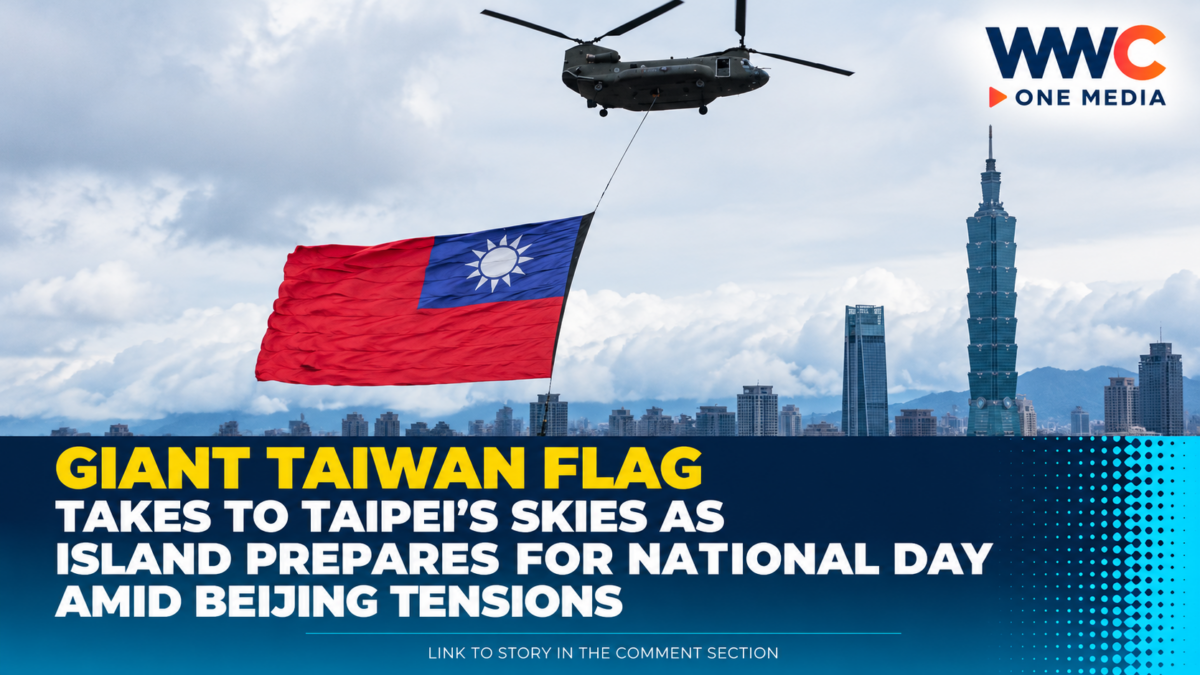
A giant Taiwan flag suspended beneath a military helicopter has become one of the most striking sights ahead of the island’s National Day celebrations, highlighting Taiwan’s determination to maintain its identity amid mounting pressure from Beijing.
The massive Republic of China flag was flown beneath a US-made CH-47SD Chinook helicopter during rehearsals in Taipei on Oct 6, ahead of the Oct 10 celebrations.
The annual display has taken place since 2019, with the flag carried over the Presidential Office as the national anthem is sung. For Taiwan’s authorities and many residents, the spectacle is more than a ceremonial tradition — it is a visible expression of identity and sovereignty.
The event comes as tensions remain high between Taiwan and China, which claims the self-governed island as part of its territory.
A Giant Flag With a Powerful Message
Measuring approximately 12 metres by 18 metres, the flag is made from lightweight, durable material similar to that used in parachutes. It hangs from a long, weighted cable beneath the helicopter to keep it spread out during flight.
Lin Chang-cheng, a pilot involved in the rehearsals, described the flag as a concrete symbol of national sovereignty, saying its display carries particular significance given Taiwan’s limited international recognition.
For residents watching from the hills surrounding Taipei, the sight also evokes ideas of freedom, democracy and the island’s distinct political identity.
However, the flag’s meaning is not universally interpreted in the same way within Taiwan. While some see it as an essential national symbol, others who favour a stronger Taiwanese identity prefer symbols that more clearly distinguish the island from China.
Why the Display Matters to Beijing
China regards Taiwan as part of its territory and has sought to limit the island’s participation in international affairs. Beijing has also opposed the display of Taiwan’s flag at various international events, including sporting competitions where the island competes under the name “Chinese Taipei”.
Taiwan, meanwhile, has its own democratically elected government, military and institutions. Neither Taipei nor Beijing formally recognises the other government.
The helicopter flyover therefore carries political significance beyond its role in the celebrations, particularly as Taiwan continues to face diplomatic and military pressure from China.
Chinese officials had not publicly responded to the latest National Day rehearsal at the time of the Reuters report.
President Lai to Address Taiwan’s Future
Taiwan President Lai Ching-te is scheduled to deliver a keynote address on Oct 10, outlining his administration’s policy priorities and addressing relations with China.
Beijing has strongly criticised Lai in the past, accusing him of pushing Taiwan towards independence. Lai’s government maintains that Taiwan’s future should be decided by its people.
The National Day celebrations mark the anniversary of the 1911 uprising that led to the fall of China’s last imperial dynasty and the establishment of the Republic of China, the name Taiwan officially retains.
The Republic of China government relocated to Taiwan in 1949 after losing the Chinese Civil War to Mao Zedong’s communist forces, which established the People’s Republic of China.
From Military Displays to Global Visibility
Taiwan’s National Day celebrations were once heavily focused on military strength and the ambition to retake mainland China. In recent years, the event has increasingly highlighted the island’s culture, international visibility and democratic identity.
Alongside the flag flyover, this year’s celebrations are expected to feature aerial displays and fireworks near Taipei 101, one of the world’s tallest buildings.
For Taiwan, the annual event offers an opportunity to present itself to the world while reinforcing a sense of unity among its people.
As the island prepares for another National Day, the giant flag flying above Taipei serves as a reminder of the unresolved political dispute across the Taiwan Strait — and the competing views of identity and sovereignty that continue to shape relations between Taipei and Beijing.