Iraqis marked the departure of the last US forces from the country on Wednesday, Sept. 30, with celebrations in Baghdad and Najaf alongside concerns that the withdrawal could create a security gap and give armed groups or Islamic State remnants greater room to operate.
The final US troops left their remaining bases, including a major contingent from an airbase in Erbil in Iraq’s semi-autonomous Kurdistan region. The withdrawal formally ended the US-led coalition’s military mission in Iraq after more than two decades of American involvement.
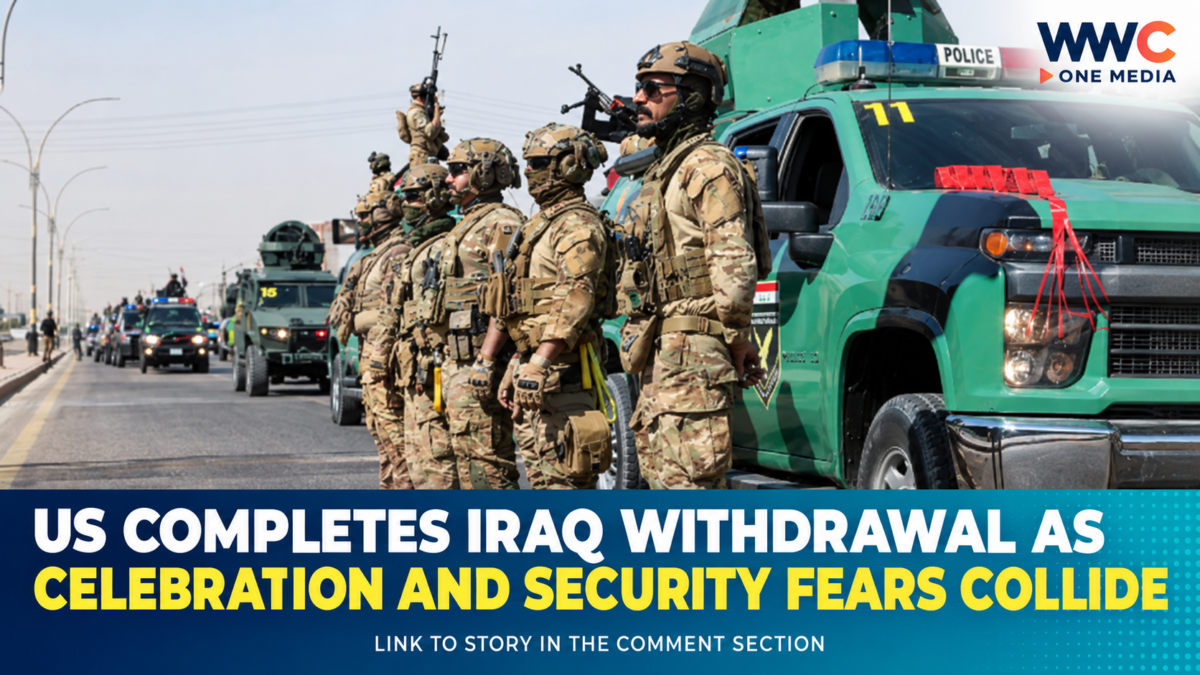
Iraqi security forces paraded vehicles through Baghdad and Najaf as the withdrawal was completed. For some Iraqis, the departure represented a long-awaited return of full national sovereignty after years of foreign military involvement.
The US invasion in 2003 toppled Saddam Hussein but was followed by years of conflict and instability. American troops initially withdrew in 2011, but returned in 2014 after Islamic State fighters captured large areas of Iraq and declared their self-styled caliphate.
The latest withdrawal was agreed in 2024 under then-President Joe Biden and was implemented by President Donald Trump’s administration. More than 4,500 US troops died during the Iraq war, while the Iraq Body Count project estimates that more than 200,000 Iraqi civilians were killed.
The Pentagon said the United States and coalition partners have formally concluded Operation Inherent Resolve. Washington will nevertheless continue providing targeted training and intelligence support to Iraqi partners, meaning the end of the military mission does not represent a complete end to US security cooperation with Iraq.
Iraqi Prime Minister Ali Faleh al-Zaidi said the conclusion of the international coalition mission marks a transition in which Iraq assumes full responsibility for its security and stability. Iraqi forces are expected to continue suppressing Islamic State remnants and maintaining domestic security.
However, some Iraqi analysts and security figures have warned that the country’s forces could face challenges without the US military presence. Concerns include the continued activity of powerful militias operating outside full state control and the possibility that Islamic State sleeper cells could exploit weaknesses.
The withdrawal is also significant for Iran, which has built substantial influence in Iraq through allied armed groups. Iranian-backed groups celebrated the US departure, while analysts said the absence of American forces could increase Tehran’s influence over Iraq’s security and political environment.
Iraq’s government now faces the task of maintaining security while balancing relations with both Washington and Tehran. The country remains a strategic partner of the United States but is also closely connected to Iran through political, economic and armed-group networks.
The immediate impact of the withdrawal remains uncertain. Iraqi forces now have primary responsibility for protecting the country, while the United States retains a limited role through training and intelligence support.
For many Iraqis, the departure closes a major chapter that began with the 2003 invasion. The next phase will test whether Iraq can maintain security and contain armed groups and Islamic State remnants without the presence of US-led coalition forces.