
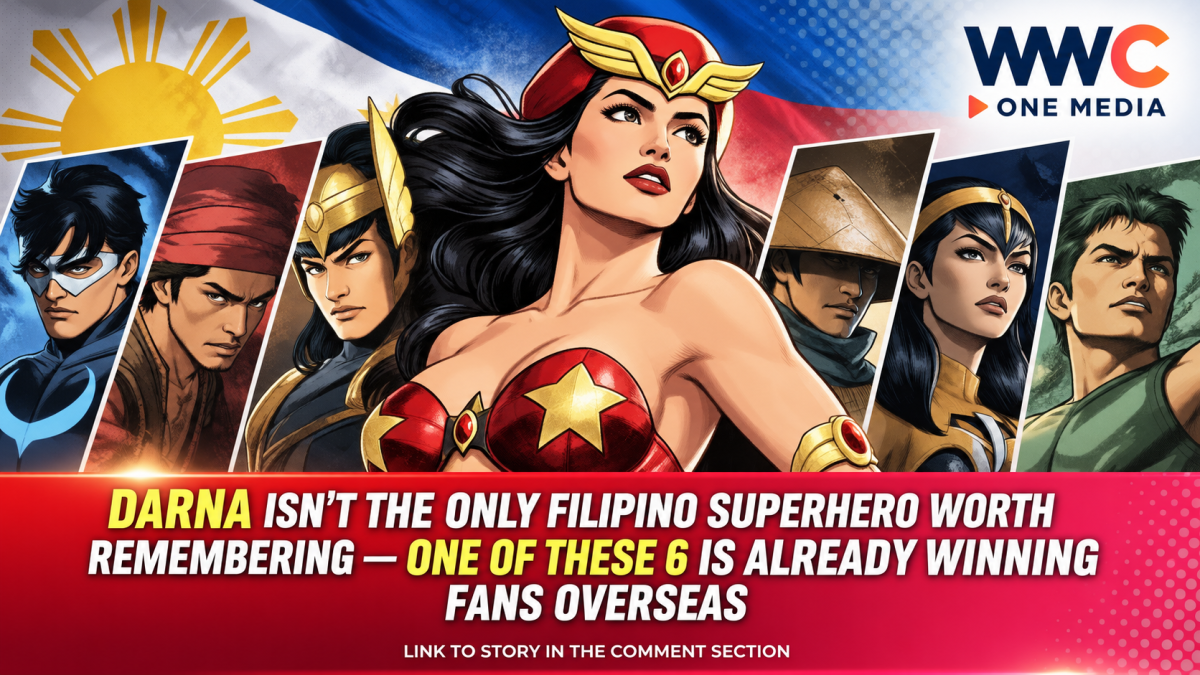
Long before superhero universes became billion-dollar franchises, Filipino pop culture already had its own extraordinary lineup: a woman who transforms after swallowing a magical stone, an unlikely strongman powered by a mysterious barbell, an elastic alien, a folk hero armed with supernatural objects, a spider-powered ice cream vendor and a queer superheroine who challenged conventions.
These are not imported characters with Filipino costumes. They are Darna, Captain Barbell, Lastikman, Pedro Penduko, Gagamboy and Zsazsa Zaturnnah — six homegrown heroes highlighted by the Manila Standard in its Sept. 12 feature on characters that helped shape Philippine popular culture.
And in 2026, their stories may be more relevant than nostalgia suggests.
Darna: The Pinay superhero who became a cultural icon
Few Philippine superheroes have endured as powerfully as Darna.
Mars Ravelo had earlier introduced a heroine called Varga in Bulaklak Magazine in 1947. After leaving the publication, Ravelo reworked the concept, and Darna — illustrated by Nestor Redondo — made her debut in Pilipino Komiks No. 77 on May 13, 1950. Her alter ego Narda transforms after swallowing a magical stone and calling out Darna’s name.
The character made the leap to cinema just a year later, with Rosa del Rosario becoming the first actress to play Darna in the 1951 film. Through the decades, the role has been reinvented repeatedly for film and television, with performers including Vilma Santos, Rio Locsin, Nanette Medved, Anjanette Abayari, Angel Locsin, Marian Rivera and Jane de Leon associated with different screen incarnations.
That longevity helps explain why Darna has become more than a costumed crime fighter. Her appeal is built around an ordinary young woman becoming powerful enough to defend people who cannot defend themselves — a theme that has survived enormous changes in Philippine entertainment.
ABS-CBN’s 2022 Mars Ravelo’s Darna, starring Jane de Leon, showed the character could still command attention generations after her creation. Its premiere reached nearly 296,000 concurrent viewers on Kapamilya Online Live on YouTube, according to the network.
Captain Barbell: Power hidden inside the ordinary
Mars Ravelo followed with another enduring superhero concept: Captain Barbell.
Created in 1963 and introduced in Pinoy Komiks Magasin, the classic story centers on the physically unimposing Enteng, whose encounter with a magical barbell allows him to transform into a powerful hero. Early depictions borrowed visually from traditional circus strongmen, while later movie and television adaptations repeatedly redesigned both the character and his origin.
Captain Barbell reached cinemas in the 1960s and was repeatedly revived, including versions involving Herbert Bautista and Edu Manzano, Bong Revilla and, on television, Richard Gutierrez.
The basic fantasy remains easy to understand decades later: the person everyone overlooks may be carrying extraordinary strength.
Lastikman: A Filipino elastic hero decades before today’s CGI era
Then there is Lastikman, another Ravelo creation whose superpower is immediately recognizable from his name.
First appearing in Aliwan Komiks in 1964, Lastikman could stretch and reshape his body into different forms. His original komiks incarnation was extraterrestrial, although subsequent movie adaptations changed his origin story.
Von Serna played the character in a 1968 film, while later adaptations featured Vic Sotto, Mark Bautista and Vhong Navarro.
What once required practical tricks, imagination and limited effects technology could today be realized with sophisticated digital effects — one reason Lastikman remains an obvious candidate for a modern reboot.
Pedro Penduko: A Filipino everyman thrown into the supernatural
Not every local hero needs to fly or possess superhuman muscles.
Pedro Penduko, created by acclaimed Filipino illustrator and storyteller Francisco V. Coching, became a different kind of hero — an ordinary Filipino pulled into a world of witches, monsters and supernatural forces. Manila Standard describes him as an everyman whose adventures place him against extraordinary threats.
Coching, who was later named National Artist for Visual Arts, created dozens of illustrated stories, many of which were eventually adapted for cinema. The Philippine Star identifies Pedro Penduko among his most famous creations, while a more recent film adaptation starred Matteo Guidicelli in the title role.
Unlike heroes defined principally by physical strength, Pedro’s world draws heavily from Filipino ideas about anting-anting, folk belief, monsters and the supernatural.
That gives the character something difficult for imported superheroes to imitate: a mythology unmistakably rooted in the Philippines.
Gagamboy: When Pinoy superhero culture learned to laugh at itself
The list also stretches beyond classic komiks.
Director Erik Matti’s 2004 superhero comedy Gagamboy starred Vhong Navarro as Junie, an ordinary ice cream vendor who develops spider-like powers after an encounter with a chemically affected spider. Jay Manalo played his mutated enemy Ipisman.
Unlike Darna, Captain Barbell and Lastikman, Gagamboy was created for cinema rather than emerging from the classic komiks tradition.
That difference matters.
The film embraced parody and the recognizable conventions of foreign superhero movies while turning them into something distinctly Filipino — complete with humor, neighborhood settings and characters far removed from billionaire vigilantes or intergalactic warriors.
It also travelled beyond the Philippines. Contemporary reporting noted that Gagamboy appeared at international film festivals, including events in Hong Kong and Italy.
Zsazsa Zaturnnah: The superhero who broke the old mold
Perhaps the most striking example of how Filipino superhero storytelling continued evolving is Zsazsa Zaturnnah.
Created by Carlo Vergara, the character emerged from the 2002 graphic novel Ang Kagila-gilalas na Pakikipagsapalaran ni Zsazsa Zaturnnah. At the center is Ada, a gay beauty salon owner who gains a glamorous, superpowered female alter ego after swallowing a mysterious object from space.
The story became a successful stage musical and was adapted for live-action cinema.
Now, more than two decades after the original graphic novel appeared, Zsazsa has reached an even bigger international platform.
Avid Liongoren’s animated Zsazsa Zaturnnah was selected for the prestigious 2026 Annecy International Animation Film Festival in France, putting a distinctly Filipino and queer superhero story before a global animation audience.
The film later took a bronze audience award at Canada’s Fantasia International Film Festival, providing fresh evidence that this decades-old local character can still connect with audiences well beyond the Philippines.
Why Filipino superheroes suddenly feel relevant again
The larger story is not simply that the Philippines has its own version of superheroes.
It is that Philippine creators were building these characters, transforming them across media and embedding them in local culture long before today’s obsession with shared cinematic universes.
Darna represents sacrifice and courage. Captain Barbell turns an underestimated person into a symbol of strength. Lastikman takes the elastic superhero concept into distinctly Filipino territory. Pedro Penduko mixes heroism with folk spirituality. Gagamboy turns the genre into comedy. Zsazsa Zaturnnah expands what a Filipino superhero — and a superhero protagonist — can look like.
There is even renewed public discussion in 2026 about whether familiar Mars Ravelo characters such as Darna, Captain Barbell and Lastikman could eventually form the foundation of a connected Filipino superhero universe. That remains an idea rather than an announced production slate, but its resurfacing reflects continuing interest in putting Philippine heroes back at the center of popular entertainment.
Hollywood may have perfected the modern superhero franchise machine.
But the Philippines does not need to invent its own heroes from scratch.
They have been here for generations.
The more interesting question is whether today’s film, television and streaming industry can give them the scale — and the storytelling — needed to make a new generation care.



Leave a Reply