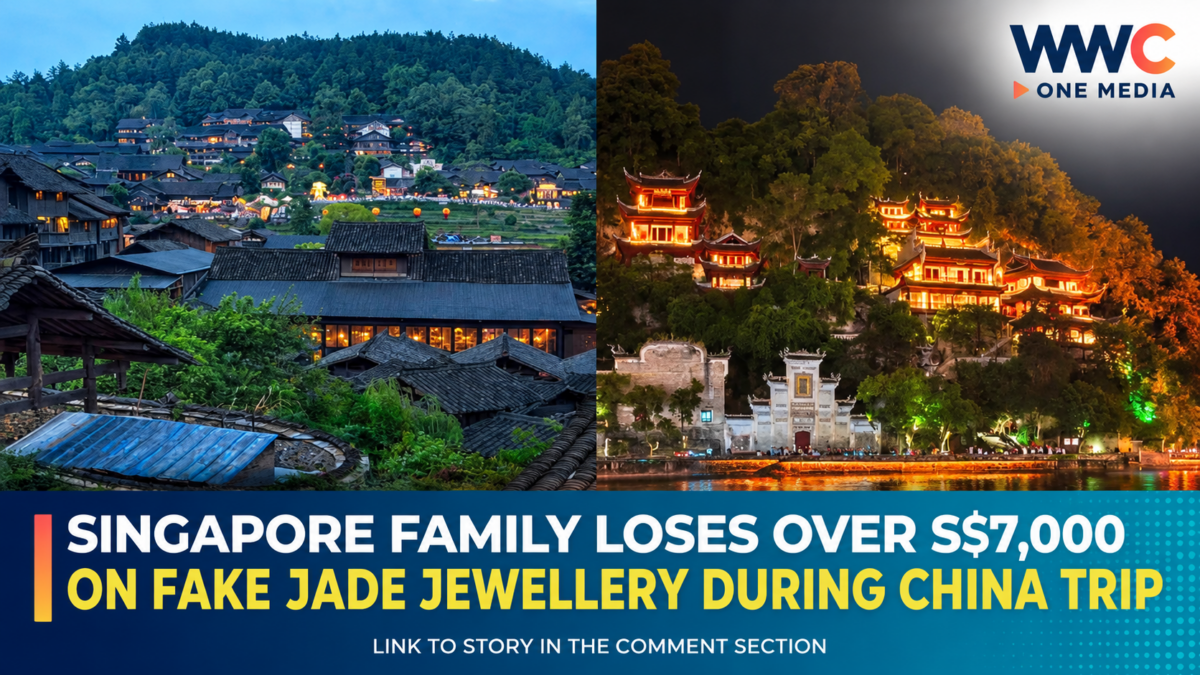
A Singaporean family allegedly spent more than S$7,000 on jewellery they believed was made from genuine jade during a holiday in China’s Guizhou province, only to discover after returning home that at least one of the pieces was made from a much cheaper stone.
The family became involved in the purchase during the final day of a tour of Guizhou. The parents, who were travelling with a group of about 20 people, were taken by their tour guide to a shop selling jade products.
According to their daughter, Liu, 37, her mother initially showed interest in the jewellery but was soon overwhelmed as shop staff continued presenting different products. The couple eventually bought 16 pieces of jewellery for about 37,240 yuan, or roughly S$7,100. Some of the items reportedly came with certificates claiming they were genuine jade.
After returning to Singapore, Liu examined the jewellery and became suspicious about a Buddha pendant that was supposedly made from black jade. Having been interested in jade since she was young, she said she noticed characteristics that did not appear consistent with the gemstone.
The pendant and other pieces were subsequently appraised by the Nan Yang Gemological Institute. The institute reportedly determined that the pendant was not black jade but serpentine, a much more common mineral. Liu said the pendant was worth less than S$100.
Liu then sought help from the Singapore Tourism Board and was advised to approach the bank because the purchase had been made using a credit card. The bank reportedly told her that the refund process could take another 12 to 16 weeks.
The travel agency that organised her parents’ tour said it was aware of the complaint and was checking the circumstances with authorities in China. The agency said it would assist with a refund if the family’s complaint is found to be valid.
The case comes amid continuing concerns over forced shopping and questionable sales practices involving organised tourist groups in China. Chinese authorities announced a year-long campaign in July 2025 targeting tour operators involved in illegal practices such as forcing tourists to shop, with authorities saying enforcement and supervision would be strengthened.
The latest case also follows another incident involving Singaporean tourists in China. In November 2025, a group of 23 Singaporeans travelling in Chengdu said they were pressured to purchase goods at several shops and were not allowed to leave until an unspecified sales quota was met. Chinese police later became involved and the group received a full refund.
For travellers purchasing gemstones or other high-value items overseas, the incident highlights the importance of obtaining independent verification before making expensive purchases, particularly when sales take place as part of an organised tour.