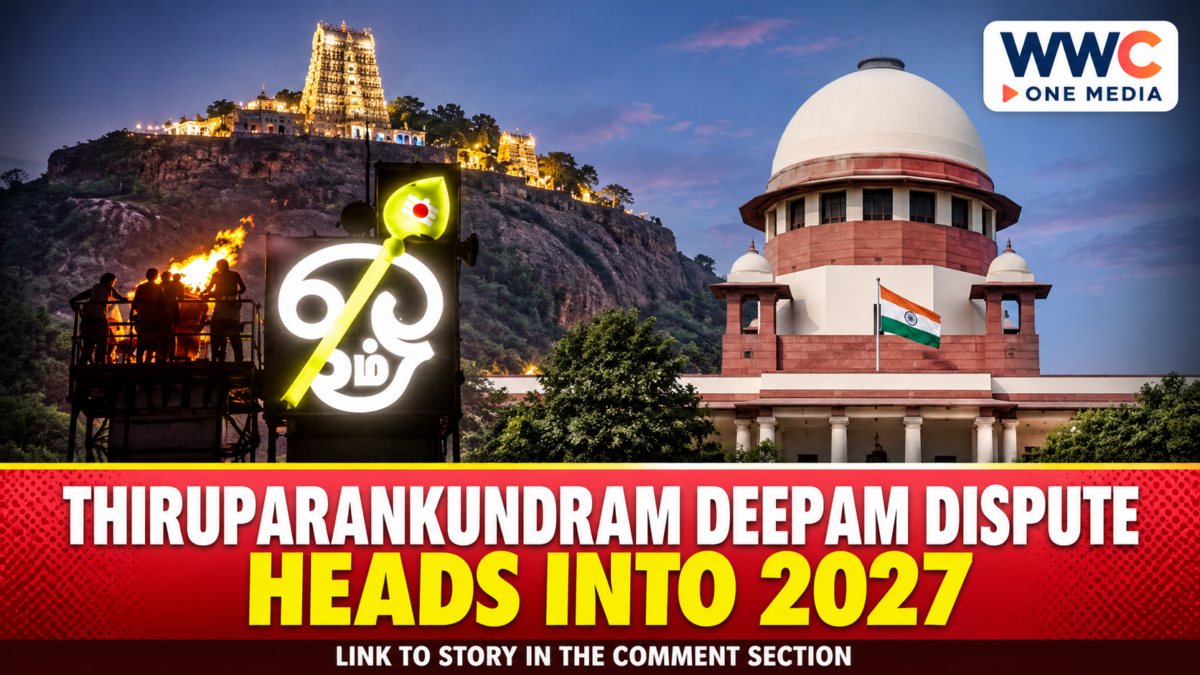
MADURAI, India — November 25, 2026 — India’s Supreme Court has allowed a one-time Karthigai Deepam lamp-lighting arrangement at the Deepathoon stone pillar on Thiruparankundram Hill, while keeping the larger dispute over religious custom, site ownership and access unresolved. The case is scheduled to return to the Court in the second week of January 2027, after the parties complete their pleadings.
The interim order is significant because it separates permission for a particular festival ceremony from a final determination of who has the legal right to use the disputed location. That distinction matters to the temple administration, the parties associated with the nearby Dargah and the public authorities responsible for implementing court directions.
Thiruparankundram Deepam order was limited to one festival
In its November 20 order, the Supreme Court permitted the ceremonial lamp to be lit at the Deepathoon on November 24, 2026. The permission was granted as a temporary, one-time arrangement while the appeals and related proceedings remain under consideration.
The Court made clear that the arrangement did not recognise or enforce any claimed customary, religious or property right. It also stayed the relevant findings in the Madras High Court Division Bench judgment dated January 6, 2026, until further orders.
The Court explained that it was not deciding the competing arguments at the interim stage. Questions about the nature of the alleged custom, the legal status of the site, earlier decrees and the authority of the institutions involved were left for consideration at a later stage.
That wording is central to understanding the case. A temporary permission to conduct a ceremony does not automatically establish a permanent right to repeat it at the same location in future years.
What the Supreme Court required from authorities
The order placed responsibility for coordinating the arrangement on the Madurai District Collector, who was designated as the nodal officer.
The lamp-lighting team was to consist exclusively of persons authorised by the temple administration. The Collector was directed to settle the team’s composition and number in consultation with the Temple Executive Officer, the Archaeological Survey of India and the Madurai Commissioner of Police.
The order also assigned security responsibilities to the police and allowed the Union government to examine the deployment of an appropriate Central Reserve Police Force contingent if the State requested it and operationally required it.
Public access to the Deepathoon itself was restricted. The general public was not permitted to accompany the authorised team, and processions, demonstrations, public congregations and activities unrelated to the ceremonial lighting were prohibited at the site.
The Archaeological Survey of India was tasked with prescribing conditions to protect the monument and its surroundings. Excavation, construction, structural alterations and permanent installations were prohibited.
These conditions show that the Court was not authorising unrestricted access to the hilltop. It established a controlled arrangement for a specific ceremony, with responsibilities distributed among the temple administration and public authorities.
The Court did not settle the religious or property claims
The Supreme Court expressly stated that its interim arrangement did not amount to a finding that the stone pillar was historically a place of customary religious observance.
It also declined to decide whether lighting the lamp there constituted an essential religious practice or whether any individual, religious denomination or institution possessed an enforceable right to do so.
The Court further stated that neither the permission nor the performance of the ceremony could be used as evidence of an established custom, precedent of religious usage, possessory right or entitlement to access while the appeals remained pending.
This is an important safeguard against treating a temporary judicial arrangement as a permanent legal precedent.
The underlying dispute involves more than the location of a ceremonial lamp. It raises questions about religious observance, the authority of temple administrators, historical records, property claims and access to places of worship.
WWC has previously examined how Indian court proceedings can place public authorities under scrutiny in its report on the Supreme Court’s examination of building regulation enforcement. The subject is different, but the institutional issue is relevant: government bodies must distinguish their administrative responsibilities from questions that remain before the courts.
Madras High Court addressed implementation and public access
A separate common order issued by the Madurai Bench of the Madras High Court on November 24 addressed petitions concerning the implementation of the Supreme Court’s directions and restrictions imposed in Madurai.
The High Court recorded that Madurai District Collector Nishant Krishna appeared before it and said he had acted, and would continue to act, in strict compliance with the Supreme Court’s order.
The Collector explained that the prohibitory order issued under Section 163 of the Bharatiya Nagarik Suraksha Sanhita, 2023, was intended to prevent unauthorised persons from climbing the hill. The High Court recorded that the order itself did not apply to actions taken to give effect to the Supreme Court’s directions.
The High Court also addressed the rights of devotees who wished to undertake Girivalam, or circumambulation of the hill, and view the ceremonial lamp from permitted vantage points. It directed that the prohibitory order should not be applied in a manner that prevented those activities, while making clear that members of the public could not climb the hill.
The Court recorded the State’s submission that devotees could undertake Girivalam and visit the main temple at the foot of the hill.
The proceedings illustrate the difference between restricting access to a sensitive hilltop site and preventing lawful religious observances in surrounding areas. Those are separate questions requiring separate treatment.
Why the compliance report matters
The Supreme Court directed the Madurai District Collector to submit a brief report on compliance with its November 20 directions within three days after the festival.
That report is an important next document because it should provide the Court with an official account of how the arrangements were implemented. It may help clarify which authorities participated, what steps were taken and whether the prescribed safeguards were followed.
The November 24 High Court order also records that the Collector had undertaken to comply with the Supreme Court’s directions. The High Court disposed of the petitions after recording the State’s submission and expressed hope that persons unlawfully detained would be released without delay.
The compliance report should not be confused with a final ruling on the underlying dispute. Even a finding that the administrative arrangements were properly carried out would not, by itself, settle ownership or establish a permanent religious custom.
A similar distinction between an interim court direction and a final decision has appeared in other WWC coverage of Indian proceedings, including its report on India’s battery procurement dispute and the effect of a Supreme Court stay.
What happens next
The Supreme Court has directed that the matters be listed in the second week of January 2027, by which time the pleadings are to be completed.
The parties will have an opportunity to place their arguments and supporting records before the Court. The proceedings may then address questions that the November interim order deliberately left unresolved.
For now, the legal position is narrower than either side’s broader claims might suggest: the Supreme Court authorised a one-time arrangement for the November 24 festival, imposed safeguards and reserved the underlying questions for later adjudication.
The next stage will depend on the records submitted by the parties and the Court’s subsequent directions. Until then, neither the temporary permission nor the competing claims should be treated as a final determination of rights over the Deepathoon.
Frequently asked questions
1. What did India’s Supreme Court decide in the Thiruparankundram Deepam dispute?
The Supreme Court permitted a one-time ceremonial lamp-lighting arrangement at the Deepathoon on November 24, 2026, subject to strict safeguards. It did not decide the underlying ownership or customary-rights dispute.
2. Did the Supreme Court establish a permanent right to light the lamp at Deepathoon?
No. The Court expressly stated that its temporary permission did not establish a customary, religious or proprietary right and could not be used as proof of an established practice in future proceedings.
3. Who was responsible for coordinating the November 24 arrangement?
The Madurai District Collector was appointed as the nodal officer. The order required coordination with the temple’s Executive Officer, the Archaeological Survey of India and the Madurai Commissioner of Police.
4. Could the general public access the Deepathoon during the ceremony?
No. The Supreme Court restricted access to an authorised temple team and necessary officials. It prohibited public congregations, processions and demonstrations at the site.
5. When will the Supreme Court consider the dispute again?
The Court directed that the matters be listed in the second week of January 2027, after completion of the pleadings.