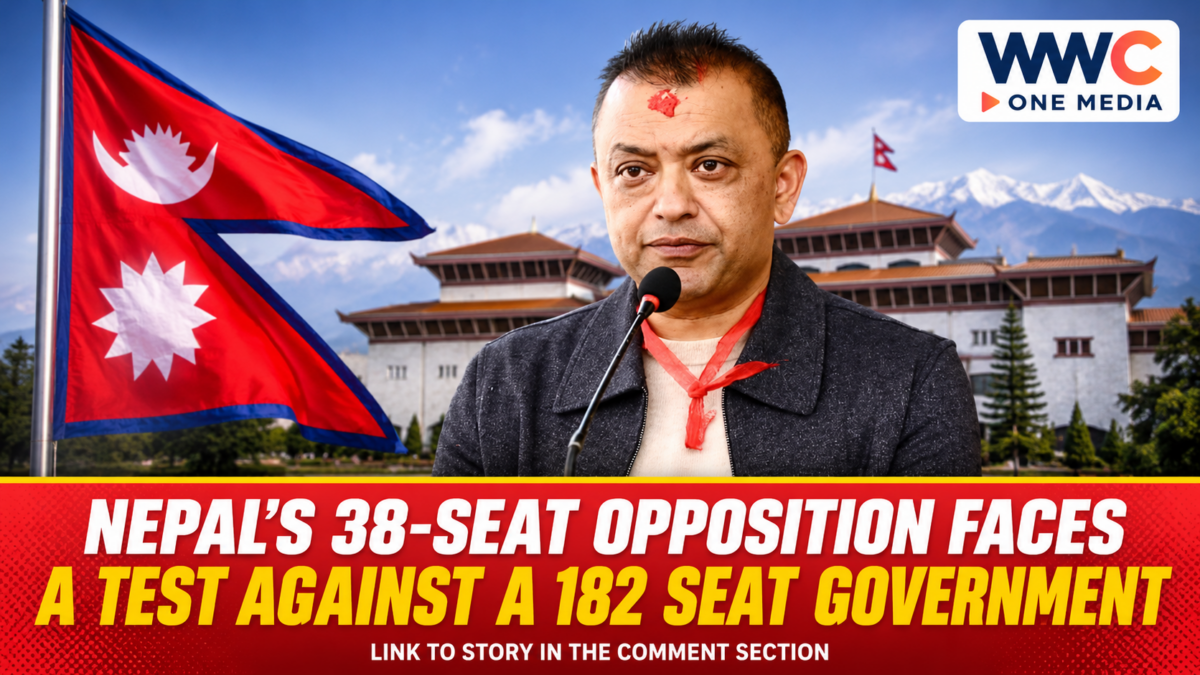
KATHMANDU — Nepal’s parliamentary balance gives the ruling Rastriya Swatantra Party (RSP) a commanding position in the 275-member House of Representatives, while the Nepali Congress holds 38 seats. The difference puts the opposition’s ability to scrutinise government decisions, organise parliamentary challenges and offer credible alternatives under close political scrutiny.
The numbers are more than an election result. They define the environment in which Nepali Congress leaders, including party president Gagan Thapa, must work if the party intends to remain an effective parliamentary counterweight to the government.
The official parliamentary-party listing records 182 RSP members and 38 Nepali Congress members. The RSP therefore holds more than four times the Congress seat count and has a majority large enough to shape the government’s legislative programme without relying on the opposition for ordinary votes.
That does not make the opposition irrelevant. It makes the quality of its work more important.
Nepal opposition faces a steep parliamentary imbalance
The House has 275 seats. The RSP’s 182 members account for roughly 66.2% of the chamber, while the Nepali Congress’s 38 seats represent about 13.8%.
The remaining seats are distributed among other parties and an independent member. The official listing records 25 members for the Communist Party of Nepal (UML), 17 for the Nepal Communist Party, seven for the Shram Sanskriti Party, five for the Rastriya Prajatantra Party and one independent member.
This composition gives the ruling party considerable room to advance legislation. It also means the Congress cannot rely on its own numbers to defeat government measures through a simple vote.
But parliamentary influence is not measured only by the ability to block a bill. Opposition lawmakers can question ministers, examine proposed laws, raise constituency concerns, scrutinise public expenditure and demand explanations through parliamentary procedures.
The practical test is whether those tools are used consistently and with evidence.
A majority does not remove the need for scrutiny
A large governing majority can make decision-making more predictable. It can also reduce the need for compromise with smaller parties when the ruling bloc is united.
That creates a responsibility for the opposition to focus on the substance of government action rather than treating every policy disagreement as a contest over power.
Effective scrutiny requires more than criticism. Lawmakers need to examine draft legislation, identify gaps in implementation, ask for supporting data and explain how proposed measures may affect citizens, businesses and public institutions.
The same standard should apply when the government pursues policies that the opposition supports. A responsible opposition can acknowledge sound decisions while still asking whether they are properly funded, legally grounded and capable of delivering their stated results.
For the Congress, the challenge is to demonstrate that parliamentary oversight can be constructive without becoming passive.
The Congress needs a clear identity beyond its seat count
With 38 seats, the Nepali Congress has a smaller parliamentary presence than the RSP, but it remains one of the represented political parties in the House. Its influence will depend partly on whether it can establish a coherent position on major national questions.
That means identifying which government proposals deserve support, which require amendment and which raise concerns serious enough to justify sustained opposition.
It also means explaining those positions to the public. A party that only objects after decisions are made risks appearing reactive. A party that presents workable alternatives can make its arguments relevant even when it lacks the votes to control the outcome.
This is where organisational discipline matters. Members need consistent policy positions, clear parliamentary priorities and a credible way to communicate the results of their scrutiny.
The question is not simply whether the Congress can oppose the government. It is whether it can show voters what its opposition is intended to achieve.
Parliamentary accountability depends on evidence
Opposition politics is most useful when it turns public concerns into questions that institutions must answer.
For example, concerns about spending should be tied to budget documents and implementation records. Questions about public appointments should be grounded in the relevant legal requirements and disclosed procedures. Claims of misconduct should be supported by evidence and handled through the appropriate oversight or investigative bodies.
This approach protects the credibility of the opposition as well as the public interest. Unsupported accusations may generate attention, but they can weaken legitimate scrutiny and distract from verifiable policy failures.
The broader democratic principle is that a government’s electoral mandate does not exempt it from accountability. Equally, an opposition party’s duty to scrutinise does not give it licence to misrepresent facts.
WWC has examined similar questions in its coverage of the debate over voters’ right to elect local leaders, where the legal framework and the public’s electoral rights must be considered separately from political arguments.
Nepal’s political test extends beyond the chamber
The balance of seats is only one measure of political strength. Public confidence, internal party organisation, policy credibility and the ability to work with other parliamentary groups can also shape how much influence an opposition party exercises.
For the Congress, a clear programme on governance, public services, economic policy and institutional independence could help it build support beyond its current parliamentary numbers. But that programme must be specific enough for voters to assess.
The party also faces a communication challenge. It needs to explain not only what it opposes, but what it would do differently and how its proposals could be implemented.
Other democracies offer a useful comparison, although their political systems and circumstances are not identical. WWC’s reporting on Spain’s election debate and competing approaches to democratic renewal illustrates how opposition and governing parties are judged not just by criticism, but by the policy alternatives they place before voters.
Nepal’s parliamentary arithmetic gives the RSP a strong legislative position. It does not settle whether government decisions will be effective, fair or accountable. Those questions will be answered through performance, scrutiny and the institutions responsible for checking the exercise of power.
What happens next
The key indicators will be how the government uses its majority, how parliamentary committees examine its work and whether opposition lawmakers consistently use the House’s procedures to seek answers.
For the Nepali Congress, the immediate task is to turn its 38 seats into a disciplined oversight platform. That will require clear policy positions, evidence-based criticism and cooperation where public interests justify it.
The opposition cannot change the seat count through speeches. It can, however, influence the quality of debate and make government decisions more visible to the public.
That is the measure by which its parliamentary role should be judged.
FAQ
How many seats does the Nepali Congress hold in Nepal’s House of Representatives?
The official parliamentary listing records 38 Nepali Congress members in the 275-seat House of Representatives.
Which party has the most seats in Nepal’s parliament?
The Rastriya Swatantra Party is the largest parliamentary party, with 182 seats in the official listing.
Does the RSP have a majority in Nepal’s House of Representatives?
Yes. Its 182 seats amount to approximately 66.2% of the 275-member chamber.
Can the Nepali Congress influence government decisions with only 38 seats?
Yes. Although it cannot outvote the RSP on its own, it can question ministers, scrutinise bills, participate in committees, raise constituency issues and work with other parties.
What makes an opposition party effective?
An effective opposition uses evidence to scrutinise government decisions, offers credible policy alternatives, explains its positions publicly and holds the government accountable through parliamentary procedures.