
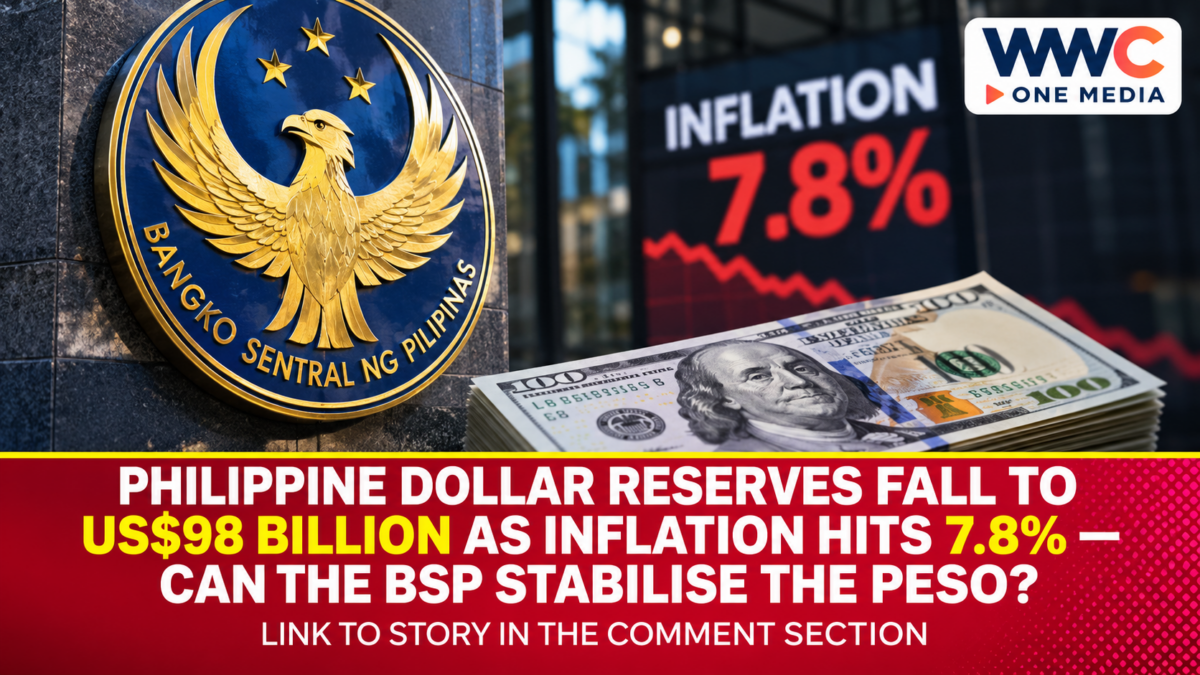
MANILA, Philippines — The Philippine peso is facing mounting economic pressure as the country’s foreign currency reserves decline, consumer prices accelerate and borrowing costs remain elevated, creating a difficult balancing act for the Bangko Sentral ng Pilipinas (BSP).
Gross international reserves fell to US$97.95 billion at the end of October 2026, down from approximately US$99.49 billion in September.
Meanwhile, headline inflation accelerated to 7.8% in October, while the BSP’s benchmark interest rate stood at 5.50% as of November 24.
The central bank’s latest available data for November 24 placed the exchange rate at ₱63.863 per US dollar.
Together, these developments highlight the increasingly complicated economic environment facing households, importers, exporters and businesses with foreign currency obligations.
The bigger challenge is whether monetary authorities can restore price stability and preserve sufficient foreign reserves without placing excessive pressure on economic activity.
Philippine Peso Under Pressure as Foreign Reserves Decline
The Philippines’ international reserves have declined considerably from levels recorded earlier in 2026.
The country’s latest reported reserve position of US$97.95 billion represents a decrease of approximately US$1.54 billion from the preceding month.
The deterioration matters because international reserves provide an important financial buffer against external economic shocks.
These assets help support a country’s ability to meet international payment obligations, including those associated with imports and foreign debt.
However, gross international reserves are not composed entirely of US-dollar cash. They also include other eligible international financial assets.
A reduction in reserves does not automatically mean that the central bank has spent an equivalent amount defending the currency.
Changes in asset valuations, international financial transactions and government foreign currency requirements can also affect the reported balance.
The distinction between supporting currency stability and preserving foreign reserves has previously emerged in WWC ONE MEDIA’s coverage of the Philippine peso’s earlier recovery from record-low levels.
For monetary authorities, the objective involves managing currency-related risks without unnecessarily exhausting the financial resources available to respond to future economic shocks.
Inflation Reaches 7.8% as Transport Costs Surge
The Philippines’ latest inflation figures reveal significant pressure on household purchasing power.
The Philippine Statistics Authority recorded annual inflation of 7.8% in October, compared with 7.2% in September and 1.7% in October 2025.
Average inflation for the first ten months of 2026 reached 5.6%.
Transportation expenses were among the principal contributors to the latest acceleration.
| Inflation indicator | September 2026 | October 2026 |
|---|---|---|
| Headline inflation | 7.2% | 7.8% |
| Core inflation | 4.8% | 5.4% |
| Transport | 14.6% | 20.1% |
| Housing, water, electricity, gas and other fuels | 8.4% | 9.3% |
| Food inflation | 6.8% | 6.4% |
| Rice inflation | 20.3% | 20.7% |
Although overall food inflation moderated, rice prices continued increasing at a substantially faster annual rate than the general consumer price index.
The acceleration in core inflation also deserves attention because it indicates that price pressures extend beyond selected volatile food and energy products.
These developments reinforce the challenges identified in the Philippines’ broader inflation and economic growth outlook.
For households, higher essential expenses can reduce the income available for discretionary purchases, savings and debt repayments.
BSP Interest Rate Remains at 5.50%
Official central bank statistics identify the target reverse repurchase rate at 5.50% as of November 24, 2026.
The overnight lending facility rate stood at 6.00%.
Higher policy rates are intended to tighten financial conditions and help contain inflationary pressures.
They can influence commercial lending rates, consumer borrowing decisions and business investment.
However, monetary policy does not immediately eliminate every source of inflation.
Higher interest rates cannot directly increase agricultural output, expand energy supplies or resolve international transportation disruptions.
Instead, monetary tightening generally seeks to influence demand, financing conditions and expectations about future prices.
Its commercial consequences may include more expensive variable-rate borrowing and greater caution among companies considering expansion.
The extent of these effects will depend on individual loan agreements, banking conditions and the wider economy.
Trade Deficits Reveal a Deeper Foreign Currency Challenge
The Philippines’ external accounts provide additional context for the pressure on the peso.
During the second quarter of 2026, the country recorded merchandise exports of US$17.256 billion and merchandise imports of US$37.061 billion on a balance-of-payments basis.
The resulting goods trade deficit reached US$19.805 billion.
However, other international transactions helped offset part of this imbalance.
The country recorded a services trade surplus of approximately US$2.106 billion and net secondary income of US$7.778 billion.
These figures illustrate why assessing the country’s external financial position requires more than examining merchandise trade alone.
Services exports, overseas income transfers, foreign investment and other international transactions can influence the availability of foreign currency.
Nevertheless, the overall current account recorded a deficit of US$8.968 billion during the second quarter.
More recently, the country’s overall balance of payments posted a deficit of US$1.499 billion in October, following a US$3.144 billion deficit in September.
For an import-dependent business, a weaker peso can increase the domestic currency cost of overseas purchases.
Exporters receiving foreign currency may experience different financial effects, depending on their imported inputs, operating expenses and financing arrangements.
The wider consequences of currency depreciation have also been examined in the impact of a weakening peso and El Niño on Philippine economic targets.
What the Weak Peso Means for Households and Businesses
Currency movements can affect consumers through the prices of imported goods and products manufactured using overseas materials.
Fuel importers, retailers and industrial businesses may face higher peso-denominated purchasing costs when the domestic currency depreciates.
Companies must then decide whether to absorb additional expenses, improve operating efficiency or adjust selling prices.
However, not every exchange-rate movement translates immediately into higher retail prices.
Existing inventory, supply contracts, market competition and currency hedging arrangements can influence the timing and extent of price changes.
For households receiving US-dollar remittances, a weaker peso can increase the domestic currency value of each dollar received. Rising living costs, however, may offset part of that benefit.
The interaction between purchasing power and economic confidence has also emerged in the financial pressure facing Filipino consumers despite improving confidence.
For businesses, the immediate concern is whether household spending can remain resilient while essential expenses and borrowing costs remain elevated.
What Happens Next for the Philippine Peso?
The next significant indicators will include updated international reserve balances, inflation statistics, balance-of-payments figures and future monetary policy decisions.
A moderation in inflation could eventually provide policymakers with greater flexibility, while improving external financial flows could help support currency stability.
Conversely, persistent import costs and additional foreign currency outflows could complicate the recovery.
Neither outcome is guaranteed.
The latest figures establish that the Philippines faces substantial economic pressures, but they do not independently establish that a currency collapse or sovereign debt crisis is imminent.
The challenge for the BSP is balancing price stability, external financial resilience and the broader economic consequences of tighter monetary conditions.
For households and businesses, the eventual recovery will be measured not simply by a stronger peso, but by improving purchasing power and more predictable financial conditions.
Frequently Asked Questions
How much are the Philippines’ gross international reserves?
The latest official figures place gross international reserves at US$97.95 billion at the end of October 2026.
What was the Philippine peso exchange rate on November 24, 2026?
The BSP’s published exchange-rate series recorded ₱63.863 per US dollar for November 24.
What is the current BSP policy rate?
The target reverse repurchase rate stood at 5.50% as of November 24, 2026.
Why is Philippine inflation increasing?
The October inflation acceleration was primarily influenced by faster price increases in transportation and housing, water, electricity, gas and other fuels.
Does declining foreign currency reserves mean the Philippines is running out of dollars?
No. Declining reserves warrant monitoring, but the country still holds substantial international reserve assets. A reduction alone does not establish an imminent financial crisis.










