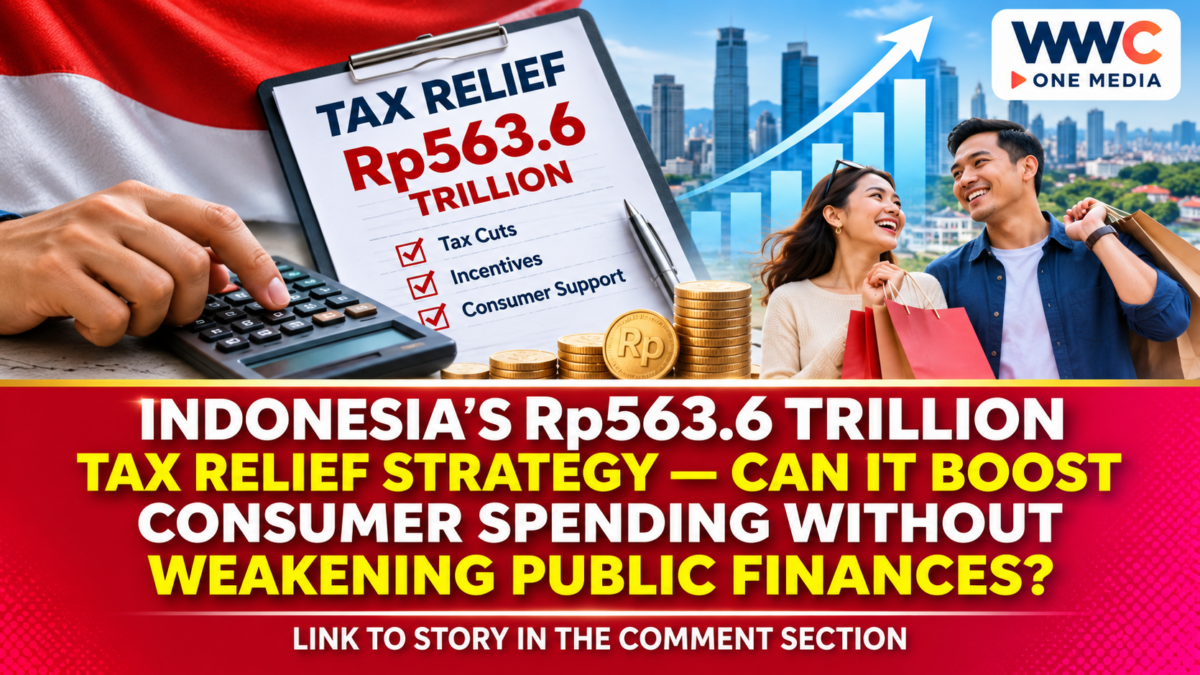
JAKARTA, Indonesia — Indonesia’s tax incentives are becoming an increasingly important instrument for supporting household purchasing power, business expansion and industrial competitiveness as the government balances its economic growth ambitions against fiscal sustainability.
The Ministry of Finance’s Tax Expenditure Report 2024, published on December 31, 2025, projected tax expenditure of Rp563.6 trillion for 2026, equivalent to 2.19% of gross domestic product (GDP).
The earlier projection represents a substantial increase from the estimated Rp400.1 trillion recorded in 2024.
Unlike conventional government expenditure, tax incentives allow qualifying households and businesses to retain money that would otherwise be collected under benchmark taxation rules.
However, the growing scale of these incentives raises an important economic question: Can Indonesia generate enough additional consumption, employment and investment to justify the revenue it deliberately forgoes?
Indonesia Tax Incentives: How the Government Supports Economic Activity
Tax expenditure refers to the estimated government revenue forgone through preferential taxation arrangements, including exemptions, reduced rates and other fiscal incentives.
These measures can support economic activity without requiring equivalent direct cash transfers from the state budget.
Indonesia’s Ministry of Finance has identified household welfare, micro, small and medium-sized enterprises (MSMEs), investment conditions and business competitiveness as important objectives of its tax expenditure framework.
The ministry’s 2024 report illustrates how the value of these arrangements has developed.
| Year | Tax expenditure | Share of GDP |
|---|---|---|
| 2021 | Rp293.0 trillion | 1.73% |
| 2022 | Rp328.5 trillion | 1.68% |
| 2023 | Rp360.0 trillion | 1.72% |
| 2024 | Rp400.1 trillion | 1.81% |
| 2025 projection | Rp530.3 trillion | 2.23% |
| 2026 projection | Rp563.6 trillion | 2.19% |
All figures reflect the estimates published in the 2024 Tax Expenditure Report. Subsequent government assessments may revise these amounts.
The longer-term increase demonstrates the growing financial significance of preferential taxation within Indonesia’s economic strategy.
Nevertheless, a larger estimated incentive value does not necessarily mean that the government has introduced an equivalent amount of entirely new tax relief. Changes in economic activity and the use of existing facilities can also influence tax expenditure estimates.
Households and Small Businesses Receive a Major Share
The 2024 report identifies household purchasing power and small business development as two principal beneficiaries of Indonesia’s tax expenditure framework.
| Policy objective | Estimated 2024 tax expenditure | Share |
|---|---|---|
| Household support | Rp181.4 trillion | 45.3% |
| MSME development | Rp89.0 trillion | 22.2% |
| Investment climate | Rp76.2 trillion | 19.0% |
| Business support | Rp53.6 trillion | 13.4% |
Individual amounts and percentages are rounded independently.
Together, households and MSMEs accounted for approximately two-thirds of estimated tax expenditure in 2024.
The government’s approach includes preferential value-added tax arrangements for specified essential goods and services, alongside simplified income tax arrangements for qualifying small businesses.
For consumers, reduced taxation could help limit the cost of eligible goods and services. For smaller businesses, preferential arrangements may provide additional financial flexibility.
However, the actual benefit depends on the applicable regulations, market competition and the circumstances of individual beneficiaries.
Businesses should not assume that every tax incentive is automatically available to them.
Manufacturing Leads Indonesia’s Sectoral Tax Incentive Distribution
Indonesia’s manufacturing industry represents an important component of the government’s fiscal support strategy.
In 2024, manufacturing accounted for an estimated Rp98.9 trillion in tax expenditure, the largest amount among individually identified economic sectors.
Other significant beneficiaries included agriculture, financial services, transportation and education.
| Economic sector | Estimated 2024 tax expenditure |
|---|---|
| Manufacturing | Rp98.9 trillion |
| Other services | Rp49.9 trillion |
| Agriculture | Rp49.2 trillion |
| Financial services and insurance | Rp45.8 trillion |
| Transportation and warehousing | Rp29.4 trillion |
| Trade | Rp27.2 trillion |
| Education services | Rp21.6 trillion |
| Health and social services | Rp13.6 trillion |
The distribution highlights the importance of fiscal policy in supporting productive industries alongside household consumption.
Nevertheless, the estimated tax benefit received by a sector does not independently establish the amount of additional investment or employment generated.
The commercial effectiveness of such policies requires separate evaluation.
This challenge also extends to Indonesia’s ambitious Rp10,303 trillion infrastructure investment programme and its reliance on private capital.
For Jakarta, attracting investment involves more than offering favourable tax treatment. Businesses must also be confident that projects can generate sustainable returns.
Tax Relief Could Help Businesses Navigate Higher Borrowing Costs
Indonesia’s fiscal incentives are particularly relevant amid tighter monetary conditions.
On November 18, 2026, Bank Indonesia raised its benchmark interest rate by 25 basis points to 6.00%.
The central bank also increased its Deposit Facility rate to 5.25% and its Lending Facility rate to 6.75%.
The decision was intended to strengthen rupiah stability and maintain inflation within the official target range.
October consumer price inflation stood at 3.23% year on year, while volatile food inflation reached 5.81%.
Higher borrowing costs can complicate investment decisions, particularly for businesses dependent on external financing.
Under these circumstances, appropriately targeted tax incentives could provide some financial relief, although they cannot automatically offset every increase in financing or operating costs.
The interaction between currency stability and economic activity has also been examined in Indonesia’s recent interest rate increase to 6%.
Maintaining coordination between fiscal and monetary policy will remain important as Indonesia pursues its development objectives.
Could Tax Incentives Create a Hidden Fiscal Burden?
Tax expenditure presents a different accounting challenge from conventional public spending.
When the government provides a direct subsidy, public funds are transferred to eligible beneficiaries through an expenditure programme.
When it provides a tax exemption, qualifying taxpayers retain resources that would otherwise be collected under the benchmark tax framework.
Both approaches can pursue similar economic objectives, but their administrative and financial consequences differ.
A growing tax expenditure figure warrants examination because government revenue also supports public infrastructure, healthcare, education and other essential services.
However, eliminating every incentive would not necessarily generate an equivalent increase in tax collections.
Businesses and households could respond by changing investment decisions, purchasing behaviour or other economic activities.
The University of Indonesia’s economic research institute, LPEM FEB UI, identifies this distinction in its 2027 economic outlook, emphasising the importance of systematically evaluating the effectiveness of tax preferences.
For policymakers, the central challenge is determining which incentives produce meaningful public benefits and which may need to be redesigned.
This issue also forms part of the broader fiscal responsibilities explored in Indonesia’s finance ministry leadership transition and investor confidence.
What Happens Next for Indonesia’s Tax Incentive Strategy?
Future assessments should examine whether individual tax incentives generate additional investment, improve household welfare or support sustainable employment.
The value of revenue forgone is only one measurement. Equally important are the economic outcomes achieved through those policies.
This consideration is particularly relevant to emerging industries, including Indonesia’s carbon market and its efforts to attract commercially viable clean energy investment.
Tax incentives can provide an important foundation for economic development, but they cannot independently guarantee project financing, stronger consumer demand or business profitability.
Indonesia’s long-term challenge will be ensuring that preferential taxation delivers measurable benefits while maintaining sufficient resources to finance public services.
The success of its tax incentive strategy will ultimately depend not simply on how much revenue the government forgoes, but on how effectively that financial flexibility contributes to sustainable economic growth.
Frequently Asked Questions
How much tax expenditure did Indonesia project for 2026?
The Ministry of Finance’s Tax Expenditure Report 2024, published in December 2025, projected Rp563.6 trillion for 2026. This represents an earlier projection that may subsequently be revised.
What is tax expenditure?
Tax expenditure is the estimated government revenue forgone through preferential tax provisions, including exemptions and reduced rates.
Who benefits from Indonesia’s tax incentives?
The framework supports qualifying households, MSMEs, businesses and investment activities across various economic sectors.
Which Indonesian industry received the largest sectoral tax expenditure in 2024?
Manufacturing, with an estimated Rp98.9 trillion in tax expenditure.
Are tax incentives the same as direct government spending?
No. Tax incentives reduce qualifying tax obligations, while direct government spending involves payments or expenditure through public budgets.