
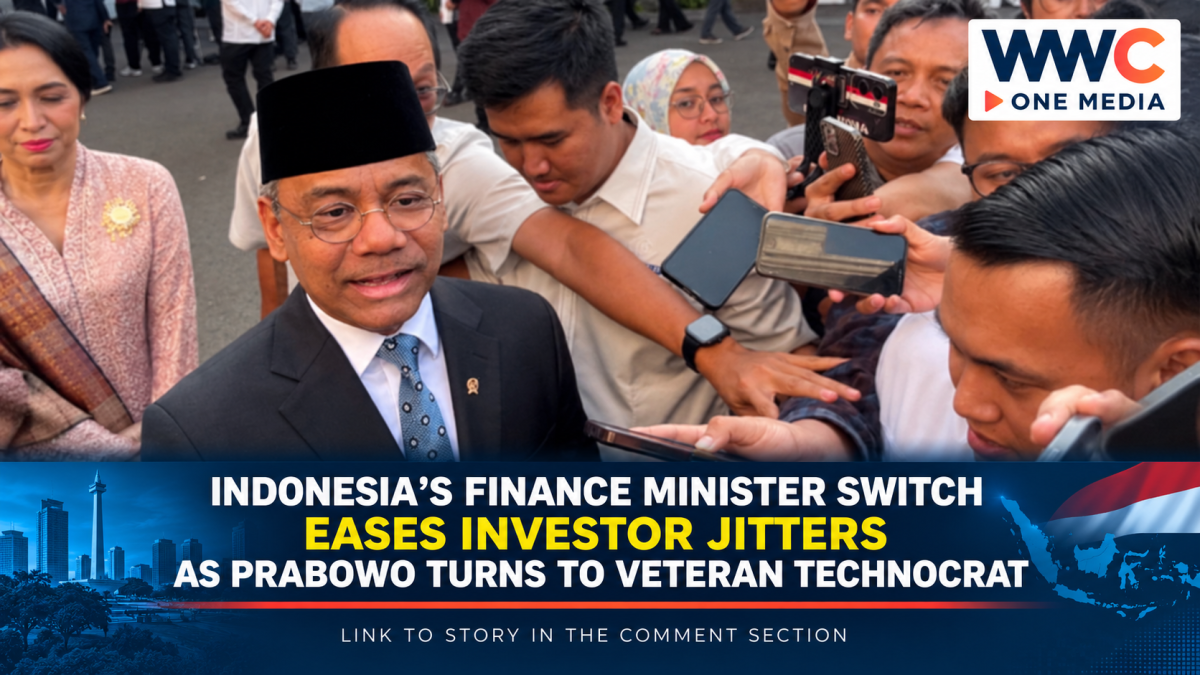
Indonesia’s surprise decision to replace Finance Minister Purbaya Yudhi Sadewa with veteran technocrat Suahasil Nazara is being welcomed by investors as a potentially stabilising move after months of concern over fiscal policy, market volatility and the government’s ambitious spending plans.
President Prabowo Subianto appointed Suahasil, the former deputy finance minister, on Sept. 14, making him the third person to hold Indonesia’s top finance post since Prabowo took office in October 2024.
The abrupt change initially unsettled markets, but investor sentiment improved after Suahasil was confirmed.
The Jakarta Composite Index, which had fallen sharply during the day, recovered most of its losses after the appointment was announced.
Why investors were worried about Purbaya
Purbaya took over as finance minister in September 2025 after replacing long-serving minister Sri Mulyani Indrawati.
His appointment was initially seen as a sign that Prabowo wanted a more aggressive approach to economic growth and government spending.
Purbaya openly supported policies aimed at boosting economic activity and had pushed for greater use of fiscal and financial measures to stimulate growth.
But his approach also raised concerns among investors about the government’s commitment to fiscal discipline.
Indonesia’s weakening rupiah, widening fiscal pressures and uncertainty over several economic policies added to market anxiety.
Credit-rating agencies Fitch and Moody’s have also placed Indonesia’s outlook under pressure, reflecting concerns over policy uncertainty and the government’s fiscal direction.
Suahasil offers a more familiar face to investors
Suahasil is viewed very differently.
The 55-year-old economist has spent years inside the Finance Ministry and has served as deputy finance minister since 2019.
He previously headed the ministry’s Fiscal Policy Agency, giving him extensive experience in managing Indonesia’s budget and communicating with financial markets.
His appointment therefore represents less of a radical change in personnel and more of a return to a familiar, technocratic style of fiscal management.
For investors, that familiarity matters.
Suahasil already knows the ministry’s machinery, senior officials and budget process, reducing the risk of a prolonged period of uncertainty following Purbaya’s sudden departure.
New minister promises fiscal discipline
Suahasil moved quickly to reassure markets after taking office.
He pledged to maintain the credibility of Indonesia’s state budget and keep the fiscal deficit within the country’s legal ceiling of 3 per cent of gross domestic product.
He also presented his appointment as a continuation rather than a dramatic policy reversal.
That message is important because investors have been increasingly focused on whether Prabowo’s ambitious economic agenda can be financed without putting excessive pressure on government finances.
Suahasil will therefore need to demonstrate that Indonesia can continue funding major programmes while maintaining confidence in its fiscal position.
The challenge: growth versus fiscal discipline
Prabowo has set an ambitious target of eventually lifting economic growth to 8 per cent.
His administration has also launched expensive programmes, including a nationwide free school meals initiative and other development and social-welfare projects.
The challenge for Suahasil will be ensuring that these programmes do not undermine the credibility of the national budget.
Investors are looking for evidence that spending will be carefully prioritised and that government finances will remain sustainable.
The new finance minister’s technocratic background could make it easier for him to communicate that message.
But the ultimate direction of fiscal policy will still depend heavily on Prabowo and his willingness to balance political priorities with market concerns.
Markets initially reacted with relief
The appointment triggered a rapid change in market sentiment.
The Jakarta Composite Index had fallen by more than 2.5 per cent at one point amid uncertainty surrounding the cabinet shake-up and broader global market pressures.
After Suahasil was announced, much of the decline was erased.
The reaction suggested that investors viewed the appointment as a signal of greater policy predictability.
The Indonesian rupiah and local financial assets also came under scrutiny as investors assessed whether the new minister would be able to restore confidence in the country’s economic management.
The immediate response was positive, but analysts cautioned that sentiment alone will not be enough.
Oil prices and subsidies pose another test
One of Suahasil’s immediate challenges will be managing the impact of global energy prices.
Indonesia remains sensitive to movements in international oil prices because higher fuel costs can increase the government’s subsidy burden.
Keeping fuel prices affordable can help protect households from inflation, but extensive subsidies can put additional pressure on the state budget.
The government will therefore have to balance economic support with fiscal sustainability.
That task could become increasingly difficult if global energy prices remain elevated.
Relations with the central bank also matter
Another challenge will be maintaining effective coordination between the Finance Ministry and Bank Indonesia.
During Purbaya’s tenure, some of his economic proposals and interventions raised questions about the appropriate division between fiscal and monetary policy.
Investors generally prefer clear coordination between the government and central bank, particularly when markets are under pressure.
Suahasil’s more conventional technocratic approach could help reduce tensions and improve communication between the two institutions.
That could become important as Indonesia attempts to support growth without undermining the rupiah or reigniting inflation.
A second finance minister change under Prabowo
The reshuffle also highlights how quickly Indonesia’s economic leadership has changed under Prabowo.
Purbaya was already the second finance minister of the administration after Sri Mulyani, one of Indonesia’s most internationally respected economic officials.
Replacing him after only about a year creates questions about policy continuity.
The appointment of Suahasil appears designed to answer at least some of those concerns by placing an experienced Finance Ministry insider in charge.
But investors will ultimately judge the government by its policies rather than its personnel.
The 2027 budget will be the real test
Suahasil’s biggest early challenge will be delivering a credible budget while accommodating Prabowo’s spending priorities.
The 2027 budget will provide an important indication of whether the government has genuinely shifted toward tighter fiscal management or simply changed the person overseeing the same strategy.
Investors will be watching government revenue projections, spending plans, the deficit target and the treatment of subsidies and major social programmes.
Any sign that spending is running beyond sustainable levels could quickly revive market concerns.
Investor confidence gets a temporary boost
For now, Suahasil’s appointment appears to have given Indonesia’s markets some breathing room.
His experience, familiarity with investors and reputation as a technocrat make him a more predictable figure than the outgoing minister.
That predictability is particularly valuable at a time when Indonesia is trying to attract investment while financing ambitious development programmes.
But the change is not a solution to all of Indonesia’s economic problems.
Suahasil still has to prove that he can protect fiscal discipline while supporting Prabowo’s growth ambitions.
If he succeeds, the finance ministry could regain its reputation as a stabilising force for the Indonesian economy.
If not, investor concerns over spending, debt and policy uncertainty could quickly return.
For now, however, the message from markets is clear: replacing Purbaya with Suahasil has bought Prabowo some valuable breathing room — and restored a measure of confidence in Indonesia’s economic management.



Leave a Reply