
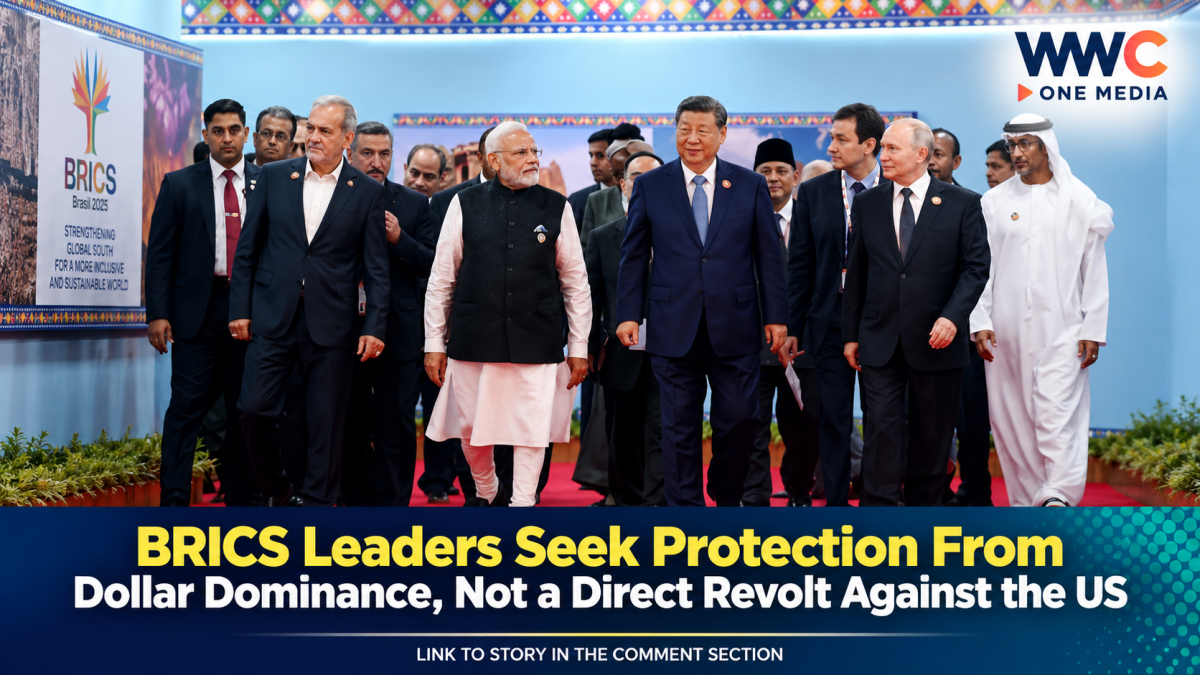
BRICS leaders are pushing for greater financial independence from the US dollar, but the latest summit showed that the expanded bloc is more interested in building protection against dollar-related risks than launching an outright assault on the currency’s global dominance.
The distinction is important.
Rather than attempting to replace the dollar with a BRICS currency, members are pursuing a slower strategy built around local-currency trade, alternative payment systems and greater financial cooperation.
The approach reflects both the ambitions and limitations of a group whose members have very different economic interests and relationships with the United States.
No BRICS currency breakthrough
The New Delhi summit produced no agreement to create a common BRICS currency.
That outcome was widely expected to disappoint some of the bloc’s strongest supporters of de-dollarisation, who have argued that BRICS should develop a monetary alternative to the dollar.
Instead, the group’s leaders endorsed efforts to increase the use of national currencies in trade and investment.
The strategy avoids one of the biggest obstacles facing any common currency: BRICS members would have to surrender significant control over their monetary policies and agree on a shared financial framework.
For now, governments appear unwilling to take that step.
Hedging against dollar risks
The more practical objective is to reduce exposure to the dollar without trying to eliminate it.
BRICS countries still rely heavily on the US currency for international trade, investment and financial reserves.
Even countries seeking to reduce dollar dependence have little interest in abruptly cutting themselves off from the world’s deepest financial markets.
Instead, they want more choices.
If businesses can settle transactions directly in yuan, rupees, rubles, reais or other national currencies, they can reduce the number of transactions that need to pass through the dollar.
That gives governments greater room to manoeuvre during periods of geopolitical tension, sanctions or currency volatility.
China and Russia push hardest
China and Russia remain among the strongest supporters of efforts to build alternatives to the dollar-based financial system.
Beijing has promoted wider international use of the yuan and has expanded cross-border settlement in its currency.
Moscow has even stronger incentives after Western sanctions severely restricted its access to parts of the global financial system.
For Russia, alternative payment arrangements are not simply an economic preference. They are a way to maintain trade relationships despite sanctions.
China’s motivations are broader, including reducing vulnerability to US financial restrictions while increasing the international role of the yuan.
India takes a more cautious approach
India has supported greater use of national currencies but has shown less enthusiasm for creating a common BRICS currency.
New Delhi has strong economic relationships with both Western countries and the wider BRICS bloc.
That makes an aggressive campaign against the dollar potentially costly.
India’s approach is therefore more pragmatic: expand the use of the rupee and alternative payment mechanisms while preserving access to the existing international financial system.
That position helps explain why the BRICS strategy has focused on financial diversification rather than outright monetary confrontation.
Payment systems may matter more than a currency
The most important long-term development may not be a new currency at all.
Instead, BRICS is examining ways to improve cross-border payment systems so members can conduct transactions more directly.
The objective is to reduce dependence on Western financial infrastructure and make it easier for banks and businesses in member countries to settle payments using their own currencies.
Such systems could eventually give BRICS members greater protection against sanctions and disruptions in traditional international payment channels.
They also avoid the enormous political and economic complications of creating a single currency.
The dollar remains difficult to replace
Despite years of discussion about de-dollarisation, the US dollar remains deeply embedded in global finance.
It is widely used for international trade, foreign-exchange transactions, financial contracts and central-bank reserves.
The dollar’s strength is also reinforced by the size and liquidity of US financial markets.
That means even countries that want to reduce their exposure to the dollar may continue using it because there are few alternatives capable of matching its scale.
BRICS leaders therefore face a basic contradiction: they want greater independence from the dollar while many of their economies still benefit from access to dollar-based markets.
BRICS is not a unified economic bloc
Another obstacle is the diversity of the expanded BRICS group.
Members have different currencies, monetary policies, financial systems and levels of economic development.
They also have competing geopolitical priorities.
China and India, for example, are major economic partners but remain strategic rivals.
Other members have close relationships with the United States and Europe and may be reluctant to support measures that could be interpreted as an anti-Western financial campaign.
That makes sweeping economic integration difficult.
Trump has strengthened the incentive to diversify
US policy has nevertheless given BRICS members another reason to explore alternatives.
The use of tariffs, sanctions and financial restrictions has reinforced concerns among some emerging economies about becoming overly dependent on US-controlled economic infrastructure.
The more Washington uses economic tools for geopolitical purposes, the greater the incentive for other countries to develop backup systems.
That does not mean BRICS is preparing to abandon the dollar.
It means members increasingly want the ability to operate when access to the dollar becomes politically or economically difficult.
A gradual shift could still matter
The significance of the BRICS strategy may therefore lie in accumulation rather than a single dramatic announcement.
More local-currency trade, expanded payment links and increased lending in national currencies could gradually reduce the dollar’s role in specific parts of the global economy.
The process would be slow and uneven.
But even a modest reduction in dollar dependence across a large group of emerging economies could eventually change how international trade and finance operate.
For now, BRICS is not leading a financial revolution against the United States.
It is building a hedge.
And if that hedge becomes large enough, the long-term effect could still be a more fragmented global monetary system in which the US dollar remains dominant but faces a growing number of alternatives.




Leave a Reply