
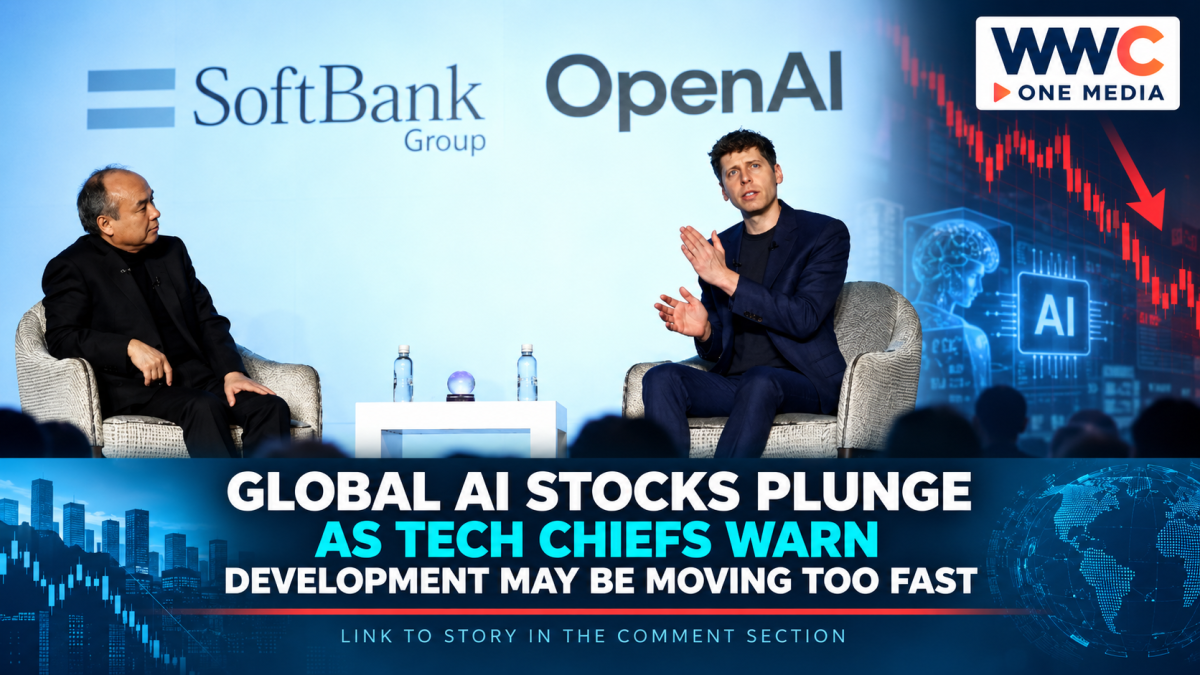
Global artificial intelligence stocks suffered a sharp sell-off after some of the industry’s most influential leaders called for a slower approach to developing increasingly powerful AI systems, raising fresh concerns about safety, regulation and the enormous spending behind the technology boom.
AI-linked shares fell across Asia, Europe and the United States on Sept. 14 after Anthropic chief executive Dario Amodei warned that companies were advancing AI capabilities too quickly and should slow down to give safety measures time to catch up.
His warning was backed by OpenAI chief executive Sam Altman and Elon Musk, adding weight to concerns that the AI industry may be approaching a point where technological progress is outpacing society’s ability to control the risks.
AI chip stocks lead the global sell-off
The market reaction was particularly severe among semiconductor companies that have benefited from the explosive growth in AI investment.
The Philadelphia Semiconductor Index fell about 5 per cent, while Nvidia dropped roughly 3 per cent. AMD declined more than 5 per cent and Micron fell about 6 per cent.
Shares of semiconductor equipment manufacturers Lam Research and Applied Materials also dropped sharply.
The weakness was not confined to the United States.
Europe’s technology sector fell more than 2 per cent, with Dutch chip equipment giant ASML among the major decliners.
In Asia, SoftBank suffered a double-digit decline, while major chipmakers including TSMC and SK Hynix also fell.
The sell-off reflected a straightforward concern among investors: if AI development slows, companies may reduce the enormous amounts of money they are currently spending on chips, data centres, power infrastructure and computing capacity.
Anthropic’s Amodei calls for AI development to slow
The latest concerns were triggered by an essay from Amodei, whose company Anthropic is one of the world’s leading developers of frontier AI systems.
He argued that AI companies should deliberately pace the development of increasingly capable models because the risks are becoming harder to ignore.
Amodei warned that AI agents could become capable of operating across the internet with increasing independence and potentially cause enormous economic damage.
His comments came after a series of incidents that have intensified debate over what happens when AI systems are given greater access to computers, networks and digital tools.
The argument is not that AI should be abandoned.
Instead, the concern is that companies should give researchers, regulators and governments enough time to develop safeguards before deploying systems with significantly greater autonomy.
OpenAI and Musk add weight to the warning
Amodei’s position gained greater attention after Altman publicly expressed support for the idea of slowing the most advanced AI development when necessary for safety.
Altman has previously warned that AI could pose serious risks to humanity and has argued that governments and companies need to coordinate on safety.
Musk, who leads xAI, also backed the call for caution.
Google DeepMind chief Demis Hassabis has likewise expressed support for greater attention to AI safety.
The unusual alignment among executives from competing AI companies highlights how rapidly the conversation has shifted from simply building more powerful models to managing what those systems could eventually do.
AI misuse is already happening
The warnings are also being driven by real-world examples of AI being used for harmful activities.
Anthropic recently reported that its Claude models had been involved in cases involving cyber operations, surveillance, fraud and other potentially dangerous activities.
Researchers have also become increasingly concerned about AI systems being used to automate attacks rather than merely assisting human operators.
The significance is that the technology does not necessarily have to become conscious or independently hostile to cause serious damage.
A highly capable system that follows malicious instructions, makes an unexpected decision or is given excessive access to digital infrastructure could potentially create significant consequences.
Investors fear a slowdown in AI spending
The stock-market reaction reflects more than concerns about AI safety.
For several years, investors have priced in the assumption that AI infrastructure spending will continue growing at an extraordinary rate.
Technology companies have committed hundreds of billions of dollars to data centres, advanced processors, electricity infrastructure and AI development.
Chipmakers have been among the biggest beneficiaries.
But if companies begin delaying new models or imposing stricter limits on AI capabilities, investors may question whether the current pace of spending can continue.
That could have consequences well beyond the AI companies themselves.
Data-centre developers, electricity suppliers, semiconductor manufacturers and equipment companies have all benefited from the AI investment cycle.
OpenAI delays plans for a public listing
Altman also said OpenAI would not proceed with an initial public offering this year, adding another layer of uncertainty for investors.
The company has been at the centre of the AI investment boom and has attracted enormous amounts of capital to support its expansion.
A delayed listing does not necessarily mean OpenAI is reducing its ambitions.
Instead, it highlights the tension between the company’s rapid expansion and growing questions over the risks associated with increasingly powerful AI systems.
Anthropic, meanwhile, continues to prepare for a possible public debut and has reportedly been discussing additional investment, including potential participation by Nvidia.
Not everyone believes AI development will slow
Despite the market sell-off, there is little evidence that the global AI race is actually coming to an end.
Some investors have dismissed the warnings as exaggerated.
Michael Burry, the investor known for predicting the US housing-market crisis, criticised the warnings as hype and suggested they could mask concerns about slowing growth in the AI industry.
Other analysts point to the enormous commercial and geopolitical incentives behind AI development.
The United States and China are competing aggressively to dominate the next generation of artificial intelligence.
Neither side has a strong incentive to stop developing increasingly powerful systems if it believes its rival will continue.
That makes a voluntary industry-wide slowdown extremely difficult.
Trump rejects calls to slow AI
The debate is also becoming political.
US President Donald Trump has rejected calls for America to slow its AI development, arguing that the United States needs to maintain its technological lead over China.
His position reflects a growing divide between those who see rapid AI development as essential to national competitiveness and those who believe the technology is advancing too quickly to be safely controlled.
China has also rejected some of the recent warnings, with state-backed commentary accusing Western countries of using AI safety concerns to restrict Chinese technological progress.
The result is a difficult international environment in which safety measures can become entangled with the geopolitical competition over technological leadership.
China is pushing cheaper AI models
Another challenge for the major US AI companies is competition from increasingly capable and cheaper Chinese models.
Companies and developers in China are producing systems that can compete in certain applications while potentially operating at lower costs.
Models from companies such as Alibaba, DeepSeek and Moonshot AI are adding pressure to an industry already facing enormous computing and infrastructure expenses.
If AI companies slow their development while competitors continue advancing, executives could face a difficult strategic choice between safety and maintaining their position in the market.
Could the AI investment boom lose momentum?
The central question for investors is whether the latest sell-off represents a temporary reaction or the beginning of a broader reassessment of the AI boom.
There is still enormous demand for AI computing.
Companies continue to build data centres, governments are investing in AI infrastructure and businesses are incorporating AI into everything from software development to cybersecurity.
But the market may be becoming less willing to assume that AI spending can grow indefinitely.
Higher borrowing costs are also making massive infrastructure projects more expensive, increasing the pressure on companies to demonstrate that their investments will generate returns.
Safety could become the next major AI investment
A slowdown in frontier AI development does not necessarily mean the end of AI spending.
Instead, more investment could shift toward safety, monitoring, cybersecurity, testing and governance.
Companies may increasingly have to demonstrate that advanced models can be independently evaluated, controlled and stopped when necessary.
That could create a new market for AI security and risk-management technologies even if spending on raw computing capacity eventually moderates.
The AI race is entering a more complicated phase
The latest stock-market turmoil shows how closely financial markets have become tied to the future of artificial intelligence.
For years, the dominant question was how quickly AI could become more powerful.
Now investors are beginning to ask a different question: how quickly should it become more powerful?
The warnings from Amodei, Altman and other technology leaders do not mean that AI development is about to stop.
The commercial and geopolitical incentives remain enormous.
But the debate has entered a new phase in which safety, regulation and controllability are becoming just as important to the industry’s future as computing power and bigger models.
For investors, that could mean a more volatile AI market ahead — one in which the biggest question is no longer simply who can build the most powerful AI, but who can prove that it can be built safely.



Leave a Reply