
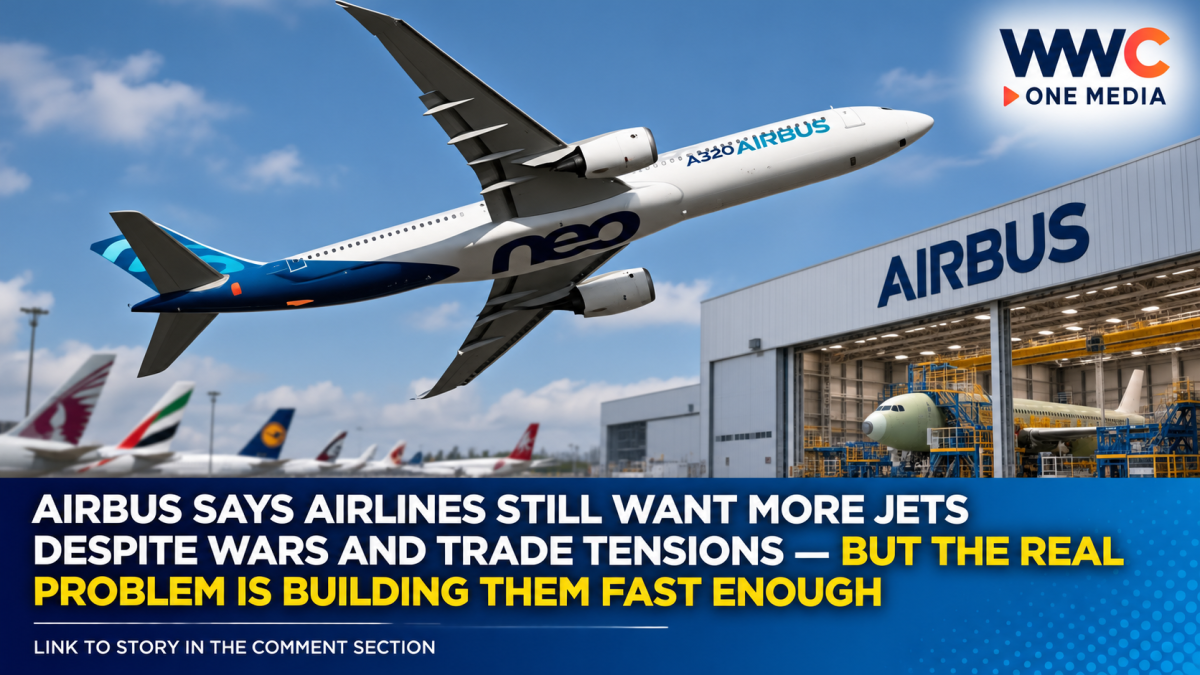
HONG KONG — Wars are disrupting flight schedules.
Oil is again above US$100 a barrel.
Trade tensions are reshaping global supply chains.
Engine manufacturers are struggling to meet production schedules.
And economic growth in China, the world’s biggest single commercial-aircraft market for Airbus, has become less predictable.
Normally, that would sound like a brutal environment in which to sell aircraft costing tens or hundreds of millions of dollars each.
Airbus says airlines are still lining up anyway.
Speaking in Hong Kong on Sept. 15, Airbus Asia-Pacific President Anand Stanley said the European aircraft manufacturer had seen no material weakening in customer demand or willingness to accept new aircraft despite geopolitical and supply-chain pressures.
Airlines, he said, continue to want aircraft — and deliveries are rising not only across Asia-Pacific but also in markets such as the Middle East.
That confidence is backed by some striking numbers.
Airbus believes airlines worldwide will require 42,060 new commercial aircraft between 2026 and 2045.
And almost half of them are expected to go to Asia-Pacific.
But beneath the bullish forecast lies an increasingly awkward reality for the world’s largest aircraft manufacturer:
Airbus does not have a shortage of people who want airplanes.
It has a shortage of airplanes it can deliver quickly enough.
Airbus expects the world to need 42,060 new aircraft
The number at the center of Airbus’ latest Global Market Forecast is 42,060.
Of those aircraft, Airbus expects about 33,920 to be single-aisle jets — the category dominated by aircraft such as the A320neo and A321neo — and 8,140 to be widebodies such as the A330neo and A350.
Nearly half of the total requirement is replacement demand.
Airbus estimates 19,820 aircraft will be needed to replace older jets, while another 22,240 will be required to expand the global fleet.
The world’s passenger-aircraft fleet is expected to nearly double from about 23,310 aircraft at the end of 2025 to 45,550 by the end of 2045.
Airbus expects global passenger traffic to increase at an average 3.9% annually, with annual passenger numbers reaching roughly 10 billion by 2045.
Those numbers explain why short-term geopolitical crises have not yet killed the order boom.
Airlines buying aircraft today are not planning only for next year.
They are making bets about where people will be flying in the 2030s and 2040s.
And Asia-Pacific could take about 45% of those jets
Airbus expects roughly 45% of global new-aircraft demand over the next 20 years to come from Asia-Pacific.
That makes the region the center of gravity of the company’s long-term commercial strategy.
The underlying drivers are familiar but powerful:
larger middle classes,
continued urbanisation,
new airports,
expanding low-cost carriers,
more secondary cities gaining direct air links,
and populations in markets such as India, Vietnam, Indonesia and Malaysia flying much more frequently than previous generations.
This is not simply an Airbus sales pitch about Asia becoming richer.
The structure of Asian aviation itself is changing.
Large hubs such as Singapore, Hong Kong, Bangkok, Tokyo, Seoul, Delhi and Shanghai remain critical.
But Airbus expects growth increasingly to come from connections involving smaller and medium-sized cities that previously could not support direct service.
That creates a powerful market for smaller aircraft with longer ranges.
India is the number Airbus cannot ignore
Among all major aviation markets, India stands out.
Airbus now expects India to require about 3,480 new passenger aircraft over the next two decades.
More dramatically, Airbus expects domestic Indian passenger traffic to grow about 9.3% a year, making it the fastest-growing major flow in its latest forecast.
That forecast was actually raised from 8.9%, according to Reuters.
India is therefore becoming one of the most important battlegrounds for Airbus, Boeing and aircraft lessors.
For decades, the world’s aviation industry was built around North America and Europe as its mature profit centers.
The next generation of growth is increasingly moving east.
India is the clearest example.
China is still enormous — even after Airbus cut its growth forecast
China is a more complicated story.
Airbus expects Chinese airlines to need approximately 8,830 new passenger aircraft through 2045, making the country its largest single national market.
But Airbus has also lowered its expectation for Chinese traffic growth.
The company now forecasts roughly 4.7% annual growth, down from an earlier estimate of 5.4%.
Francois Cabaret, Airbus’ head of global market forecasting, said the downgrade reflected macroeconomic conditions rather than a belief that China simply has too many aircraft.
That distinction is important.
China’s economy is currently dealing with weak consumer spending and a severe property downturn. August retail sales increased just 0.4% year on year, while fixed-asset investment over the first eight months fell 7.2%.
That is hardly an ideal backdrop for explosive aviation growth.
Yet China may still need huge numbers of jets for another reason:
its airlines have not been receiving aircraft at anything close to their pre-pandemic pace.
Chinese airlines have a huge delivery backlog to catch up on
Before COVID-19, Chinese carriers collectively took delivery of roughly 400 aircraft annually from Airbus, Boeing and COMAC, according to Airbus.
That annual figure has since fallen to less than half that level.
Airbus therefore sees enormous pent-up fleet demand.
Older aircraft still need replacing.
Passenger traffic continues recovering.
Domestic airport infrastructure continues expanding.
And airlines that delayed fleet renewal cannot postpone it indefinitely.
There is also a strategic complication Airbus did not have to worry about to the same degree a decade ago:
COMAC.
China’s state-backed aircraft manufacturer is expanding the C919 programme, creating a domestic competitor to the Airbus A320neo and Boeing 737 MAX.
So China may remain an enormous aircraft market while becoming a more complicated market for Western manufacturers.
The rest of Asia-Pacific is nearly as important as China
Airbus forecasts another 6,880 new passenger aircraft for the rest of Asia-Pacific excluding China and India over the next two decades.
That includes markets with very different aviation profiles.
Indonesia has a huge archipelago where air travel is structurally important.
Vietnam continues to record strong economic and tourism growth.
Malaysia has one of the region’s most important low-cost airline groups.
The Philippines is expanding airport infrastructure.
Australia has long distances between cities and substantial international traffic.
Singapore remains a major hub despite having a tiny domestic market.
These countries do not need to replicate China’s scale individually.
Together, they create an enormous aircraft market.
Recent orders show that forecast is not merely theoretical
Only days before Airbus delivered its bullish forecast in Hong Kong, Vietnam Airlines signed a memorandum of understanding for five additional A350-900 widebody aircraft.
Deliveries are planned for 2033 and 2034 as the carrier works toward a longer-term fleet plan involving 30 widebody aircraft after 2030.
Earlier this year, AirAsia placed a landmark order for 150 A220 aircraft, another example of Asian airlines planning aggressively beyond their immediate needs.
AirAsia said the smaller A220 would allow it to open thinner routes across ASEAN and Central Asia while freeing larger jets for longer routes.
Those are very different airlines buying very different airplanes.
But they point toward the same conclusion.
Asian carriers still believe they will need substantially more capacity.
Airbus’ A220 bet is really a bet on smaller cities
For decades, commercial aviation strategy revolved heavily around feeding passengers through giant hubs.
Airbus now expects a more decentralized network.
Its forecast suggests around 600 new small and medium-sized cities will emerge globally over the next 20 years, creating opportunities for new airports and direct routes.
That is why the A220 matters.
Stanley said the aircraft has already helped enable more than 400 new routes globally, while Airbus sees the potential for another roughly 800 city pairs in Asia-Pacific.
The basic economics are straightforward.
A route between two smaller cities may not generate enough passengers to fill an A321 or a widebody.
A smaller aircraft can make the same connection commercially viable.
Once direct service exists, it can also stimulate new demand.
Passengers who previously avoided a journey because it required an inconvenient connection suddenly have a nonstop option.
The A321XLR attacks the same problem from the opposite direction
Airbus’ A321XLR carries more passengers than an A220 and attacks a different gap in airline networks.
It offers a range of up to 4,700 nautical miles while retaining single-aisle economics.
Airbus told the Hong Kong briefing that it sees more than 2,200 potential routes in Asia-Pacific that could theoretically be opened with the A321XLR’s capabilities.
That matters because long-haul flying traditionally required larger twin-aisle aircraft.
A carrier launching a marginal route might have to gamble on filling 250 or 300 seats.
The XLR allows airlines to experiment with thinner long-distance connections at lower capacity.
Singapore to secondary Indian cities.
Japan to smaller Southeast Asian markets.
Australia to parts of Asia.
Secondary Chinese cities to international destinations.
Not every theoretically possible route will be launched, of course.
But Airbus is betting that enough will.
So why did Airbus cut its global forecast in July?
This is where the phrase “no softening in demand” needs context.
Only two months ago, Airbus reduced its global 20-year aircraft-demand forecast by around 1%, citing the impact of the Iran conflict and trade tensions on the post-pandemic aviation recovery.
It also trimmed its global passenger-traffic growth assumption on a comparable basis.
So geopolitics is affecting the forecast.
It just has not changed the broad conclusion.
Airbus still believes aircraft demand will remain historically strong.
A 1% reduction in a 42,000-aircraft market is meaningful for economists.
It does not fundamentally change the production challenge facing Airbus.
Oil above US$100 creates a strange aviation paradox
Expensive fuel hurts airlines.
It raises operating costs.
It can reduce profitability.
It can push ticket prices higher and weaken discretionary travel.
Current geopolitical instability has once again driven crude prices above US$100 a barrel.
But expensive fuel can also make newer aircraft more attractive.
Modern jets consume substantially less fuel than the aircraft they replace.
That means an airline facing persistently high oil prices has an additional incentive to retire inefficient older planes.
Airbus expects 19,820 of the aircraft delivered over the next two decades to replace existing jets.
So high fuel prices can weaken airline finances in the short term while strengthening the economic case for fleet renewal over the longer term.
That tension helps explain why order books can remain strong even during energy shocks.
Airlines in the Middle East are already demonstrating that resilience
The latest numbers from Etihad Airways offer a useful example.
Despite serious disruptions earlier this year from the Iran conflict, the Abu Dhabi carrier said passenger capacity had rebounded strongly.
Available seat kilometres were running roughly 15% to 17% above the previous year, while its August load factor reached 92%.
That does not mean every airline is performing well.
Airlines vary enormously in balance-sheet strength, route structure and fuel hedging.
But it helps explain Stanley’s comment that Airbus continues delivering aircraft in the Middle East despite geopolitical disruption.
People have repeatedly resumed flying after wars, pandemics, terrorism incidents and economic crises.
Airbus is betting that the long-term pattern will continue.
The bigger Airbus problem is sitting inside factories
This is where the story becomes almost paradoxical.
Airlines want aircraft.
Airbus has thousands of orders.
Its problem is getting enough completed aircraft out of the factories.
At the end of June, Airbus’ commercial-aircraft backlog stood at 9,222 aircraft, up from 8,754 a year earlier.
During the first half of 2026 alone, Airbus booked 821 net commercial-aircraft orders while delivering 351.
That means the backlog continued growing even as production increased.
For airlines, an enormous manufacturer backlog means one thing:
waiting.
A carrier ordering a popular jet today may not receive all of those aircraft for years.
Airbus has delivered 475 aircraft this year through August
The production trend is improving.
Airbus delivered 57 aircraft in August, bringing its January-to-August total to 475 jets delivered to 83 customers.
That was 9% higher than the 434 aircraft delivered during the same period in 2025.
The manufacturer also booked 67 gross orders in August.
Its 2026 gross sales through the month totaled 1,157 aircraft, or 1,091 after cancellations and adjustments, according to Reuters.
The numbers reinforce the demand story.
Customers continue ordering faster than production can clear the queue.
Airbus still wants to deliver about 870 aircraft this year
Its formal 2026 guidance remains around 870 commercial-aircraft deliveries.
Airbus also targets adjusted operating profit of about €7.5 billion and free cash flow before customer financing of roughly €4.5 billion.
The delivery target would represent a substantial increase from the 793 aircraft Airbus delivered in 2025.
But the company’s own guidance comes with an important assumption.
It assumes there are no additional significant disruptions to world trade, the economy, air traffic, the supply chain or Airbus’ own production system.
In 2026, that is a fairly meaningful assumption.
The engine problem remains Airbus’ biggest manufacturing headache
The company’s best-selling A320neo-family aircraft can use engines supplied by either CFM International or Pratt & Whitney.
Pratt & Whitney has been a major production bottleneck.
Earlier this year, Airbus publicly criticized the RTX-owned engine manufacturer for failing to commit to the engine quantities Airbus believed it needed.
The dispute became serious enough for CEO Guillaume Faury to warn that Airbus might use contractual remedies.
Pratt supplies engines for roughly 40% of A320neo-family aircraft being assembled, according to Reuters.
If an aircraft fuselage is complete but its engines do not arrive, Airbus cannot deliver the plane to its customer.
That turns an engine supplier problem into an Airbus revenue problem and, eventually, an airline capacity problem.
Airbus had to push back its most important production milestone
The effects can already be seen in Airbus’ ramp-up plans.
The company now expects to reach 70 to 75 A320-family aircraft per month by the end of 2027, then stabilize at 75.
Earlier plans had aimed more aggressively at rate 75.
Airbus explicitly said Pratt & Whitney’s inability to commit to required engine volumes was negatively affecting the production trajectory.
That is an extraordinary situation.
The world’s biggest commercial-aircraft manufacturer has customers willing to buy enormous numbers of airplanes but cannot simply increase output at will because a commercial jet contains millions of parts coming from thousands of suppliers.
One missing component can hold up the entire aircraft.
Especially when that component is the engine.
Airbus has built 10 A320-family assembly lines to solve the capacity problem
The manufacturer is nevertheless preparing for industrial output on a scale civil aviation has never previously seen.
Airbus inaugurated another modernized A320-family final assembly line in Toulouse in June.
It now has 10 final assembly lines across four locations:
Hamburg, Toulouse, Mobile in Alabama and Tianjin in China.
Those factories give Airbus the physical capacity needed to approach 75 A320-family aircraft per month.
But assembly halls alone do not manufacture finished airplanes.
Suppliers have to expand at the same pace.
Engines.
Seats.
Landing gear.
Cabin equipment.
Electrical systems.
Castings.
Forgings.
Thousands of smaller components.
The pandemic damaged aerospace supply chains badly enough that rebuilding that synchronized industrial system has taken years.
Airbus even absorbed parts of Spirit AeroSystems to strengthen the chain
In December 2025, Airbus took control of several former Spirit AeroSystems operations supplying work packages for the A350, A220 and A320 families.
The assets span facilities in the United States, France, Morocco, Northern Ireland and Scotland.
The strategy gives Airbus greater control over strategically important aerostructure production.
It also comes with costs.
Airbus recorded €123 million in adjustments connected with integrating former Spirit operations during the first half of 2026.
This is what the aircraft shortage looks like behind the scenes.
Manufacturers are no longer merely negotiating harder with suppliers.
They are reorganizing parts of the aerospace supply chain itself.
And sometimes a much smaller problem stops deliveries
The A330 programme provided a particularly frustrating example this summer.
Airbus suspended A330 deliveries during June and July after discovering that a tool had been left inside a tail section.
Deliveries resumed in August with one aircraft handed over.
Through August, Airbus had delivered just 11 A330s during 2026, down 31% from the comparable period.
A320-family deliveries, by contrast, were up 11%.
The incident illustrates how aircraft manufacturing differs from ordinary high-volume manufacturing.
Quality-control problems cannot simply be waved through to preserve output.
Aviation regulators, manufacturers and customers demand traceability and inspection precisely because the consequences of a manufacturing defect can be catastrophic.
So even strong demand cannot override safety controls.
Airbus wants to ramp up every major commercial programme
The production challenge does not end with the A320 family.
Airbus now targets approximately 13 A220s per month in 2028.
It wants A330 production to reach around five aircraft per month in 2029.
And it continues targeting 12 A350s per month by 2028.
Chief Executive Guillaume Faury has even said he would like ultimately to see higher A350 output because demand exceeds what Airbus can produce in the near term.
That is one of the strongest pieces of evidence behind the company’s bullish message.
The constraint is not a lack of customers for widebody jets.
It is how rapidly Airbus and its suppliers can responsibly manufacture them.
Investors are already seeing the financial benefits
Airbus’ first-half 2026 results were strong.
Revenue rose 12% to €33.2 billion.
Adjusted EBIT increased 24% to €2.73 billion.
Net income jumped 47% to €2.24 billion.
Commercial-aircraft revenue alone increased 15% to almost €23.9 billion, helped by higher deliveries.
The company handed over 351 commercial aircraft during the six months, compared with 306 during the same period in 2025.
The numbers show why production speed matters so much financially.
An aircraft sitting unfinished because it lacks an engine is not simply an operational inconvenience.
Airbus generally recognizes much of the associated revenue when the aircraft is delivered.
Every delayed handover therefore pushes cash and earnings further into the future.
Boeing is also recovering, which means Airbus cannot relax
The European manufacturer does not have the market to itself.
Boeing delivered 51 aircraft in August, including 41 737 MAX jets.
Through August, Boeing had delivered 418 aircraft, its strongest January-to-August performance since 2018.
Airbus remained ahead with 475 deliveries during the same period.
Boeing’s improving production matters because years of manufacturing and certification problems gave Airbus an opportunity to consolidate its commercial lead.
If Boeing continues stabilizing the 737 MAX and 787 programmes, airlines will have a stronger alternative — particularly customers frustrated by Airbus delivery slots stretching far into the future.
And in China, COMAC creates another competitive dimension.
The next 20 years may produce extraordinary aircraft demand.
They may also produce fiercer competition to supply it.
The aerospace boom is now reshaping the supplier industry
The expectation of rising Boeing and Airbus output has triggered another phenomenon:
a surge in aerospace mergers and acquisitions.
Through August, Janes Capital Partners had counted 154 commercial-aerospace transactions worth roughly US$14 billion, putting deal volumes close to their 2019 record.
Buyers are particularly interested in companies with skilled aerospace workers, specialized production capabilities and the ability to scale with Airbus and Boeing.
That is effectively a secondary bet on the aircraft backlog.
If Airbus builds more A320neos and Boeing builds more 737 MAX aircraft, somebody has to manufacture every valve, actuator, casting, sensor and cabin component inside them.
The order boom is therefore spreading through the entire aerospace economy.
Yet the airline side of the equation remains vulnerable
It would be dangerous to interpret Airbus’ optimism as proof that airlines themselves face no financial risk.
High fuel prices can destroy margins.
Wars can close airspace.
Recessions reduce discretionary travel.
Interest rates affect aircraft financing.
Currency movements can make dollar-denominated aircraft purchases significantly more expensive.
Smaller airlines remain particularly vulnerable because they have less financial capacity to absorb shocks.
The current stresses at carriers such as airBaltic illustrate that strong global aircraft demand can coexist with financial trouble at individual airlines.
Commercial aviation is not one homogeneous market.
Airbus can have a nine-year production backlog while some customers struggle to survive.
That enormous backlog actually protects Airbus from short-term shocks
This is one reason the company can sound so confident.
A manufacturer with only a few months of orders would be highly exposed to an abrupt travel downturn.
Airbus entered the second half of 2026 with more than 9,200 commercial aircraft waiting to be delivered.
If one carrier delays expansion, Airbus may potentially have opportunities to reallocate production slots to another customer, depending on contracts and specifications.
The backlog therefore acts as a cushion.
It does not eliminate economic risk.
But it means demand would have to weaken significantly and persistently before Airbus factories suddenly ran out of work.
Almost half of future deliveries replacing old jets gives Airbus another cushion
Airbus’ forecast is not based solely on the assumption that the world will continually add more flying.
Approximately 47% of its projected deliveries are replacements for existing aircraft.
That distinction matters enormously.
Growth aircraft depend on airlines opening new routes and carrying more passengers.
Replacement aircraft are driven partly by age and economics.
Older jets consume more fuel.
They require more maintenance.
Their reliability can deteriorate.
Newer-generation aircraft can therefore remain attractive even when passenger growth slows.
That helps explain why an economic downturn does not automatically erase aircraft demand.
Airlines may delay expansion while still needing to replace inefficient planes.
Airbus’ optimism ultimately rests on one assumption: people keep wanting to fly
Airbus projects the global middle-class population most likely to travel by air will increase by 1.4 billion people by 2045, a rise of about 34%.
That is the demographic foundation underneath nearly everything else in its forecast.
More middle-income consumers means more holidays.
More family visits.
More business trips.
More students traveling overseas.
More migrants flying between their adopted countries and home communities.
More airlines serving secondary cities.
And more aircraft required to connect them.
Wars and recessions interrupt that growth.
Historically, they have not permanently stopped it.
Airbus is betting the next two decades will behave similarly.
That is why “no softening” is only half the real Airbus story
The immediate headline out of Hong Kong is bullish.
Airbus says geopolitical tensions and supply-chain difficulties have not meaningfully weakened aircraft demand or airlines’ readiness to take deliveries.
The numbers broadly support that view.
There were 9,222 aircraft in the backlog at the end of June.
There were 1,091 net aircraft orders booked through August.
Deliveries were 9% ahead of last year.
And Asia-Pacific could absorb almost half of the world’s new aircraft through 2045.
But the company’s own history over the past few years also shows why demand is no longer the hardest part of the business.
Airbus has factories.
It has customers.
It has new final assembly lines.
It has a record-sized order book.
What it needs is a supply chain capable of moving at the same speed.
That means enough engines arriving on time.
Enough parts.
Enough trained workers.
Enough quality control.
Enough supplier capacity.
And no new geopolitical shock severe enough to tear another hole through a production system spread across Europe, North America, China and the rest of the world.
The aviation industry may eventually face another demand downturn.
For now, Airbus’ more immediate problem is almost the reverse.
Airlines want more airplanes than the aerospace industry can comfortably produce.
And if Asia really does take around 45% of the next generation of aircraft, that production race is only getting started.




Leave a Reply