
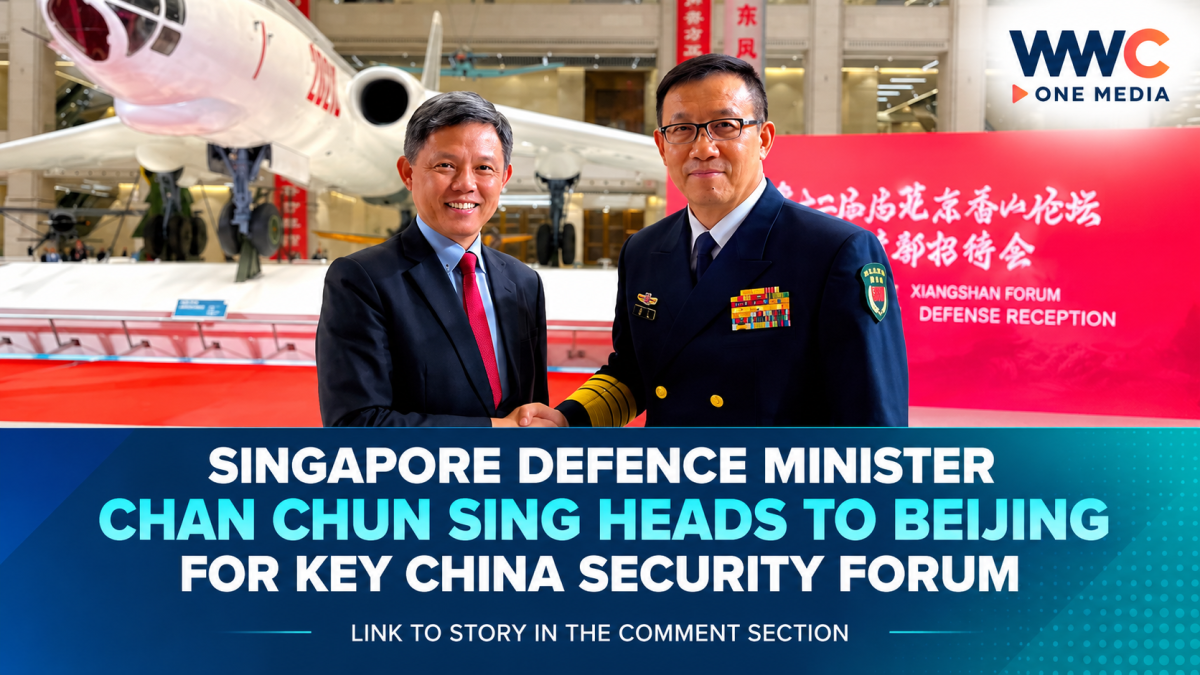
Singapore Defence Minister Chan Chun Sing is in Beijing for a three-day visit to attend a major Chinese defence and security forum, underscoring the city state’s effort to maintain close military ties with China while navigating an increasingly tense regional security environment.
Chan’s visit runs from September 15 to 17 and comes at the invitation of Chinese Defence Minister Admiral Dong Jun. He is scheduled to speak at the 13th Beijing Xiangshan Forum and meet senior Chinese defence and military leaders.
Chan to address Xiangshan Forum
The Beijing Xiangshan Forum is one of Asia’s major gatherings for defence and security dialogue, bringing together military officials, diplomats, academics and other policymakers.
This year’s forum is themed “Build consensus on stability, advance security governance together.” Dong is expected to open the three-day meeting with a call for greater international cooperation and a more multipolar approach to global security.
Chan is attending the forum for the second consecutive year, highlighting Singapore’s continued engagement with China’s defence establishment.
His visit also comes as regional tensions remain elevated over Taiwan, the South China Sea and the broader strategic competition between China and the United States.
Singapore stresses its defence relationship with China
Singapore’s Ministry of Defence described the visit as underscoring the country’s longstanding and warm defence relationship with China.
The two countries maintain regular military exchanges and have conducted joint activities, including naval exercises.
For Singapore, maintaining those channels is important because the city state has consistently sought strong relations with both China and the United States rather than aligning exclusively with either major power.
Singapore and Washington are close strategic partners and have extensive defence cooperation, while China remains an important economic and regional partner.
Chan expected to meet senior Chinese officials
During his visit, Chan is expected to meet Dong and other senior Chinese leaders and People’s Liberation Army officials.
Such meetings provide an opportunity to discuss regional security concerns directly, particularly at a time when military tensions across the Asia-Pacific are becoming more complicated.
Defence-to-defence communication can also help reduce the risk of misunderstandings between countries whose military forces increasingly operate in the same regional waters and airspace.
For Singapore, these contacts are part of a broader strategy of keeping communication open with all major powers.
A delicate moment for regional security
Chan’s visit comes as the Xiangshan Forum opens against a backdrop of heightened tensions involving Taiwan and the South China Sea.
China has been increasingly vocal about the need for a multipolar international order, while the United States and its allies continue to strengthen security partnerships across the Indo-Pacific.
Regional countries such as Singapore face the challenge of maintaining economic and diplomatic relations with China while also protecting their own strategic interests.
That makes forums such as Xiangshan particularly important for smaller states that want to maintain a voice in regional security discussions.
China seeks a bigger role in security dialogue
The Xiangshan Forum is widely viewed as China’s counterpart to Singapore’s Shangri-La Dialogue, which has become one of the region’s most prominent defence gatherings.
Beijing has used the forum to promote its own vision of international security and present China as a major contributor to global defence dialogue.
This year’s meeting is expected to include senior representatives from countries across Asia and beyond, including Vietnam, Malaysia and the United States.
The forum therefore offers China an important platform for presenting its security priorities while engaging directly with foreign defence officials.
Singapore’s balancing strategy
Singapore has long avoided choosing sides in the strategic rivalry between Washington and Beijing.
Instead, it has argued that regional stability depends on countries maintaining strong relationships with both major powers and preserving an open, rules-based regional order.
Chan’s attendance in Beijing reflects that approach.
Singapore can maintain close military cooperation with the United States while also engaging China’s defence leadership and participating in Chinese-led security forums.
The strategy allows Singapore to protect its own interests while encouraging dialogue between larger powers.
The South China Sea remains a major concern
The South China Sea is likely to remain an important issue in regional defence discussions.
Several Southeast Asian countries have competing claims with China in the strategically important waters, while the United States regularly conducts military operations and exercises in the region.
Singapore itself is not a claimant in the South China Sea disputes, but its economy depends heavily on freedom of navigation and stable regional trade.
The city state has therefore consistently supported peaceful dispute resolution and respect for international law.
Taiwan adds another layer of uncertainty
Tensions across the Taiwan Strait have also become a major concern for governments throughout Asia.
A conflict involving China and Taiwan could have consequences far beyond the island, potentially disrupting shipping, trade, financial markets and regional security.
Singapore has repeatedly stressed the importance of avoiding military conflict and maintaining stability in the Taiwan Strait.
For a highly trade-dependent country, any major confrontation between the world’s two largest economies would carry significant economic and strategic risks.
Why Chan’s visit matters
Chan’s Beijing trip is more than a routine defence visit.
It demonstrates that Singapore continues to regard military engagement with China as an important part of its regional strategy even as geopolitical competition becomes more intense.
The visit also gives Singapore an opportunity to reinforce its position as a country that supports dialogue rather than bloc confrontation.
At a time when major powers are increasingly divided over security, trade and technology, Singapore’s approach is to keep communication channels open wherever possible.
Chan’s presence at the Xiangshan Forum therefore sends a clear message: Singapore intends to remain engaged with China while preserving its broader network of strategic partnerships.
As the Asia-Pacific enters a period of heightened uncertainty, maintaining those lines of communication could become increasingly important for preventing competition from turning into confrontation.



Leave a Reply