
HONG KONG — Margaret Chung spent years being known publicly as the woman who kept moving forward.
First she moved from Toronto to Hong Kong and learned to perform professionally in a language she barely knew how to read.
Then she moved from television acting into yoga.
Later, after her eldest daughter was diagnosed with a rare genetic condition, she turned her family’s experience into advocacy for other children with special needs.
Now, at 49, the former TVB actress is facing a very different kind of challenge — and she is asking the public to allow her to face it privately.
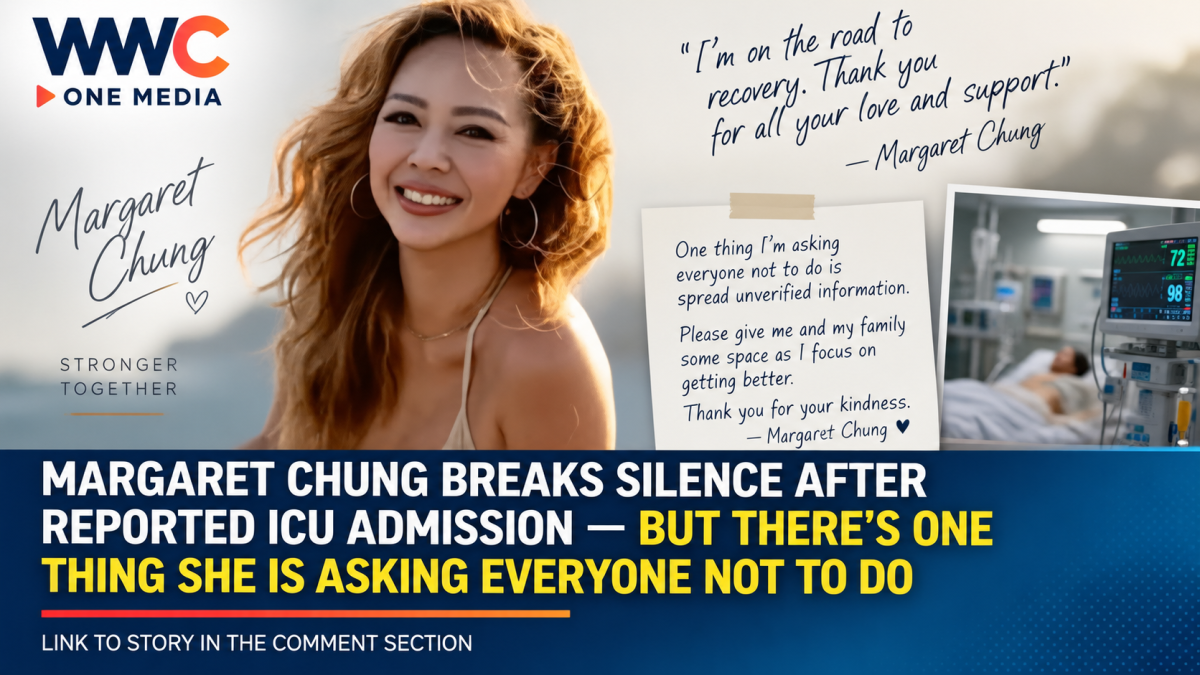
Chung spoke out after Hong Kong media reported that she had been rushed to hospital and admitted to the intensive care unit at the Chinese University of Hong Kong Medical Centre on Sept. 11 following what was described as a sudden medical situation.
She did not explain exactly what happened.
She did not name an illness.
She did not give a prognosis.
Instead, her message focused on something else entirely:
Please stop guessing.
Margaret Chung confirmed she is facing a difficult health period — but not what caused it
In a bilingual statement posted on social media, Chung acknowledged that she was going through what she called an “arduous period” and thanked people who had sent prayers, messages and words of encouragement.
She said her priorities were now her health, the people she loves and meaningful time with her family.
Most importantly, she asked the press, fans and the wider public to respect both her privacy and that of her family.
CNA reported that Chung specifically asked people not to speculate about her health or illness.
That request is crucial because speculation had already begun spreading rapidly through Hong Kong entertainment media after her hospitalization was reported.
And some of those claims went far beyond anything Chung had actually said.
What is confirmed — and what is not
Here is where careful reporting matters.
Multiple Hong Kong outlets reported that Chung was receiving treatment in intensive care at the Chinese University of Hong Kong Medical Centre.
Friends including Toby Leung and Angela Tong were reported visiting the hospital, while other members of Chung’s close-knit circle also came to support her.
Chung herself confirmed that she is dealing with a health issue and needs time to recover.
But she has never publicly identified the illness.
That means any report claiming she has been definitively diagnosed with a particular disease goes beyond what is publicly verified.
Some entertainment coverage linked her appearance and family medical history to a possible neurological condition.
That remains speculation.
Her own statement explicitly asks that people not do exactly that.
For publication, the responsible wording is therefore:
Margaret Chung is dealing with an undisclosed health condition following reports of an ICU admission.
Anything more specific requires confirmation from Chung, her family or an authorised representative.
Her husband’s first reaction was deliberately brief
When Hong Kong 01 contacted Chung’s phone after reports of her ICU admission began circulating, her husband Ruggero Nardone answered.
His message was short.
He said she was “OK” and did not elaborate when questioned further about the intensive-care reports.
That response was followed later the same day by Chung’s own more formal statement.
Taken together, the messages suggest a family intentionally trying to control the amount of medical information being released.
That is important.
Silence about a diagnosis does not automatically mean the worst.
It means the family has chosen not to make the diagnosis public.
Then Toby Leung arrived carrying takeaway food
The following day brought the most reassuring public update so far.
Singer-actress Toby Leung, one of Chung’s closest friends from her TVB years, was photographed arriving at the hospital with takeaway food.
Asked by reporters how Chung was doing, Leung described her as “OK” and “well.”
When asked whether Chung was able to speak with her, Leung reportedly nodded.
That does not constitute a medical bulletin.
It does not tell the public whether Chung remained in intensive care, what treatment she was receiving or how serious her underlying condition was.
But it is the clearest firsthand indication from someone close to her that she was conscious enough to interact during the visit.
Friends have continued arriving — and saying very little
The hospital visits did not stop there.
On Sept. 13, actress Angela Tong was reported leaving the Chinese University of Hong Kong Medical Centre after visiting Chung.
Rather than discussing her friend’s medical status, Tong asked the public and media to give them space.
Hong Kong 01 separately reported Tong appealing to reporters not to place so much pressure on Chung and her friends.
By Sept. 14, Hong Kong Commercial Daily reported that several members of Chung’s longtime friendship circle — including Janet Chow, Sherming Yiu, Angela Tong and Toby Leung — had made low-key hospital visits.
None publicly provided a diagnosis.
That consistency appears deliberate.
The people closest to Chung are closing ranks around the same message she issued herself:
support her,
but allow her privacy.
The timing of the hospitalization intensified public concern
Interest in Chung’s health did not begin entirely with the hospital reports.
Days earlier, photographs from a gathering involving members of her longtime group of female TVB friends had circulated online.
Some viewers commented on changes in Chung’s appearance and weight.
Those observations quickly became fodder for speculation after the ICU reports emerged.
But appearance alone is not a diagnosis.
Weight loss can result from numerous medical and non-medical causes.
Facial appearance in one photograph can be affected by expression, timing, lighting, fatigue and countless other factors.
Drawing a specific medical conclusion from a photograph is not reliable.
And it becomes particularly inappropriate once the person involved has specifically requested that the public refrain from guessing.
Friends had earlier said she had been unwell with flu symptoms
The Star reported that before the hospitalization story erupted, Chung’s friends had pushed back on some of the online speculation surrounding photographs from the gathering, saying she had been suffering from flu and was tired at the time.
That explanation should not itself be interpreted as the cause of her later hospital treatment.
There is no public evidence establishing that connection.
It simply demonstrates how quickly a photograph can generate a medical narrative that the people involved may never have endorsed.
Margaret Chung has spent most of her adult life in the public eye
For longtime TVB viewers, the concern surrounding Chung is understandable.
She became a familiar face during one of Hong Kong television’s most internationally popular eras.
Born in Toronto in 1976, Chung grew up in Canada before moving to Hong Kong in the mid-1990s.
She had entered the Miss Chinese Toronto Pageant in 1995 before joining TVB’s artist training programme the following year.
At the time, Cantonese presented a significant professional challenge.
Although Chung had grown up in a Cantonese-speaking family, she told Fête Chinoise that she could not read Chinese well enough to recognize even her own Chinese name when she began working in Hong Kong.
Scripts had to be translated.
She memorised phonetic guides in order to perform dialogue.
And adjusting from suburban Toronto to densely populated Hong Kong came with significant culture shock.
That makes what happened next particularly impressive.
‘Detective Investigation Files III’ turned her into a TVB face
Chung made her memorable television breakthrough in the 1997 TVB crime drama Detective Investigation Files III.
She played police constable Lee Sze-lung, joining a cast that included Michael Tao, Kenix Kwok, Joey Leung and Liu Kai-chi.
The series ran for 40 episodes and became part of one of TVB’s signature police-procedural franchises.
For many viewers across Hong Kong and Southeast Asia, that character remains the role most immediately associated with Chung.
She subsequently appeared in other TVB productions, including Untraceable Evidence, Web of Love and Justice Sung II.
Yet acting ultimately became only one part of her public identity.
She discovered yoga — and eventually changed careers
Chung’s transition out of entertainment was gradual rather than abrupt.
According to her 2024 Fête Chinoise interview, she discovered yoga around 2002 while filming a travel programme in Australia and became increasingly committed to the practice.
By 2004, she had become a certified yoga instructor.
That second career proved durable.
Long after she became less visible in television dramas, Chung remained publicly active through fitness, wellness and teaching.
Her approach to yoga also became closely connected to the philosophy she projected publicly: persistence, adaptation and trying to move forward despite circumstances that cannot always be controlled.
That philosophy would later be tested far beyond a yoga studio.
Motherhood changed the direction of her public life
Chung married businessman Ruggero Nardone in 2010, and the couple later had two daughters, Isabella and Michela.
Their eldest daughter Isabella was diagnosed with Wolf-Hirschhorn syndrome, a rare genetic disorder associated with developmental delay and other complex health challenges.
Chung has spoken publicly about the emotional and practical impact of caring for a child with significant special needs.
In her Fête Chinoise interview, she described periods of hospitalisation, seizures and surgeries involving Isabella, as well as the sense of isolation she initially experienced when trying to find support from other families in similar circumstances.
That experience ultimately redirected her public platform.
She created a foundation because she could not find the support network she needed
In 2014, Chung founded the BEYOND Children’s Special Needs Foundation.
The organisation was created to support families raising children with disabilities and special needs, connect them with resources and therapies, and encourage greater social inclusion in Hong Kong.
It was deeply personal work.
Chung has explained that when Isabella was younger, she searched for families going through similar experiences and struggled to find a community where the subject could be discussed openly.
She eventually connected with overseas support networks and began using her own public profile to help change attitudes in Hong Kong.
The foundation’s work has included family support, public-awareness efforts, collaboration with specialists and assistance in accessing therapies.
That advocacy has continued well beyond Chung’s years as a TV actress.
Her daughter’s experience also changed how Chung talked about strength
One of the most revealing things about Chung’s past interviews is that she repeatedly resisted being described simply as unusually strong.
She told Fête Chinoise that she did not necessarily regard herself as stronger than other people.
What she did believe was that once she committed herself to something, she tried not to give up.
That distinction now feels particularly relevant.
Because the current public conversation around her risks turning Chung into a symbol before anyone actually knows what she is facing.
The facts remain limited.
She is dealing with a health problem.
She has reportedly required hospital and intensive-care treatment.
Her closest friends have been visiting.
One friend has said she was doing okay and could communicate.
And Chung herself has asked everyone to let her and her family deal with what comes next privately.
Anything beyond that belongs in the category of speculation.
The unconfirmed illness rumours are the part of this story publishers should handle most carefully
Some Hong Kong reports suggested Chung could be suffering from amyotrophic lateral sclerosis, or ALS, partly because of reported illness in her family.
But neither Chung nor her husband has confirmed that claim.
Her social-media statement did not identify ALS.
Her friends have not identified ALS.
No treating physician has issued a public statement identifying ALS.
And CNA explicitly reports that Chung has not disclosed details of her condition.
So the accurate journalistic formulation is not:
“Margaret Chung has ALS.”
Nor is it:
“Margaret Chung hospitalized after ALS diagnosis.”
Both would convert speculation into fact.
The defensible version is:
“Unconfirmed reports have circulated about the nature of Chung’s illness, but she has not disclosed a diagnosis and has explicitly asked people not to speculate.”
Better still, unless the rumor itself is central to explaining misinformation around the story, a publication can simply leave the alleged diagnosis out.
Being in an ICU also does not tell outsiders exactly what a patient’s prognosis is
Another common mistake is treating “ICU” as synonymous with “near death.”
It is not.
Intensive-care units treat patients who require closer monitoring or more advanced medical support than ordinary wards can provide.
Conditions can range enormously in severity.
Without details from Chung’s medical team, it is impossible to responsibly infer a prognosis merely from reports that she was admitted to intensive care.
In this case, the available public information actually points in two directions simultaneously.
An ICU admission clearly indicates that her situation warranted serious hospital attention.
But a close friend subsequently said Chung was doing well enough to interact and share time with visitors.
Both facts can be true.
That is why medical reporting needs more restraint than entertainment gossip usually allows.
There has still been no detailed medical bulletin
As of Sept. 15, neither Chung nor her family has released a formal medical update specifying:
the diagnosis,
the treatment being provided,
whether she remains in intensive care,
when she may leave hospital,
or what recovery timeline doctors expect.
Recent Hong Kong reports through Sept. 14 continued to describe friends visiting her at the hospital, but the visitors themselves avoided giving medical details.
That absence of information should be treated as exactly that:
an absence of information.
It is not evidence supporting whichever rumor happens to be trending online.
The way her friends are responding tells its own story
For more than two decades, Chung has belonged to a close circle of women associated with Hong Kong television, including Charmaine Sheh, Angela Tong, Toby Leung, Janet Chow, Sherming Yiu and Annie Man.
Their response to her hospitalization has been unusually consistent.
They have visited.
They have offered support.
They have avoided discussing the diagnosis.
And they have asked reporters to back away.
Sherming Yiu said the group would stay beside Chung and accompany her through the difficult period while appealing for more space.
That response carries more weight than anonymous speculation because it comes from people actually in contact with Chung.
What they are saying is essentially the same thing she is:
she needs support more than she needs public diagnosis-by-rumor.
This is also an unusual reversal for someone accustomed to being the caregiver
Much of Chung’s public life over the past decade has centered on supporting other people.
Her daughter.
Other families of children with special needs.
Yoga students.
Parents struggling with caregiver burnout.
At a 2022 YAMA Foundation programme, Chung discussed the emotional isolation and anxiety experienced by parents of children with disabilities, drawing from her own family’s experience.
In 2024, she again participated publicly in discussions around resilience, accessibility and supporting families raising children with special needs.
Now those roles have temporarily reversed.
Friends are arriving at the hospital to care for her.
Public messages are being sent to her.
And she is the person asking others to protect the space around her family.
That may explain why the wording of her statement matters so much
Chung could have issued a short denial.
She could have said she was fine and left it there.
She did not.
She acknowledged that this is a profoundly difficult chapter.
At the same time, she deliberately drew a boundary around what she was willing to disclose.
That combination suggests two things can be respected simultaneously:
The public concern is genuine.
And the public is not entitled to every detail.
For someone who spent years talking openly about difficult family experiences in order to help other people, the decision to keep her own current diagnosis private deserves particular weight.
Her story has always contained more than one identity
To 1990s television audiences, she is still the fresh-faced Canadian-born actress from Detective Investigation Files III.
To another generation, she is a yoga teacher.
To parents of children with special needs, she is an advocate who turned one family’s difficult experience into a support network.
To her friends, she is a member of a circle that has remained close long after the cameras stopped rolling.
And to Isabella and Michela, she is simply their mother.
That last identity appears to be the one Chung is prioritizing now.
She said her focus is on her health and spending meaningful time with her family.
It is difficult to argue with the clarity of that request.
So what do we actually know about Margaret Chung right now?
We know she is 49.
We know multiple credible Hong Kong outlets reported that she was admitted to intensive care on Sept. 11.
We know she has publicly acknowledged facing a difficult health period.
We know she has not disclosed what illness she has.
We know her husband gave reporters a brief reassurance.
We know Toby Leung later said Chung was doing okay and signaled that she was able to communicate.
We know several longtime friends have continued visiting the hospital.
And we know Chung has asked everyone to stop speculating and give her family time and space.
That is the verified story.
For now, there does not need to be another one invented around it.
The most important update may actually be the one Margaret Chung refused to give
Celebrity health stories almost always create pressure for a diagnosis.
Readers want to know:
What happened?
How serious is it?
Will she recover?
But sometimes the most accurate answer is simply that those details are not public.
Chung has spent nearly three decades being recognizable to strangers.
She entered Hong Kong television in her 20s, reinvented herself as a yoga instructor, raised two daughters and became a public advocate for families dealing with circumstances most people rarely see.
That history explains why so many people care about what happens to her.
It does not eliminate her right to decide what they are allowed to know.
And in the statement she released after reports of her intensive-care admission, Chung could hardly have made that boundary clearer:
her health matters — but the details remain hers.


Leave a Reply