
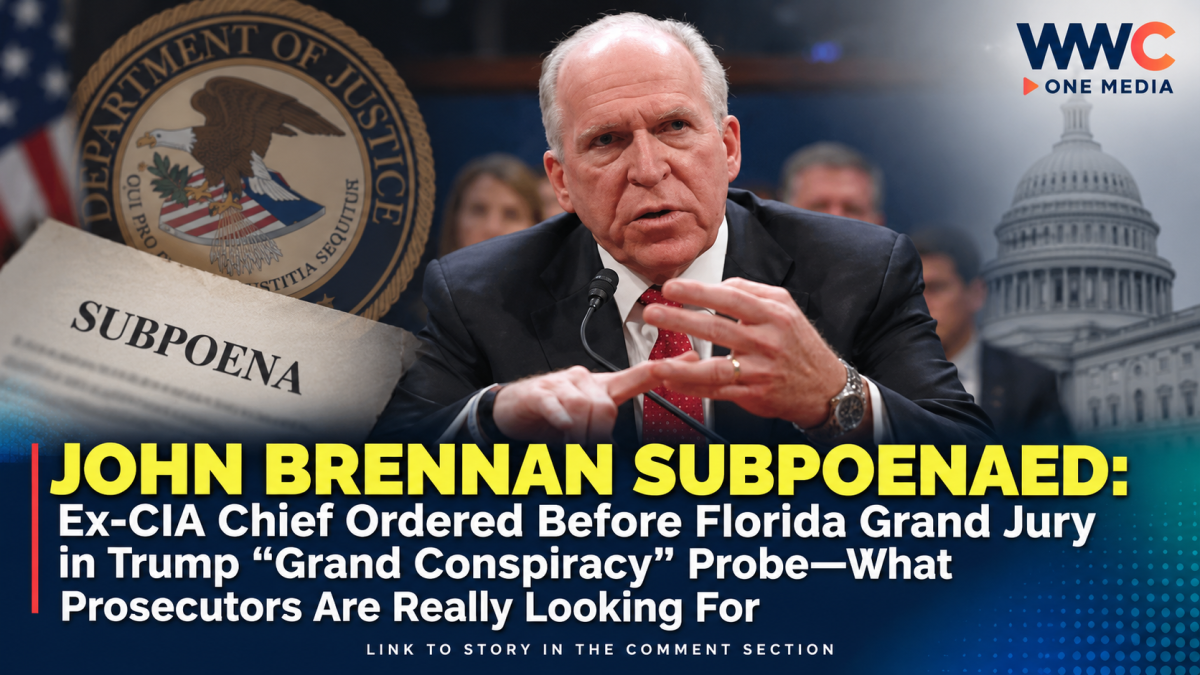
Former CIA Director John Brennan has been subpoenaed to testify before a federal grand jury in Florida, marking a significant escalation in the Justice Department’s investigation into whether former intelligence and law-enforcement officials improperly targeted Donald Trump.
Brennan is expected to appear on October 15 before a grand jury in Fort Pierce, Florida, according to his attorney, Ken Wainstein, who disclosed the subpoena in a court filing. The subpoena reportedly concerns the broader investigation into allegations that government officials conspired to deprive Trump of his civil rights through investigations involving his 2016 campaign, the Russia-interference probe and the later classified-documents case.
The development comes just days after Joseph diGenova, the Trump ally who had been brought in to help lead the sprawling investigation, abruptly resigned from the Justice Department. His departure has added another layer of uncertainty to a politically explosive investigation that has yet to produce criminal charges.
Brennan now faces two separate investigations
The subpoena is particularly significant because Brennan has been caught up in two Justice Department investigations.
One concerns the broader alleged conspiracy involving officials who investigated Trump.
The second focuses specifically on whether Brennan made false statements to Congress in 2023 concerning the intelligence community’s assessment of Russian interference in the 2016 U.S. presidential election. Brennan has denied wrongdoing and has argued that the investigations amount to politically motivated retaliation.
The broader investigation has been examining actions surrounding the intelligence community’s 2017 assessment that Russia interfered in the 2016 election and sought to benefit Trump’s candidacy.
It has also expanded into the 2022 FBI search of Trump’s Mar-a-Lago property, which resulted in the recovery of classified documents and eventually became the basis of a federal criminal case that was later dismissed. Investigators have reportedly sought information from officials involved in that operation as part of the wider probe.
Why the subpoena matters
Grand jury subpoenas are not indictments. They compel testimony or the production of evidence while prosecutors investigate whether criminal charges should be brought.
So far, no charges have been announced as a result of the broader “grand conspiracy” investigation. Reuters reported that prosecutors have been examining several issues, including the 2016 Russia assessment, the Mar-a-Lago investigation and other actions involving Trump’s political and legal opponents. Legal experts have questioned whether such a wide-ranging collection of events can ultimately support a single criminal conspiracy case.
The investigation has nevertheless intensified.
The Associated Press reported earlier this month that prosecutors began issuing new grand jury subpoenas to former government officials, shifting from earlier voluntary interviews toward compelled testimony. Brennan’s lawyers had already been informed that he was considered a target of the separate investigation into his congressional testimony.
The Russia investigation remains at the center
Much of the controversy traces back to the intelligence community’s assessment that Russia interfered in the 2016 election and sought to help Trump defeat Hillary Clinton.
That conclusion has become a central point of dispute between Trump and his political opponents.
Reuters reported in May that FBI agents had interviewed current and former CIA officers as part of the investigation into Brennan’s role in the assessment. The report noted that the assessment’s core conclusions were subsequently supported by the Justice Department, a bipartisan Senate investigation and a CIA review.
At the same time, congressional Republicans have accused Brennan of misleading lawmakers about the role of the controversial Steele dossier in the intelligence assessment. In 2025, the House Judiciary Committee referred Brennan to the Justice Department for potential prosecution over alleged false statements. Those allegations remain allegations, and Brennan has denied wrongdoing.
An important distinction is that the existence of the current DOJ investigation does not establish that Brennan or other former officials committed a crime.
Previous investigations found Russian interference—but not a Trump-Russia criminal conspiracy
The renewed investigation is also unfolding against the backdrop of earlier inquiries into Russian election interference.
Special Counsel Robert Mueller’s investigation concluded that Russia interfered extensively in the 2016 election, but it did not establish that the Trump campaign criminally conspired with Russia to influence the election.
Later reviews identified serious problems and errors in aspects of the FBI’s handling of the Russia investigation, but the findings did not establish the sweeping anti-Trump conspiracy now being examined by the Justice Department.
That history is central to the current political and legal dispute.
Trump and his allies have long argued that the Russia investigation was part of an effort by government officials to undermine his presidency. Critics of the current DOJ investigation argue that prosecutors are now attempting to turn that political allegation into a criminal case without sufficient evidence.
DiGenova’s sudden resignation adds another twist
The Brennan subpoena also comes at a particularly turbulent moment for the investigation.
DiGenova, a longtime Trump ally and former U.S. attorney, was brought into the Justice Department in April to help oversee the investigation. He resigned on September 10 after months of work on the case. AP reported that the investigation had generated frustration within the Justice Department and White House over its pace and direction.
His resignation came as prosecutors were seeking testimony from more former officials, making the timing particularly notable.
CBS News also reported that the investigation had previously undergone another major personnel change after a career prosecutor involved in the case was removed. That prosecutor had reportedly raised concerns about the strength of the evidence.
Brennan fights back in federal court
Brennan has not remained passive.
In July, he sued the Justice Department and senior Trump administration officials, asking a federal judge to require the government to preserve records connected to the investigations. His lawyers argued that those materials could become important if prosecutors eventually charged him and he needed to challenge the prosecution as vindictive or selective.
The case is before U.S. District Judge Jia Cobb in Washington, D.C. Court records show that Brennan’s legal team filed a supplemental declaration on September 10, shortly before news of the grand jury subpoena became public.
What happens next?
The most immediate development will be Brennan’s scheduled appearance before the Florida grand jury in October.
His testimony could provide prosecutors with information about the 2016 intelligence assessment, Brennan’s interactions with other officials and the government’s handling of information concerning Trump’s campaign.
But the subpoena itself should not be interpreted as proof of criminal wrongdoing.
The bigger question is whether prosecutors can transform the wide-ranging allegations at the heart of the investigation into a legally sustainable criminal case—and whether the inquiry will ultimately produce indictments or become another politically charged investigation that ends without charges.
For now, John Brennan is being compelled to answer questions under oath as one of the most consequential figures pulled into the Trump administration’s expanding investigation of his former adversaries.



Leave a Reply