
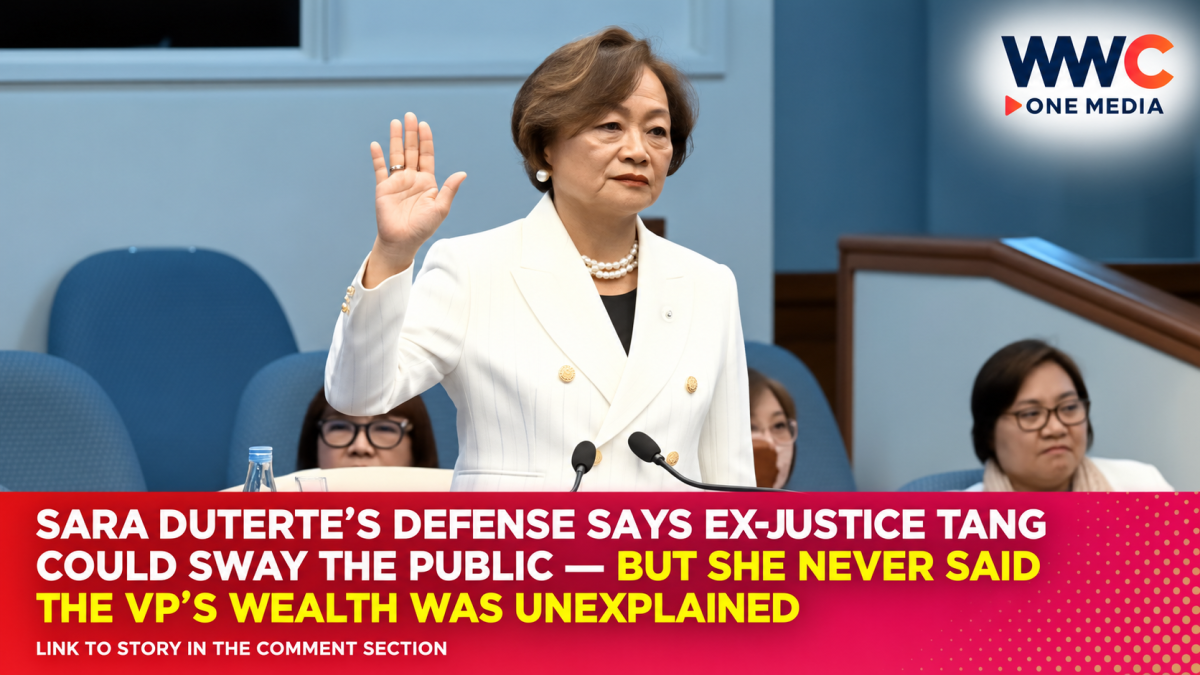
MANILA, Philippines — Vice President Sara Duterte’s defense is warning that a retired anti-graft court justice’s testimony could influence millions of Filipinos watching her impeachment trial — even though the witness herself did not testify that Duterte actually accumulated unexplained wealth.
That distinction emerged as former Sandiganbayan Presiding Justice Amparo Cabotaje-Tang took the witness stand on Monday, September 14, opening the prosecution’s presentation on Article II, the portion of the impeachment case dealing with alleged unexplained wealth, Statements of Assets, Liabilities and Net Worth, or SALNs, and business interests.
Defense lawyer Mark Vinluan told the Senate impeachment court that while Tang’s legal views may not bind the senator-judges, ordinary viewers could interpret them very differently.
The defense’s concern was essentially this: even a general explanation of laws governing unexplained wealth might cause the public to begin applying those principles to Duterte before prosecutors have finished presenting the financial evidence needed to prove their allegations.
Senate impeachment Presiding Officer Francis “Chiz” Escudero, however, drew a clear boundary around Tang’s testimony.
He noted that she was not being presented as a factual witness against Duterte and had no personal knowledge of the circumstances alleged in the impeachment complaint.
That may turn out to be the most important fact from Day 24 of the trial.
Tang explained the rules.
She did not decide whether Sara Duterte broke them.
What Tang actually testified about
House prosecutors presented Tang to explain legal principles surrounding public accountability, unexplained wealth, SALNs, beneficial ownership and restrictions on certain business activities by high-ranking executive officials.
The prosecution had announced before the hearing that her role would be to explain the framework governing those issues as Article II moved into the evidence stage.
Among the laws discussed was Republic Act No. 1379, the Philippine forfeiture law on unlawfully acquired property.
Under Section 2, when a public official acquires property during government service that is manifestly out of proportion to salary, lawful income and income from legitimately acquired property, that property may be presumed prima facie to have been unlawfully acquired in proceedings brought under the law.
Tang also discussed Section 8 of Republic Act No. 3019, the Anti-Graft and Corrupt Practices Act, which says that a finding under RA 1379 that an official acquired wealth manifestly disproportionate to lawful income can constitute grounds for dismissal or removal. The provision allows property in the names of a spouse and unmarried children to be considered under specified circumstances and expressly says bank deposits may be examined.
But explaining that legal standard is not the same as proving Duterte satisfies it.
That determination depends on evidence.
And Tang did not examine Duterte’s financial case
This point became central during cross-examination.
Tang acknowledged that she did not have personal knowledge of the factual allegations against the vice president and was not appearing to authenticate Duterte’s bank transactions, tax filings or corporate records.
Philstar described her appearance as essentially a legal primer ahead of the more document-heavy portion of Article II.
Escudero echoed that point after Vinluan raised fears about the effect of the testimony on public opinion.
The presiding officer said prosecutor Chel Diokno himself had acknowledged that Tang lacked personal knowledge of the facts particular to Duterte’s case.
That provides a critical guardrail for interpreting Monday’s hearing:
Tang explained what unexplained wealth can mean under Philippine law. She did not testify that Duterte’s wealth is, in fact, unexplained.
So why did prosecutors call her?
The prosecution’s strategy appears designed to establish the legal map before presenting the financial trail.
Article II alleges that Duterte accumulated wealth allegedly disproportionate to her lawful earnings, failed to fully and truthfully disclose assets and liabilities in her SALNs, and continued business interests prohibited while serving as vice president. Duterte disputes the impeachment charges and is entitled to challenge the prosecution’s evidence before the Senate court.
Prosecutors say they need more than SALNs to test those allegations.
Diokno previously argued that the court should examine bank, Bureau of Internal Revenue and Anti-Money Laundering Council records to establish the complete financial picture rather than relying solely on annual asset declarations.
The impeachment court later authorized subpoenas for financial and tax records after hearing arguments from both sides. The ruling allowed the documents to be produced but did not itself establish that they prove wrongdoing.
The prosecution says it has assembled more than 1,800 financial, tax and related documents for its Article II presentation.
That is why Tang’s testimony may ultimately function more like an instruction manual than the prosecution’s centerpiece.
The documents that follow could matter far more.
Defense tried to stop Tang from testifying
Tang’s appearance was controversial even before she began discussing the law.
Vinluan objected that the retired justice had not been listed in the pre-trial order as a prosecution witness and characterized her as an unexpected addition to the case.
The defense asked the impeachment court to exclude her testimony.
Escudero rejected the objection, ruling that the pre-trial framework permitted the prosecution to present additional witnesses under the circumstances.
He also noted that prosecutors were choosing to use one of their allotted witnesses and trial dates on Tang and that the court had allowed them to do so.
The ruling did not mean the Senate accepted Tang’s legal conclusions as automatically controlling.
Nor did it mean the senator-judges had accepted the prosecution’s unexplained-wealth allegations.
It meant she could testify.
Those are very different things.
Then the cross-examination became political
The defense did not limit its questioning to technical legal doctrine.
Vinluan questioned Tang about possible political motivations, asking whether she was “anti-Duterte,” whether she was a “Kakampink,” and whether she had personal connections with Diokno or Akbayan.
Tang denied those suggestions and said she had been apolitical throughout her professional life.
The defense also noted that Tang had previously sought appointment to the Supreme Court during the administration of former President Rodrigo Duterte but was not appointed, apparently testing whether that history could have affected her neutrality. Tang denied political bias.
Then came one of the hearing’s most memorable exchanges.
Vinluan asked whether anyone had promised Tang anything for appearing, including a possible ambassadorial appointment.
Tang rejected the suggestion.
“My testimony is not for sale, sir.”
She said she was retired and wanted to enjoy retirement.
The exchange became one of the most widely reported moments of Day 24, even though it had little to do with the underlying bank and asset records at the heart of Article II.
The public-opinion argument comes at an awkward moment
The defense’s complaint that Tang’s testimony could condition public opinion is especially notable because the impeachment court itself has spent weeks trying to prevent the proceedings from becoming a trial by publicity.
On August 26, Escudero ordered stricter enforcement of Rule 18 of the Senate impeachment rules, which prevents senator-judges, prosecutors, Duterte, counsel and witnesses from publicly commenting outside the proceedings on the merits of the pending case.
Escudero warned against using media attention to substitute public outrage for actual evidence.
Repeat violations can carry a ₱30,000 fine, while lawyers may also face restrictions or possible professional consequences depending on the circumstances.
But Tang’s testimony presents a different issue.
She was speaking inside the impeachment court while under examination, not holding a press conference outside it.
So the defense’s concern about public influence should not be confused with an allegation that Tang violated Rule 18.
Instead, it reveals the unusual reality of a nationally televised impeachment trial:
Everything said as evidence to the senators is simultaneously heard by millions of potential voters.
The Constitution adds another layer to Article II
Article II also goes beyond the question of whether Duterte’s assets can be explained.
The impeachment charge includes allegations concerning continued business interests while she served as vice president.
Article VII, Section 13 of the 1987 Constitution imposes unusually strict restrictions on the president, vice president, Cabinet members and their deputies and assistants.
During their tenure, they may not directly or indirectly participate in any business, practice another profession, or hold certain financial interests involving government contracts or privileges. They must also strictly avoid conflicts of interest.
Again, the existence of that constitutional rule does not prove that Duterte violated it.
Prosecutors still have to establish the relevant facts, while the defense can contest whether the businesses cited by prosecutors were active, whether Duterte participated in them, how ownership was structured, and whether the evidence satisfies the constitutional standard.
That evidentiary battle is still ahead.
The prosecution has already sought admissions on 104 financial matters
The scale of the coming fight became clearer before Tang ever took the stand.
On September 8, prosecutors served Duterte’s defense with 104 requests for admission relating to subpoenaed bank records and ownership of financial accounts.
The prosecution asked Duterte to acknowledge whether the bank records were genuine and whether specific accounts belonged to her individually or jointly with others.
The defense received 15 days to respond.
Escudero also cautioned that the impeachment court still has to resolve exactly how conventional civil-procedure mechanisms such as requests for admission apply in an impeachment trial, which is a unique constitutional proceeding.
That unresolved procedural issue reinforces why Monday’s legal lecture should not be mistaken for a verdict.
The most disputed evidence has barely begun to be unpacked.
Prosecutors point to a large gap — but a transaction is not automatically wealth
Earlier in the impeachment process, Diokno highlighted what prosecutors call a discrepancy between Duterte’s declared net worth and financial activity identified by the AMLC.
House proceedings cited roughly ₱2.87 billion in account inflows and an approximately ₱88.5 million declared net worth for 2024.
Those numbers are politically explosive.
But they need careful interpretation.
Money flowing through an account is not the same thing as net worth, income or illegally acquired property. Funds can move in and out of accounts for many reasons, and the prosecution still bears the burden of connecting relevant transactions to the allegations it is trying to establish.
The defense is entitled to offer lawful explanations, challenge the provenance and admissibility of records, question calculations, and contest the inferences prosecutors draw from them.
The Senate, not the public, ultimately decides the impeachment case.
Which is exactly why Tang’s testimony matters — and doesn’t
Tang’s appearance can be significant without being decisive.
It gives senator-judges a framework for evaluating concepts they will repeatedly encounter as thousands of pages of financial records move through the courtroom.
It tells viewers why SALNs, lawful income, bank accounts, beneficial ownership and business interests may matter.
But it does not establish the answer to the central question.
Did Sara Duterte actually accumulate wealth that she cannot lawfully explain?
Monday’s witness could not answer that because she did not examine the case as a factual investigator.
That job now falls to the prosecution’s documents and witnesses — followed by the defense’s challenges and evidence.
Article II may be where the trial becomes much more complicated
The first day of the unexplained-wealth phase was dominated by arguments about law, witness selection and alleged political bias.
The coming hearings are likely to be much more numerical.
Bank records.
Tax documents.
SALNs.
Corporate filings.
Ownership interests.
Sources of income.
Transfers between accounts.
And potentially thousands of pages requiring senator-judges to separate legitimate financial activity from transactions prosecutors argue support impeachment.
The prosecution says that fuller financial picture is necessary.
The defense has consistently challenged attempts to infer wrongdoing from incomplete or improperly presented evidence and argues Duterte must receive full constitutional and procedural protections.
Neither side has won Article II simply because Tang took the stand.
That is the part viewers should remember
A televised impeachment trial inevitably has two audiences.
One consists of the senator-judges who will weigh admissible evidence and eventually vote.
The other consists of Filipinos watching clips, headlines and livestreams and forming judgments long before the proceeding ends.
Vinluan’s warning was aimed squarely at that second courtroom — public opinion.
But Escudero’s response supplied the essential qualification.
Tang did not arrive to say Sara Duterte was guilty.
She arrived to explain the legal rules under which the real evidence could eventually be judged.
And that makes the next stage considerably more important than Monday’s headline-grabbing exchanges.
The defense fears Amparo Cabotaje-Tang’s legal explanations could shape what Filipinos already believe about Sara Duterte. But the Senate’s real test begins now: when the bank records, SALNs and corporate documents are placed beside those legal rules, will the numbers actually prove the prosecution’s case — or give the defense the explanation it says is still missing?




Leave a Reply