
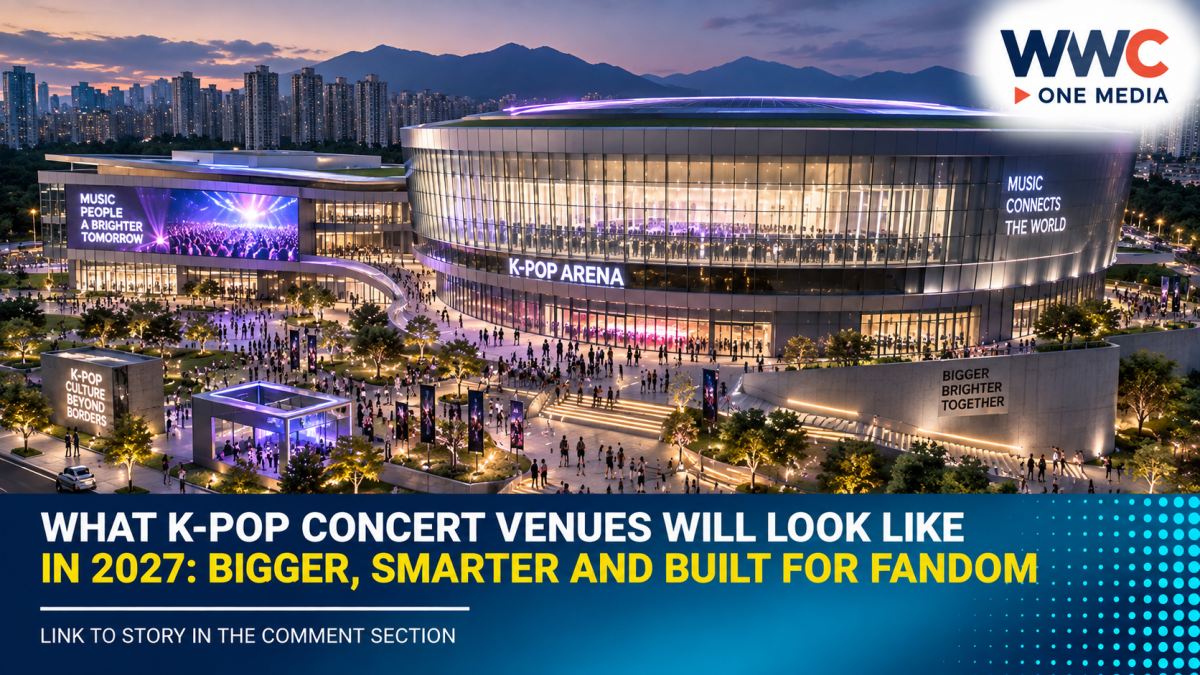
K-pop concerts are entering a new era — and by 2027, the venues themselves could become just as important as the artists performing inside them.
From dedicated K-pop arenas to massive stadium productions and fandom-focused festivals, South Korea is preparing for a live-entertainment landscape designed around the global scale of Korean pop music.
One of the biggest changes will come with the opening of Seoul Arena, a purpose-built indoor venue expected to be completed in the first half of 2027. With an expected capacity of around 20,000, the arena is being positioned as a major new home for K-pop concerts in the capital.
Seoul Arena could change the concert map
For years, Seoul has relied on a mixture of sports stadiums, exhibition halls and existing indoor arenas to accommodate major K-pop performances.
Seoul Arena is designed specifically to address that shortage.
The venue is expected to provide approximately 20,000 seats and is being developed as a dedicated large-scale music venue rather than simply adapting an existing sports facility for concerts.
That distinction matters.
As K-pop tours become increasingly international, artists and promoters need venues capable of handling enormous audiences while supporting increasingly sophisticated stage productions.
The arrival of Seoul Arena could give Seoul another major option alongside venues such as KSPO Dome, Gocheok Sky Dome and Inspire Arena.
2027’s Fanomenon could put the new venue in the spotlight
Seoul Arena is scheduled to play a central role in Fanomenon, a major K-culture project planned for December 2027.
The government-backed event is expected to combine K-pop concerts, awards ceremonies and exhibitions rather than operate as a conventional music festival.
According to the announced plans, concerts are scheduled for December 3–5 and December 10–12, 2027, with additional awards events taking place across the two weekends.
The project is particularly notable because it brings together South Korea’s four major entertainment agencies — HYBE, JYP Entertainment, SM Entertainment and YG Entertainment — through a joint venture created for the initiative.
That makes Fanomenon more than another concert series.
It represents an attempt to build a major international platform around Korea’s fandom-driven entertainment industry.
Concerts are becoming more immersive
The evolution is not only about venue capacity.
Large K-pop productions are increasingly designed to make audiences feel surrounded by the performance.
BTS’ 2026–27 world tour, for example, was announced with a 360-degree in-the-round stadium stage, putting fans around the performance area rather than concentrating the audience on one side of the venue.
That type of configuration can change the entire concert experience.
Instead of simply watching an artist from a distant seat, audiences can become part of a production built around movement, lighting, giant screens and multiple sightlines.
For K-pop — where choreography, visuals and fan interaction are central to the live experience — that evolution could become increasingly important.
Stadiums will still matter
Dedicated arenas will not replace stadiums.
The continued expansion of K-pop’s international audience means the biggest artists will still require some of the world’s largest venues.
Current touring patterns already show K-pop acts moving between indoor arenas, stadiums and festival stages depending on the market and scale of the production. BTS’ extensive 2026–27 world tour is one example of how the genre has evolved into a stadium-level global concert business.
Meanwhile, Stray Kids and other major acts continue to build tours around large venues across Asia and international markets.
The global K-pop festival model is also expanding
The Korean government’s longer-term plans suggest that the future may extend beyond individual concerts.
Fanomenon’s planned 2027 launch in Seoul is expected to serve as a major test of a new festival model built around fandom, awards, concerts and K-culture exhibitions.
A larger overseas festival under the same brand is planned for Los Angeles in 2028, showing that South Korea is thinking beyond domestic venues and attempting to build a global event ecosystem around Korean popular culture.
That could mean future K-pop events increasingly combine music with technology, tourism, merchandise, exhibitions and other elements of the Korean entertainment industry.
What could a 2027 K-pop concert feel like?
If current developments continue, the typical major K-pop concert of 2027 could feature:
- 20,000-plus-seat dedicated arenas for major indoor shows
- 360-degree and in-the-round stage designs
- Larger LED and immersive visual systems
- More sophisticated lighting and production technology
- Stadium-scale productions for the biggest global acts
- Concerts integrated with fan events and exhibitions
- Greater connections between concerts, tourism and K-culture
- Purpose-built venues designed specifically around live entertainment
Not every venue will adopt all of these features, and individual productions will vary. But the direction of travel is clear: K-pop concerts are becoming increasingly designed as immersive experiences rather than conventional stage performances.
The biggest change may happen beyond the stage
The rise of new venues such as Seoul Arena could ultimately affect more than where fans watch their favorite artists.
Dedicated concert infrastructure can influence tourism, surrounding businesses, transportation, hospitality and the ability of cities to attract international entertainment events.
For Seoul, the stakes are particularly high.
The city is already one of the world’s most important destinations for K-pop fans. A growing network of purpose-built venues could strengthen its position as a global live-music hub.
And as K-pop continues to expand internationally, the question may no longer be simply which artist is performing.
It could increasingly be:
What kind of venue and experience can match the scale of the fandom?
By 2027, the answer may be a new generation of arenas and concert spaces built specifically for the global K-pop era.




Leave a Reply