
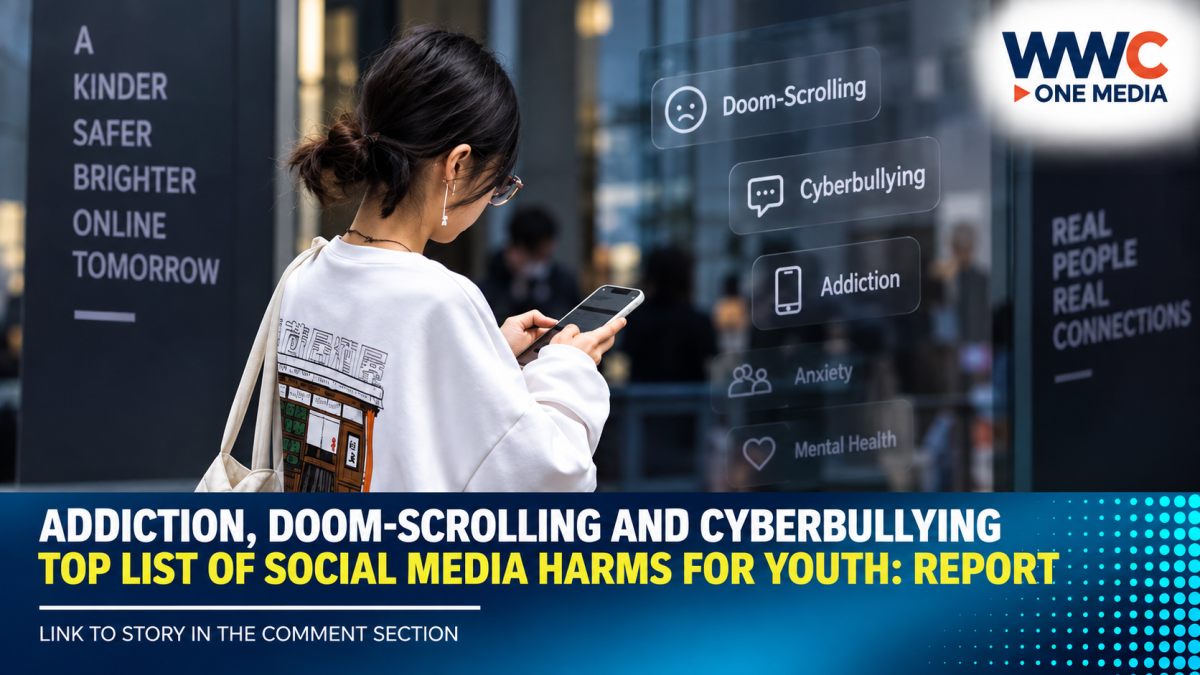
SINGAPORE — Social media may be an essential part of modern youth culture, but a new youth-led report is highlighting a darker side of constant connectivity: addictive use, doom-scrolling, cyberbullying and exposure to inappropriate content.
The findings were released by YouthTechSG, a youth-led charity, on September 14 after the group examined how young people experience social media and the harms they encounter.
The research combined focus-group discussions, street interviews and an online poll involving 227 people aged 13 to 35.
Addiction and doom-scrolling emerge as major concerns
More than one in five of the 116 participants involved in focus groups and street interviews identified addiction and doom-scrolling as the most common harms they experienced on social media.
Cyberbullying, toxic behaviour and inappropriate content followed closely.
The findings suggest that the problem may not simply be how much time young people spend online, but how social-media platforms are designed and how people interact with them.
Nearly half of the 111 respondents who participated in the online poll identified platform-design mechanisms — including infinite scrolling and recommendation systems — as a primary source of harm.
Is the algorithm part of the problem?
The report points to a growing debate over whether certain platform features encourage users to remain online longer than intended.
Infinite scrolling removes a natural stopping point, while recommendation systems continuously deliver new material based on a user’s previous activity.
A separate Singapore expert-panel report released in July similarly highlighted infinite scroll and autoplay as features that can encourage prolonged or problematic use. It found that problematic social-media use was more closely associated with poorer well-being than time spent online alone.
The distinction matters.
Simply counting hours spent online may not fully explain the potential impact of social media. What young people encounter, how they engage with it and whether online activity interferes with sleep, relationships and other parts of daily life can also matter.
Cyberbullying and unwanted contact remain concerns
The YouthTechSG report also identified cyberbullying, toxicity and inappropriate content among the most frequently cited harms.
The researchers said anonymity, reduced social cues and physical distance can weaken some of the restraints that normally exist during face-to-face interactions. User-generated and AI-generated content, as well as unwanted messages, were also identified as sources of concern.
The expert panel’s earlier findings similarly warned that direct messaging can expose younger users to risks including harassment and cyberbullying, particularly where anonymous or pseudonymous accounts are involved.
Young people don’t necessarily want a social-media ban
Perhaps one of the report’s most striking findings is that many young respondents do not see a blanket social-media ban as the answer.
Nearly four in five of the 39 young people who participated in the focus groups opposed a complete ban, citing concerns about a sudden transition from heavy restrictions to unrestricted online access.
Instead, many participants favored stronger safeguards that would allow young people to continue using digital platforms while reducing harmful experiences.
That distinction is important as governments around the world debate how far regulation should go in protecting young users.
Singapore considers stronger safeguards
The findings arrive as Singapore considers additional measures to make social media safer for younger users.
Authorities are studying proposals including daily time limits and disabling autoplay by default, while also examining measures designed to address addiction, dangerous interactions and unhealthy comparisons.
Singapore’s Minister for Digital Development and Information Josephine Teo said in August that legislative changes were expected to be introduced in early 2027 to support enforcement through age checks.
She also said platforms that cannot or will not implement adequate safeguards could potentially be required to raise their minimum age from the industry’s commonly used threshold of 13 to 18.
Young users want better tools — not simply more restrictions
The YouthTechSG findings point toward a more nuanced approach.
About three-quarters of online survey respondents said improved in-app reporting and support tools could help address social-media harms. More than half also supported reducing algorithm-driven feeds in favor of more chronological timelines.
The message is increasingly clear: young people are not necessarily asking to leave the digital world. They are asking for safer ways to navigate it.
As governments, technology companies, parents and educators debate the future of social media, the challenge may be finding the balance between protection and participation.
The question now is no longer simply how long young people spend online — but what happens while they are there, and whether the platforms themselves are making it harder to step away.




Leave a Reply