
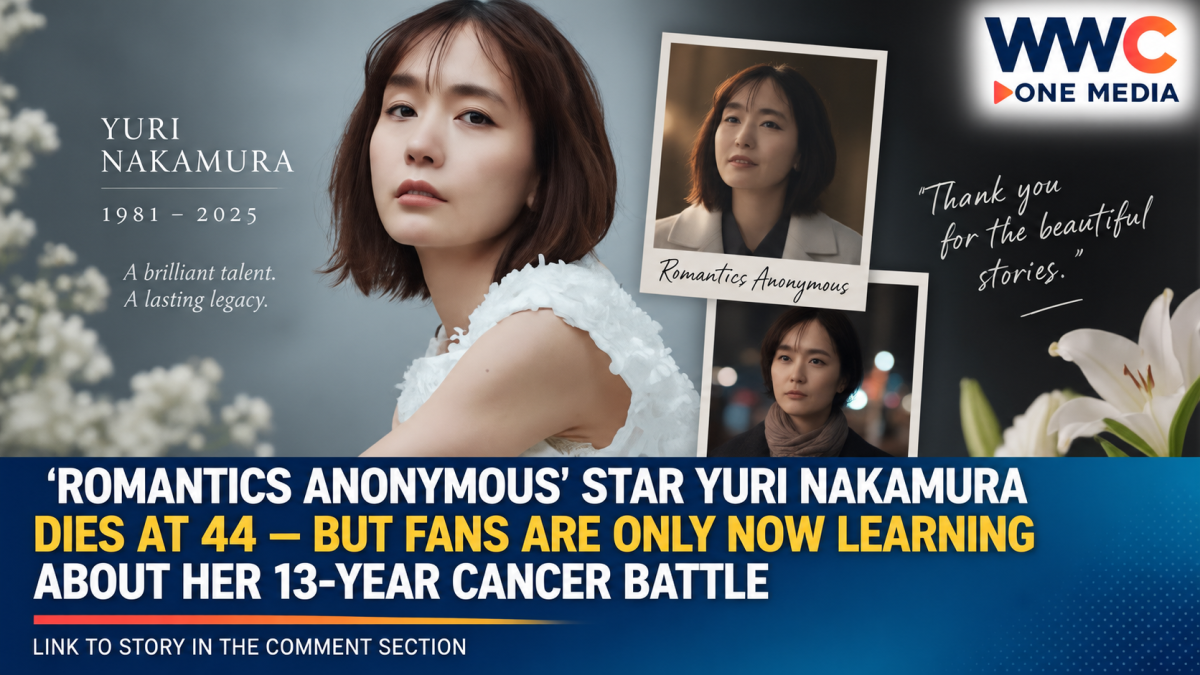
TOKYO — To viewers around the world, Yuri Nakamura was still very much a working actress.
She appeared in Netflix productions watched far beyond Japan, continued taking television roles and, as recently as this year, was preparing for another major drama.
What fans did not know was how much of that career had unfolded alongside a private fight with cancer.
Nakamura, the Osaka-born actress known internationally for playing therapist Irene in Netflix’s Romantics Anonymous, died on Sept. 1 from rectal cancer. She was 44. Her agency, Alpha Agency, announced her death nearly two weeks later, on Sept. 14.
Her funeral had already taken place privately, attended by close family members as well as actors and staff from her agency. The family has asked the media not to approach relatives or film around their home.
But it was what the agency revealed next that transformed the announcement from a simple obituary into the story of a health struggle almost nobody outside Nakamura’s inner circle knew was happening.
She had first been diagnosed with cancer 13 years ago
According to Alpha Agency, Nakamura had already battled cancer once roughly 13 years before her death.
At the time, she and the agency’s president agreed not to publicly disclose the illness because they did not want colleagues in the entertainment industry worrying unnecessarily about her.
She underwent treatment, entered remission and returned to the work she loved while continuing regular medical examinations.
For years, the public saw the result rather than the illness.
Film roles.
Television dramas.
Stage appearances.
Commercials.
Narration work.
And eventually high-profile streaming projects capable of introducing Nakamura to audiences throughout Asia and beyond.
Her medical history remained private.
Then the cancer was found again in January 2025
The agency said doctors discovered cancer again in January 2025.
Nakamura underwent surgery, and the operation itself was successful.
But doctors subsequently discovered that the cancer had metastasized.
At that stage, according to her agency, achieving a complete cure or another remission was considered difficult.
The goal of treatment changed.
Rather than pursuing cure as the realistic endpoint, Nakamura and her medical team worked to manage the disease while allowing her to live as long and as fully as possible.
Her agency said she studied her illness seriously and that her physician supported her continuing to work.
That detail is particularly striking when viewed against what audiences actually saw.
Because while her cancer had returned, her career did not immediately disappear.
She continued acting while the disease was being treated
Nakamura remained visible on screen after the recurrence.
One of the projects that brought her greater international recognition was Netflix’s 2025 Japanese-Korean romantic comedy Romantics Anonymous.
Netflix lists Nakamura alongside Shun Oguri and Han Hyo-joo among the principal cast. She played Irene, a therapist who is both an old friend of Sosuke and counselor to Hana, placing her at the center of the series’ intertwined relationships.
The eight-episode series premiered globally on Netflix on Oct. 16, 2025.
Its multinational production was unusually ambitious: Korean studio Yong Film developed the Japanese series, while Parasite production designer Lee Ha-jun and editor Yang Jin-mo were among the creative personnel working behind the scenes.
Nakamura’s role meant viewers discovering her through Netflix were seeing an actress who was already undergoing treatment for recurrent cancer.
Most of them had no idea.
She had already reached global Netflix audiences through ‘Beyond Goodbye’
Romantics Anonymous was not Nakamura’s first major streaming appearance.
She was also part of Netflix’s 2024 Japanese romantic drama Beyond Goodbye, adding to a late-career period in which her work became increasingly accessible to international viewers.
CNA notes that she appeared in numerous film and television productions over a career stretching close to three decades, including Ju-On: Black Ghost and Beyond Goodbye.
For many audiences outside Japan, those Netflix productions may be the roles through which Nakamura became familiar.
In Japan, however, her story began much earlier — and not as an actress at all.
Before Yuri Nakamura the actress, there was YURIMARI
Nakamura entered entertainment as a teenager.
After passing an audition connected with TV Tokyo’s influential ASAYAN program, she formed the pop duo YURIMARI with Mari Izawa.
The duo made its music debut in 1998.
It lasted only about a year before disbanding in 1999.
Nakamura later acknowledged that the idol-style role had not felt entirely natural to her.
After YURIMARI ended, she stepped away from the entertainment business for several years and worked ordinary jobs before finding her way toward acting.
That detour turned out to be the beginning of the career for which she would ultimately become known.
‘Pachigi! Love & Peace’ changed everything
Nakamura began acting professionally in the early 2000s.
Her major breakthrough came with director Kazuyuki Izutsu’s 2007 film Pachigi! Love & Peace.
She played the film’s heroine, and Nakamura later described the production as the work that truly made her an actress.
In a 2021 interview, she said the film taught her how demanding serious acting could be and became the project after which more professional opportunities began arriving.
Her performance earned her the Actress Award at the 2007 Zenkoku Eiren Awards, according to Oricon’s biographical record.
From there, Nakamura built exactly the kind of career many actors spend decades trying to achieve:
not always the loudest star in the cast,
but repeatedly trusted with emotionally complex roles across film and television.
Her credits stretched from prestige cinema to prime-time television
Among Nakamura’s film credits was Hirokazu Kore-eda’s acclaimed 2013 drama Like Father, Like Son.
On television, she appeared in productions including Hanako to Anne, Tantei no Tantei, Kurosagi and the Konya wa Konoji de series. She also worked in commercials, stage productions, music videos and narration.
Her filmography also included Ichiko, Fukushima 50, Madobe nite, Amalock and other projects spanning genres from family drama to thrillers and period pieces.
That range helps explain the reaction across Japan’s entertainment industry after her death was announced.
She had spent more than two decades becoming the kind of actor who appeared almost everywhere.
Ryohei Suzuki had known her for around 20 years
Actor Ryohei Suzuki, who appeared with Nakamura in several productions including NHK morning drama Hanako to Anne, said the news was difficult to process.
He recalled meeting her about 20 years earlier at acting school and described her as strong, gentle, dignified and beautiful.
Their connection stretched well beyond one television set.
They had also appeared together in Sono Machi no Ima wa and Y.O.U Yamabiko Ongaku Dokokai.
Actor Jun Kaname similarly remembered Nakamura as energetic when they worked together the previous year and said her death felt painfully premature.
Director Shunji Iwai, musician Shikao Suga, actor Hideo Nakano and others also publicly mourned her following the announcement.
But one tribute came from someone who knew her before most viewers did
Mari Izawa — Nakamura’s former YURIMARI partner — described her not simply as an old colleague but as a best friend and someone like family.
The two had known each other for approximately 35 years.
Mari said Nakamura remained considerate and strong until the end and spent her final period surrounded by family and close friends.
Her tribute also provided one of the clearest accounts of how rapidly Nakamura’s final weeks changed.
According to Mari, Nakamura had been working toward recovery and a return to work when another intestinal obstruction occurred in August.
Then came the prognosis nobody expected.
July had already produced the first public sign that something was seriously wrong
On July 13, it was announced that Nakamura was withdrawing from NHK’s planned 2027 drama Dangerous because of an intestinal obstruction.
At the time, her agency said she was undergoing treatment and working toward recovery and a return to acting.
Oscar-nominated actress Rinko Kikuchi was brought in to replace her in the role.
Actress Riho Yoshioka, who was starring in the drama, publicly expressed sadness at Nakamura’s withdrawal and said Nakamura’s performance had been beautiful and compelling during the work already completed.
At that point, the public explanation centered on intestinal obstruction.
There was no announcement that Nakamura was living with metastatic cancer.
Only after her death did the fuller medical history emerge.
Then another obstruction occurred in August
Alpha Agency said Nakamura suffered another intestinal obstruction in August 2026 while she was trying to recover.
It was then that she was suddenly told she had only a limited amount of time remaining.
Her agency said she remained calm and spent her remaining time with family and people close to her.
Nakamura died on Sept. 1.
The announcement was withheld until Sept. 14, by which point the funeral had already taken place privately.
That sequence also explains why the news seemed so abrupt to fans.
Only weeks earlier, the public had been told she was receiving treatment with hopes of returning to work.
The agency revealed that much of her 30s and 40s had been shaped by illness
Perhaps the most sobering section of Alpha Agency’s statement was its description of Nakamura’s later adult life.
The agency said much of her 30s and 40s had included a battle with illness, one she often endured through considerable willpower.
But it also emphasized that those years were filled with meaningful relationships, happiness and professional fulfillment.
That reframes a large portion of her public career.
The actress audiences watched moving steadily from supporting parts to prestige films, television dramas and international streaming projects was simultaneously navigating a medical history she had deliberately chosen not to make part of her public identity.
That privacy deserves to remain part of how her story is reported.
The fact that the agency has now disclosed her cancer history does not turn every year of her career into a medical narrative.
She spent those years working.
Her last public social-media period gave little indication of what was coming
Oricon reported that Nakamura’s final permanent Instagram feed post came in May, when she promoted an appearance in the June issue of Japanese magazine STORY.
The accompanying material showed her smiling during the shoot.
In March, she had also marked her 44th birthday.
Nothing about those public moments suggested to most viewers that she was receiving treatment for cancer that had already metastasized.
That is why the agency’s announcement has landed with such force.
Fans are not only processing the death of an actress at 44.
They are learning retrospectively that the illness had accompanied her through far more of her professional life than they understood.
Rectal cancer was confirmed as her cause of death
Alpha Agency specifically identified rectal cancer as Nakamura’s cause of death.
According to figures from Japan’s National Cancer Center cited by Oricon, 51,603 people in Japan were diagnosed with rectal cancer in 2023, while 16,119 deaths were recorded in 2024.
Those population figures are useful context but do not explain Nakamura’s individual prognosis.
Cancer outcomes vary widely depending on factors including stage, biological characteristics, treatment response and whether the disease has spread.
In Nakamura’s case, the agency said that after the recurrence was discovered in 2025, metastasis was identified following surgery and doctors determined that another complete cure or remission would be difficult.
That is the most precise public explanation currently available.
One wording issue deserves care
It would be tempting to describe Nakamura as having “hidden terminal cancer for 13 years.”
That would be inaccurate.
The agency says she was diagnosed with cancer 13 years ago, subsequently entered remission and returned to work.
Cancer was then detected again in January 2025.
After surgery, metastasis was discovered and treatment shifted toward long-term disease management.
The prognosis that she had very little time remaining came only after another intestinal obstruction in August 2026.
Those are distinct stages of illness.
Combining them into one continuous “terminal battle” would sensationalize what the agency actually said.
Her nationality and identity also need accurate wording
CNA describes Nakamura as a Japanese-born Korean actress.
She was born in Osaka in 1982 to a third-generation Korean-Japanese father and a South Korean mother. Other biographical references list her as holding South Korean nationality while building essentially her entire entertainment career in Japan.
That background became relevant to some of her early work, particularly Pachigi! Love & Peace, but it should not eclipse the breadth of her career.
Nakamura was a Japanese entertainment fixture whose life and identity also reflected the Korean diaspora experience in Japan.
Her later Netflix work made that cross-border dimension even more visible.
‘Romantics Anonymous’ gave her career a final international chapter
For global audiences, Romantics Anonymous may ultimately become one of Nakamura’s most remembered roles.
The series deliberately brought together Japanese and Korean stars and creators.
Shun Oguri played Sosuke, an heir unable to tolerate physical contact.
Han Hyo-joo played Hana, a gifted chocolatier with an intense fear of eye contact.
Jin Akanishi appeared as Hiro.
Nakamura’s Irene was both therapist and friend, tying the principal characters together emotionally.
It was exactly the type of multinational streaming production that increasingly allows Japanese actors to reach audiences beyond domestic television.
For Nakamura, it arrived during the final years of her life.
And viewers watching it had no reason to know what she was carrying off-camera.
NHK has now joined the tributes
NHK expressed shock and sadness following the announcement of Nakamura’s death.
The broadcaster had expected her to appear in Dangerous before her July withdrawal because of intestinal obstruction.
That July announcement has now taken on a very different meaning.
At the time, co-stars and audiences were hoping for recovery and an eventual return.
Less than two months later, they learned she had already died.
Her career was never built around celebrity spectacle
One reason Nakamura’s death may resonate so strongly in Japan is the way her career developed.
She did not primarily become famous through tabloid attention or highly manufactured celebrity branding.
After an early attempt at pop-idol life, she gradually built an acting career role by role.
She once recalled feeling that the heightened personality expected of her during the YURIMARI period did not fit comfortably.
Acting ultimately gave her another route into the industry.
That route was slower.
It also lasted far longer.
By her 40s, Nakamura had become one of those performers audiences might recognize from several completely different projects even when she was not always the name appearing first on a poster.
And she was still working toward what came next
That may be the hardest part of the agency’s statement.
Nakamura was not portrayed as someone who had already withdrawn from public life and accepted that her career was over.
She was trying to return.
When she withdrew from Dangerous in July, Alpha Agency said she was focusing on treatment and recovery in hopes of resuming activities.
In August, another intestinal obstruction changed that trajectory.
The prognosis shifted suddenly.
By Sept. 1, she was gone.
Her final story should not be reduced to the illness she chose to keep private
The revelation of a 13-year cancer history is understandably the detail now dominating headlines.
It is also worth remembering why the public did not know.
According to the agency, Nakamura and her management originally chose privacy because they did not want the diagnosis to burden the people she worked with.
So there is an irony in allowing the illness to become the only lens through which her career is remembered after death.
Nakamura was first an idol who discovered she did not quite belong in idol culture.
Then an aspiring actress who temporarily left show business.
Then a performer who found her breakthrough through Pachigi! Love & Peace.
Then a working actor who moved across film, television, stage, narration and commercials.
Then an increasingly international face through Netflix.
And through much of that journey, she was managing a health history almost nobody watching her knew existed.
The public has learned that history only now because the people closest to her decided it was time to explain what happened.
The most striking part is not simply that Yuri Nakamura fought cancer.
It is that, for so many years, audiences mostly saw the life she kept building around it.



Leave a Reply