
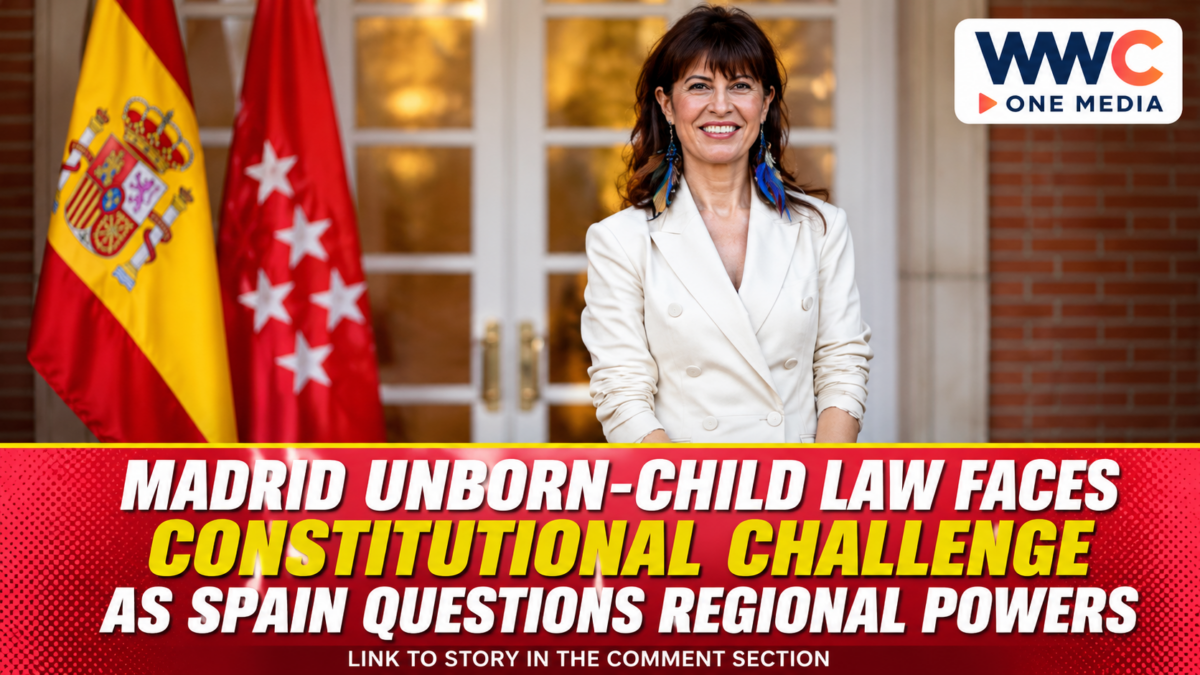
Spain’s national government approved a constitutional challenge on November 24, 2026, against a Madrid regional law that treats an unborn child as equivalent to a born child for certain family-support benefits. The move asks Spain’s Constitutional Court to review the entire measure and suspend its application, setting up a dispute over regional authority, family policy and women’s rights.
The challenge concerns Law 5/2026, enacted by the Community of Madrid in July under regional president Isabel Díaz Ayuso. While Madrid presents the measure as a family-protection and birth-support policy, the national government argues that parts of it exceed regional powers and could interfere with fundamental rights.
The dispute is significant because it is not simply about whether a regional government may offer additional assistance to families. It concerns how far a region can go in defining eligibility for benefits when national legislation already governs important parts of family status and protection.
What Madrid’s Law 5/2026 Actually Does
The law’s central provision allows an unborn child to be treated as if already born when determining eligibility for certain benefits and rights within the Community of Madrid’s areas of responsibility.
Its first article limits the arrangement to regional powers. It specifically identifies benefits connected with having children and the classification of large families as areas where the measure may apply.
The law also establishes conditions for using this recognition. Applicants must provide a medical report issued within the five working days before submitting an application. The report must identify the doctor and professional registration number and certify the pregnancy week and expected delivery date.
The measure does not automatically make every pregnant applicant eligible for every family benefit. Other requirements attached to the relevant programme still apply.
For the special certificate recognising a family as equivalent to a large family, the law sets a threshold beginning on the first day after the end of the 14th week of pregnancy. It also provides for certain tax benefits available to large families to extend to qualifying families under the new regional category.
Why Spain Is Challenging the Madrid Unborn-Child Law
The national government’s November 24 decision identifies several constitutional and legal objections.
One concerns the division of powers between Spain’s central government and its autonomous communities. The government argues that determining the legal status of an unborn child is a matter reserved to the state, rather than something Madrid can establish through regional legislation.
A second objection concerns the national framework governing large-family recognition. Spain’s Law 40/2003 establishes the basic requirements and categories for large families. The national government argues that Madrid cannot create a separate regional equivalence that changes the conditions attached to that nationally regulated status.
The government also questions provisions involving pregnancy after the 14th week and the requirement to notify the regional administration if the unborn child does not ultimately arrive at birth.
Its position is that tying certain benefits to continuing a pregnancy beyond the legal period for voluntary termination could affect reproductive freedom. It further argues that requiring notification after a pregnancy does not result in a birth could involve sensitive medical information and interfere with privacy and personal-data protections.
These are arguments advanced by the national government in support of its challenge. They have not yet been established as findings of the Constitutional Court.
The Law’s Timeline Matters for Families
Madrid’s Assembly processed the proposal as a government bill in June. The Assembly’s official record identifies the measure as PL-5/2026 and records its approval as Law 5/2026 on July 7.
The law was published in Madrid’s regional official bulletin on July 10 and entered into force the following day, subject to a separate commencement date for the large-family-equivalence provision.
That distinction is important. The law states that the special recognition of a family as equivalent to a large family would take effect six months after publication in the regional bulletin, making January 10, 2027, the scheduled date under the original timetable.
The national and regional administrations had already begun addressing their disagreements before the November 24 decision. An agreement published in Spain’s national official gazette on November 3 recorded the opening of negotiations through a bilateral cooperation commission and the creation of a working group.
The government’s later decision to pursue a constitutional challenge indicates that the disagreement had not been resolved through that process.
What the Constitutional Challenge Could Mean
The national government has requested review of the entire law and the suspension of its application. The Constitutional Court, rather than either government, will determine the legal outcome.
Spain’s Constitution gives the Constitutional Court authority to hear challenges against laws and other provisions with the force of law. Article 161 also provides a mechanism through which the national government may challenge measures adopted by autonomous communities.
The suspension question is particularly important. Under Article 30 of the Organic Law of the Constitutional Court, a constitutional challenge does not normally suspend a law merely because it has been admitted. An exception applies when the national government invokes the relevant constitutional suspension mechanism against a regional law.
The public government announcement says that suspension has been requested. The actual procedural effect must be established through the formal filing and any subsequent Constitutional Court action. A request should not be confused with a final ruling on constitutionality.
The institutional question resembles other disputes in which courts must distinguish a government’s stated legal position from what a court has actually decided. WWC has examined that distinction in its coverage of Japan’s Supreme Court decision on prisoner voting rights, where the judgment and the wider policy debate were separate matters.
Why the Dispute Extends Beyond Madrid
The case raises a broader question about how Spain balances regional autonomy with national standards.
Autonomous communities exercise substantial responsibilities in areas of public administration and social policy. But regional powers operate within the limits established by the national Constitution and legislation.
The dispute also involves competing public-policy concerns. Madrid’s law is framed around family assistance and support for birth rates. The national government’s challenge focuses on the legal definition of family status, the allocation of powers and the possible consequences for women’s rights and personal information.
Those positions should be examined separately rather than reduced to a simple political confrontation.
Constitutional disputes in other countries show why the legal process matters. WWC’s reporting on Poland’s contested Constitutional Tribunal leadership and a US federal court’s restrictions involving religious communications in government workplaces has explored how institutional authority and individual rights can become intertwined in legal disputes. The legal systems and issues are different, but the importance of distinguishing allegations, interim measures and final decisions is shared.
What Happens Next
The next decisive step is the formal Constitutional Court process. The public record reviewed for this report establishes that Spain’s Council of Ministers approved the challenge and that the government wants the law suspended.
The Court’s handling of the filing will determine the procedural position of the measure. Any suspension, confirmation of its validity or declaration of unconstitutionality must be grounded in the Court’s own decisions.
For families in Madrid, the distinction between the law’s general provisions and the delayed large-family-equivalence provision remains important. The latter was scheduled to take effect on January 10, 2027, under the original law, but the government’s request for suspension may affect that timetable if the relevant legal mechanism is activated.
Until the Court acts, the dispute remains unresolved. The central question is whether Madrid stayed within its authority when it created a regional system for treating an unborn child as equivalent to a born child for specified family benefits.
Frequently Asked Questions
What is Madrid’s Law 5/2026?
It is a regional law allowing an unborn child to be treated as equivalent to a born child for certain family-support benefits and rights within the Community of Madrid’s areas of competence.
Why is Spain challenging the law?
The national government argues that Madrid has exceeded its powers, interfered with the national framework for large-family recognition and introduced provisions that could affect women’s privacy and reproductive freedom.
Has the Constitutional Court declared the law unconstitutional?
No. The Council of Ministers approved a challenge on November 24, 2026. That is not a final Constitutional Court judgment.
Does the law automatically grant benefits to every pregnant woman?
No. Applicants must meet the requirements of the relevant benefit programme and provide the medical documentation required by the law.
When was the large-family-equivalence provision scheduled to take effect?
The law set a six-month period after its publication in Madrid’s regional official bulletin. Based on the July 10, 2026 publication date, the scheduled date was January 10, 2027, subject to any legal suspension or later court decision.










