
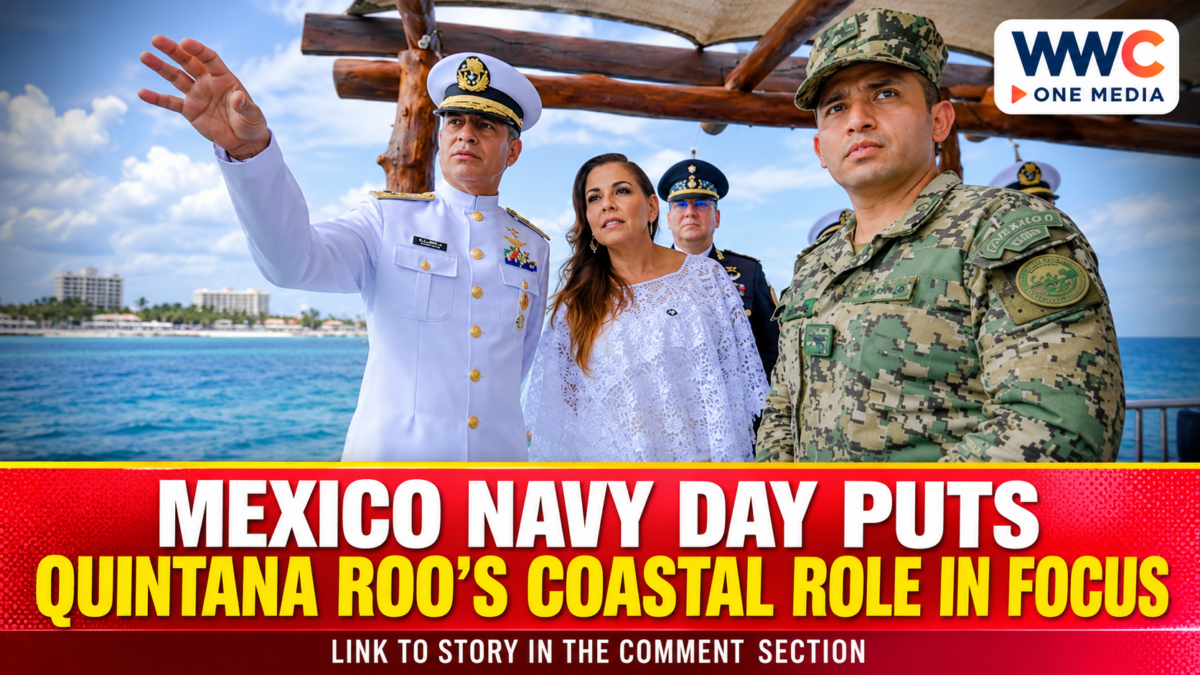
ISLA MUJERES, Mexico — November 25, 2026 — Quintana Roo Governor Mara Lezama Espinosa joined naval and civilian officials in Isla Mujeres on November 23 to mark Mexico’s Navy Day, using the ceremony to highlight the military institution’s roles in coastal protection, public security and emergency assistance.
The observance at the Fifth Naval Region included the presentation of service decorations to 14 naval personnel and two operational demonstrations: a rescue exercise involving a person and a beach-landing exercise at the Naval Club pier.
The event placed attention on a question important to coastal communities and tourism-dependent regions: how much of the Navy’s work takes place beyond traditional maritime defence, particularly when communities face environmental pressures, security concerns and natural hazards?
For Quintana Roo, the state government described the Navy as a partner in several areas that affect daily life along the Caribbean coast. Those responsibilities include coordinated security operations, efforts to contain sargassum, coastal protection and assistance to communities affected by natural events. The ceremony, however, was a public recognition event—not a performance audit of those activities.
Mexico Navy Day recalls a turning point in national history
Mexico observes Navy Day on November 23. The date commemorates the 1825 departure of the last Spanish forces from the fortress of San Juan de Ulúa in Veracruz, an event recognised in Mexican government historical records as a milestone in consolidating independence at sea.
The Mexican government’s historical account identifies naval officer Pedro Sáinz de Baranda as a central figure in the operation that led to the Spanish withdrawal. The date was formally established as Navy Day through a decree published in November 1991.
The historical anniversary gives the ceremony a national dimension beyond the local gathering in Isla Mujeres. It recognises the institution’s origins while providing an occasion to acknowledge the work of its personnel in present-day maritime and civilian responsibilities.
For Quintana Roo, a state whose economy and communities are closely connected to the Caribbean coastline, those responsibilities have practical significance. Maritime safety, environmental conditions and emergency readiness can affect residents, visitors, transport and local businesses.
What the Quintana Roo government highlighted
In its account of the ceremony, the state government said Lezama recognised the Navy’s participation in coordinated operations intended to strengthen security and protect communities. The governor also acknowledged its involvement in sargassum containment and the protection of coasts and beaches.
These are distinct areas of work. Security operations concern public safety and coordination among authorities. Sargassum response involves an environmental and coastal-management challenge. Disaster assistance requires personnel and equipment that can be mobilised when communities face emergencies.
The government’s release did not provide crime statistics, quantities of sargassum collected, coastline coverage figures or response-time data. It therefore does not establish how effective the activities have been or how much they have changed conditions across the state.
That distinction matters. A public statement can document what officials say an institution contributes, but measuring results requires separate operational data and clear indicators.
WWC has examined the same distinction in its reporting on multi-agency security exercises in coastal communities, where the value of a drill lies partly in whether agencies can coordinate when a real incident occurs.
Plan Marina and the role of emergency assistance
The governor also highlighted the Navy’s work during natural phenomena and emergency situations through Plan Marina. The state government described the programme as involving personnel and resources for search, rescue and assistance to affected communities.
The equipment identified in the government release included ships, helicopters, water-purification plants, canine teams and specialised equipment. These resources serve different purposes: vessels and aircraft can support operations over land and water, while water-treatment capacity and trained teams can assist communities facing disrupted access to essential services.
The announcement did not identify a specific recent disaster response in Quintana Roo or give figures for people assisted through Plan Marina. The programme’s mention should therefore be understood as a description of the capabilities officials highlighted, rather than evidence of a particular rescue outcome.
Disaster readiness depends on more than equipment. It also requires clear command arrangements, communication between agencies, trained personnel and plans that connect national resources with local needs. WWC’s coverage of disaster-relief preparation and emergency supply mobilisation explores another part of that response chain: preparing resources before communities need them.
Demonstrations and service recognition
The Isla Mujeres ceremony included two demonstrations at the Naval Club pier. One simulated the rescue of a person, while the other involved a beach-landing operation.
Such exercises can show the public the kinds of activities naval personnel train to perform. They can also provide an opportunity to demonstrate procedures and coordination. But a demonstration is not, by itself, proof that every operational challenge has been resolved or that the same conditions would apply during an actual emergency.
The state government also reported that 14 naval personnel received decorations recognising 10, 15, 20 and 25 years of service. The ceremony’s senior naval representative was Vice Admiral José Hermilo Cuervo Salas, identified in the release as acting commander of the Fifth Naval Region. He read the message of the Navy’s High Command.
The gathering also included state, municipal, military and security officials. Their presence reflected the institutional nature of the event and the relationship between naval authorities and other levels of government.
A comparable issue arises whenever security agencies stage joint exercises: coordination is important, but the public ultimately needs to know whether plans translate into effective responses. WWC has considered that accountability question in its review of security arrangements and unresolved evaluation questions.
Why the coastal responsibilities matter
Quintana Roo’s coastline is central to its identity and economic activity. That makes the responsibilities highlighted at the ceremony relevant beyond the naval establishment itself.
Coastal protection, environmental response and maritime safety can influence the conditions in which residents work, visitors travel and businesses operate. Emergency assistance also matters in a region exposed to natural hazards, where delays in reaching affected communities can complicate recovery.
The government’s announcement provides a snapshot of the roles it wants the public to recognise. It does not, however, offer a full assessment of the Navy’s contribution to the state. That would require public data on operations, environmental outcomes, rescue activity and coordination with local authorities.
For residents and businesses, the more useful measure is not the number of ceremonies or demonstrations held, but whether the agencies involved can show that their work improves safety, protects the coastline and reaches communities when assistance is needed.
What happens next
The November 23 observance has concluded. The state government’s public release did not announce a new programme, funding commitment, operational target or timetable arising from the ceremony.
The next meaningful test is the publication of measurable information about the activities highlighted by officials. Data on sargassum response, coastal protection, emergency deployments and security coordination would help the public understand the scale and results of the work.
For now, the ceremony records the state government’s recognition of the Mexican Navy and its stated role in Quintana Roo. Whether that recognition is matched by measurable improvements is a separate question that requires operational evidence.
Frequently asked questions
When is Mexico’s Navy Day observed?
Mexico observes Navy Day every November 23. The date commemorates the 1825 departure of the last Spanish forces from the fortress of San Juan de Ulúa.
Where was the 2026 Quintana Roo ceremony held?
The ceremony took place at the Fifth Naval Region in Isla Mujeres, Quintana Roo.
Who attended the ceremony?
Governor Mara Lezama Espinosa attended with naval, military, state and municipal officials. Vice Admiral José Hermilo Cuervo Salas, acting commander of the Fifth Naval Region, read the message of the Navy’s High Command.
How many naval personnel received decorations?
The state government reported that 14 personnel received decorations for 10, 15, 20 and 25 years of service.
What is Plan Marina?
Plan Marina is the Mexican Navy’s emergency-assistance framework referenced by the Quintana Roo government for search, rescue and support to communities affected by natural phenomena and emergencies.










