
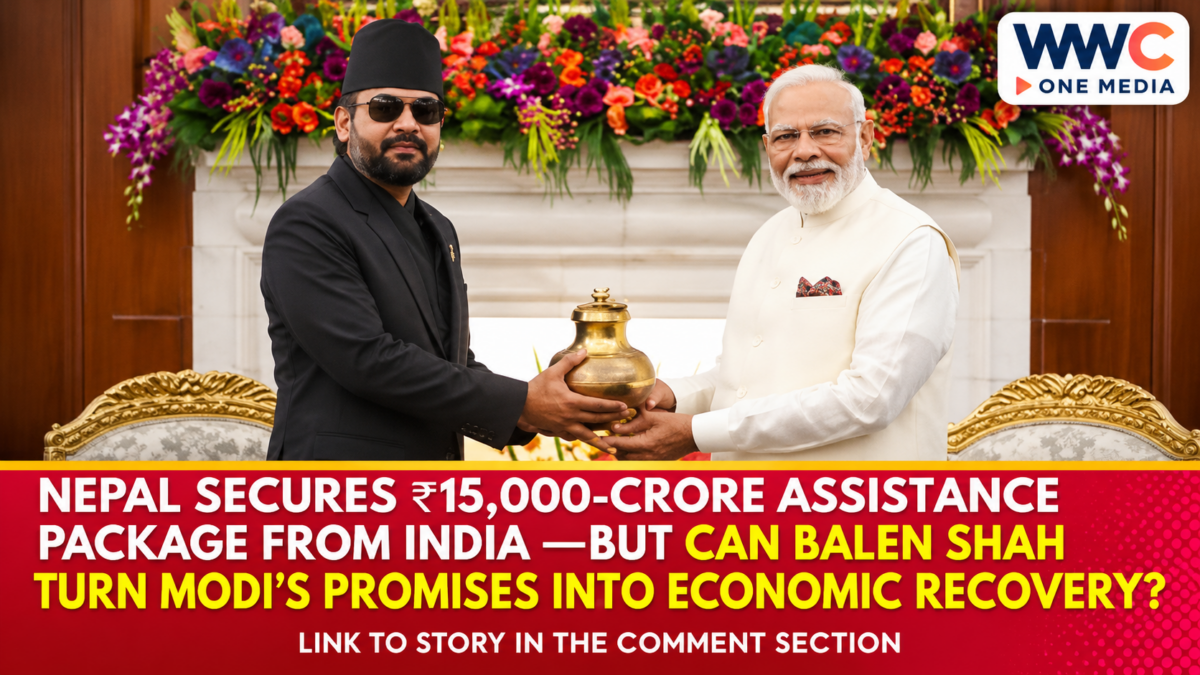
NEW DELHI, INDIA — Nepal–India relations have entered a new diplomatic phase after Nepali Prime Minister Balendra Shah secured a ₹15,000-crore development assistance commitment from Indian Prime Minister Narendra Modi during his two-day state visit to India on Nov. 22–23, 2026.
The financial package, equivalent to 240 billion Nepali rupees, accompanies a broader programme covering hydropower, international trade, aviation, infrastructure, technology and disaster recovery.
Both governments also exchanged eight memoranda of understanding, inaugurated three infrastructure projects and laid the foundation stones for three others.
However, the agreements leave important questions about financing, aviation access and longstanding territorial disagreements unresolved.
For Shah, the diplomatic breakthrough presents an opportunity to accelerate Nepal’s economic recovery. The more difficult challenge will be converting political commitments into measurable improvements for businesses, communities and public infrastructure.
Nepal–India relations enter a new diplomatic phase
Shah’s visit marked his first bilateral trip to India since assuming office as Nepal’s prime minister.
During his meeting with Modi at Hyderabad House in New Delhi, the two leaders reviewed their economic and diplomatic relationship and adopted a new framework called Viksit Bharat and Samunnat Nepal.
The framework identifies ten areas of cooperation intended to strengthen economic development and expand opportunities for citizens of both countries.
Its objectives extend beyond traditional infrastructure investments into digital services, entrepreneurship, education, climate resilience and technological innovation.
The broader policy direction was previously examined in WWC ONE MEDIA’s coverage of the new Nepal–India partnership roadmap and its implementation challenges.
The diplomatic significance of the visit lies in establishing a more structured programme for future cooperation.
However, adopting a joint vision does not independently guarantee that every proposed development will receive funding or proceed on schedule.
India’s ₹15,000-crore package comes with an important distinction
The development assistance commitment represents one of the most significant financial outcomes of Shah’s visit.
India will provide ₹3,500 crore in grant assistance for reconstruction and new infrastructure, equivalent to 56 billion Nepali rupees.
The remaining ₹11,500 crore, equivalent to 184 billion Nepali rupees, will take the form of a rupee-denominated line of credit supporting energy-sector projects.
Approximately 76.7% of the overall commitment therefore consists of credit financing rather than grants.
The distinction is important for Nepal’s financial planning.
While grants generally do not require repayment, credit facilities involve financial obligations governed by their contractual terms.
The governments have yet to finalise the specific projects and detailed arrangements for delivering the assistance.
Consequently, the announcement should not be interpreted as confirmation that the entire amount has already been transferred to Nepal.
For policymakers, the financial challenge involves selecting projects that support recovery while ensuring that borrowing remains manageable over the longer term.
Hydropower becomes a cornerstone of Nepal’s economic recovery
Energy cooperation emerged as another major outcome of the visit.
Modi and Shah jointly laid the foundation stone for the 669-megawatt Lower Arun Hydroelectric Project.
The two governments also committed to accelerating existing hydropower initiatives and advancing the development of additional cross-border electricity transmission infrastructure.
Plans include high-capacity transmission connections linking Inaruwa in Nepal with New Purnea in India, as well as another connection between Dododhara and Bareilly.
These investments could strengthen Nepal’s ability to participate in regional electricity markets.
However, constructing generation facilities alone does not guarantee successful energy exports. Transmission capacity, commercial agreements and regulatory approvals must also be in place.
The importance of these interconnected requirements was previously examined in WWC ONE MEDIA’s analysis of Nepal–India power cooperation and the challenges facing cross-border electricity trade.
Nepal’s experience following the August 2026 floods further demonstrates the importance of resilient energy infrastructure.
WWC ONE MEDIA previously covered India’s emergency electricity export arrangements following damage to Nepal’s hydropower facilities.
The new financial commitment could support longer-term energy development, but individual projects must still demonstrate commercial viability and environmental resilience.
Nepal gains additional maritime trade opportunities
Another significant development involves Nepal’s access to Indian maritime gateways.
India announced that Nepal would gain an additional transit trade option through Deendayal Port, commonly known as Kandla, in Gujarat.
Access to Paradip Port in Odisha will also become available once the necessary infrastructure is established.
For Nepal, a landlocked economy, additional maritime connections could provide greater flexibility when importing goods and exporting products to international markets.
More diverse transit options may help businesses assess alternative shipping routes, transportation costs and supply-chain arrangements.
Nevertheless, port access is only one component of an efficient trade network.
The commercial benefits will depend on inland transportation, customs procedures, storage facilities and the cost of moving goods between Nepal and Indian ports.
The requirement for additional infrastructure at Paradip also means that both newly announced gateways should not be described as immediately operational.
Aviation agreement offers progress but leaves questions unresolved
The two governments agreed to make the existing B345 Kathmandu–Bhairahawa–Lucknow air route bidirectional.
The arrangement represents a concrete advancement in bilateral aviation cooperation.
However, technical consultations are still necessary to finalise its implementation and address other aviation proposals under discussion.
The joint announcement does not establish unrestricted access to additional air routes serving every international airport in Nepal.
For airlines and tourism businesses, the commercial importance of expanded aviation access depends on whether new operating arrangements reduce travel distances, improve scheduling and support financially viable services.
These considerations were previously explored in WWC ONE MEDIA’s coverage of Nepal–India air routes and the technical requirements for expanding international aviation connectivity.
The latest agreement provides a potential foundation for improving air connectivity, but it is not yet evidence that all outstanding aviation requirements have been resolved.
Border disputes remain a sensitive diplomatic issue
Despite the positive tone of the visit, territorial disagreements remain part of the bilateral relationship.
In May 2026, Nepal’s Ministry of Foreign Affairs identified outstanding boundary issues involving Susta, Limpiyadhura, Lipulekh and Kalapani.
Nepal had also communicated its concerns through diplomatic channels regarding the use of the disputed Lipulekh area for pilgrimage access.
During the November meetings, Modi and Shah acknowledged progress in joint fieldwork and the maintenance of boundary markers.
They directed their respective foreign secretaries to address outstanding boundary matters.
This represents a commitment to continued diplomatic engagement rather than a final territorial settlement.
For both governments, the challenge is maintaining productive economic cooperation while addressing sensitive questions involving national sovereignty.
Successful infrastructure negotiations do not necessarily resolve territorial disagreements, but continuing diplomatic dialogue provides a mechanism for pursuing solutions.
What happens next for Balen Shah?
The next phase of Nepal–India relations will depend on implementation.
Financial authorities must establish project-specific funding arrangements. Aviation officials must complete technical consultations. Infrastructure developers must translate construction commitments into operational facilities.
Diplomats must also continue addressing unresolved boundary issues.
Shah formally invited Modi to visit Nepal, and the Indian prime minister accepted, with official dates to be determined through diplomatic channels.
The visit has established opportunities for deeper cooperation, but Nepal’s economic recovery cannot be measured solely through the value of announced assistance or the number of agreements signed.
Its success will depend on completed infrastructure, sustainable financing, improved international connectivity and tangible benefits for Nepali citizens.
The diplomatic opening is significant. Delivering its economic promise will be the more demanding test.
Frequently Asked Questions
How much financial assistance did India announce for Nepal?
India announced ₹15,000 crore in development assistance, equivalent to 240 billion Nepali rupees. The commitment includes ₹3,500 crore in grants and ₹11,500 crore in energy-sector credit financing.
When did Balen Shah visit India?
Nepali Prime Minister Balendra Shah visited India on Nov. 22–23, 2026, at the invitation of Indian Prime Minister Narendra Modi.
Which Indian ports will Nepal gain access to?
India announced additional transit access through Deendayal Port in Kandla, Gujarat, and future access to Paradip Port in Odisha once the necessary infrastructure is established.
What aviation agreement did Nepal and India reach?
Both governments agreed to make the existing B345 Kathmandu–Bhairahawa–Lucknow route bidirectional. Technical implementation details remain subject to consultations.
Did Nepal and India resolve their border disputes?
No final territorial settlement was announced. The two prime ministers directed their foreign secretaries to continue addressing outstanding boundary issues.










